Lowest Yen Value in 32 Years
Approaching 150 Yen Raises Financial Crisis Concerns
Secret Intervention by Foreign Exchange Authorities Discussed
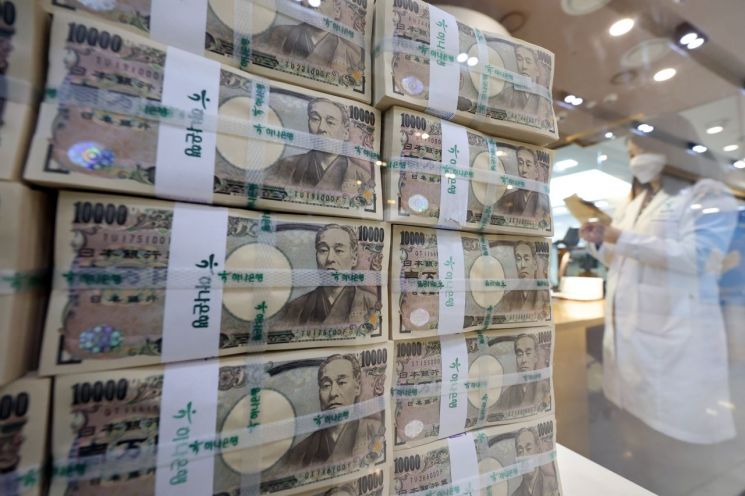
[Asia Economy Reporter Lee Ji-eun] The yen-dollar exchange rate has surpassed the 149 mark, with the yen hitting its lowest value in 32 years, drawing market attention to whether the Bank of Japan will intervene further in the foreign exchange market. Experts predict that if the psychological threshold of 150 yen is breached, internal pressure will intensify for Japanese foreign exchange authorities to intervene in the market once again.
According to Bloomberg on the 17th (local time), the yen exchange rate traded at 149.08 per dollar at one point during the day in the Tokyo foreign exchange market. The yen falling to the 149 yen level is the first time since August 1990.
The expectation that the United States will raise its benchmark interest rate further has influenced the yen's decline due to dollar buying driven by the interest rate differential between the two countries. The Nihon Keizai Shimbun explained, "U.S. President Joe Biden recently stated that the U.S. economy is very robust and that he is not concerned about the strong dollar phenomenon, which has strengthened investors' dollar buying movements."
Despite a single intervention by Japanese foreign exchange authorities, the yen's value has fallen to the psychological barrier of the 150 yen level, raising concerns in the market that a major crisis could be triggered in the financial markets.
Jim O'Neill, former chairman of Goldman Sachs Asset Management, warned in an interview with Bloomberg last month, "If a specific level such as the 150 yen mark for the dollar-yen exchange rate is breached, turmoil on the scale of the 1997 Asian financial crisis will occur."
Bloomberg also analyzed that if the value of the quasi-reserve currency yen collapses, overseas funds are likely to withdraw capital from across Asia, leading to large-scale capital outflows. The yen is the third most traded currency in the world and significantly influences other Asian currencies.
Accordingly, market experts expect the Bank of Japan to possibly purchase yen again. Previously, when the yen-dollar exchange rate surged to 145.90 yen intraday on the 22nd of last month, the Japanese government and the Bank of Japan sold dollars to buy yen, but the intervention effect weakened due to Japan's continued ultra-low interest rate policy. After the intervention, the exchange rate dropped to the 140 yen level but rose back to the high 148 yen level last week.
Shinsuke Kajita, investment strategist at Resona Holdings, a Japanese commercial bank, said, "Japan is currently facing important exchange rate milestones every 5 yen," adding, "Investors want to see how the Japanese government responds when the rate approaches the 150 yen level, so there is always a possibility of additional intervention by foreign exchange authorities."
Furthermore, the Nihon Keizai Shimbun reported that amid widespread caution in the market due to the record decline in the yen's value, there are also talks that the government is secretly intervening.
However, the interest rate gap between the U.S. and Japan, considered the fundamental cause of the yen's depreciation, is expected not to narrow for some time due to the Bank of Japan's accommodative monetary policy.
Bloomberg stated, "Bank of Japan Governor Haruhiko Kuroda insists on maintaining the lowest interest rates until inflation eases," adding, "Despite the Japanese government's spending of 2.84 trillion yen (19.5 billion dollars), the yen's value has plunged 23% against the dollar this year due to the monetary policy gap between the U.S. and Japan."
© The Asia Business Daily(www.asiae.co.kr). All rights reserved.

















