KCCI Publishes 'Import Regulation Response Guidebook for SMEs and Mid-sized Companies'
Includes Global Trends and Response Cases
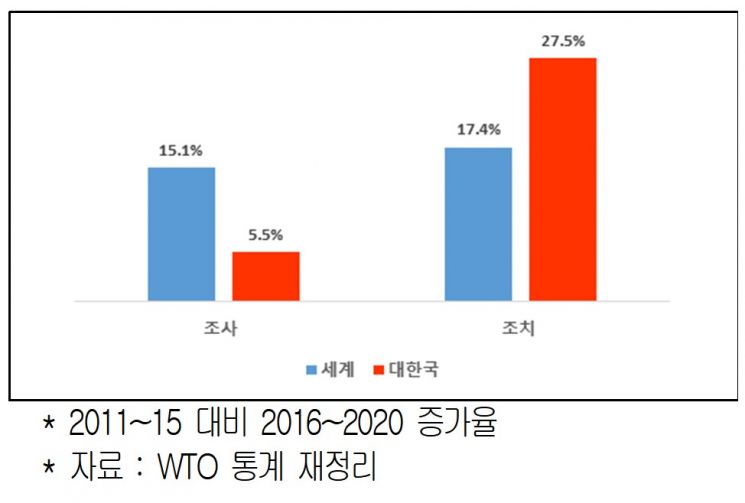 Increase rate of new import regulation investigations and measures (unit: %). Provided by Korea Chamber of Commerce and Industry
[Asia Economy Reporter Choi Seoyoon] As protectionism expands, import regulation measures such as anti-dumping (imposing high tariffs on certain imported goods) and safeguards (emergency import restrictions) are increasing. To minimize damage to our small and medium-sized enterprises (SMEs) and mid-sized companies, the government has published a guidebook for responding to import regulations.
The Korea Chamber of Commerce and Industry (KCCI) and the Ministry of Trade, Industry and Energy released the "Import Regulation Response Guidebook for SMEs and Mid-sized Companies" on the 18th. Import regulations are trade remedy measures against unfair trade practices such as anti-dumping, countervailing duties, and safeguards. Import regulations against Korea nearly doubled from 117 cases in 2011 to 228 cases in 2020. Korea ranks second worldwide as a target of anti-dumping investigations and third in countervailing duty investigations.
The guidebook includes ▲Characteristics of global import regulations ▲Features by major countries ▲Trends and response strategies for import regulations ▲Status of import regulation agencies and systems by major countries ▲Consulting cases on import regulations ▲Frequently asked questions.
With support from the Ministry of Trade, Industry and Energy, KCCI has been conducting consulting projects for SMEs and mid-sized companies on responding to import regulations since last year.
"Domestic SMEs and mid-sized companies give up responding due to lack of capacity and cost burden... Consulting support is needed"
Worldwide, new import regulation investigations increased by 15.1%, from 1,376 cases between 2011 and 2016 to 1,621 cases between 2016 and 2020. The number of measures actually implemented rose by 17.4%, from 827 to 1,001 cases during the same period. Import regulation procedures follow the steps of filing a complaint → investigation → response (company’s reply) → preliminary determination and provisional measures → public hearing → final determination and tariff imposition.
Investigations targeting Korea increased by 5.5%, from 103 to 109 cases, while implemented measures rose by 27.5%, from 58 to 80 cases during the same period. The growth rate of investigations against Korea is about 10% lower than the global average, but the increase in actual measures is about 10% higher. Compared to the global average, the fact that the number of actual measures exceeds the number of investigations is analyzed by KCCI as due to our companies’ weaker ability to respond to import regulations compared to other countries.
Kim Taehwang, president of the Trade Remedy Society and professor at Myongji University, emphasized, “Domestic SMEs and mid-sized companies tend to give up responding once import regulation investigations begin due to lack of capacity or cost burden. As new investigation techniques develop and are used in various ways, it is necessary to strengthen consulting support that provides practical help in preparing preliminary materials, drafting responses, and document preparation so that our companies can properly respond to the complex procedures.”
Import regulations against Korea: diversification of investigated products, increase in countervailing duties and safeguards, and overlapping impositions
Characteristics of import regulations against Korea include that in the past, investigated products were mainly intermediate goods such as steel, chemicals, and textiles, but recently, consumer goods such as food, medical supplies, and daily necessities have diversified. An example is Turkey’s anti-dumping investigation on implants.
Countervailing duties and safeguard measures are increasing. The number of countervailing duty investigations initiated against Korea rose from 7 cases in 2016 to 10 cases in 2020, and safeguard investigations increased from 8 cases in 2017 to 15 cases in 2020. Countervailing duties refer to tariffs imposed by the importing country on products that have suffered damage due to direct or indirect subsidies provided by the exporting country.
The third characteristic is overlapping import regulation impositions. Anti-dumping and countervailing duty investigations are conducted simultaneously on the same investigated products. For example, the United States imposed both anti-dumping and countervailing duties on large household washing machines made in Korea.
U.S. conducts annual reviews, China calculates dumping margins itself, India requires export trading companies to respond
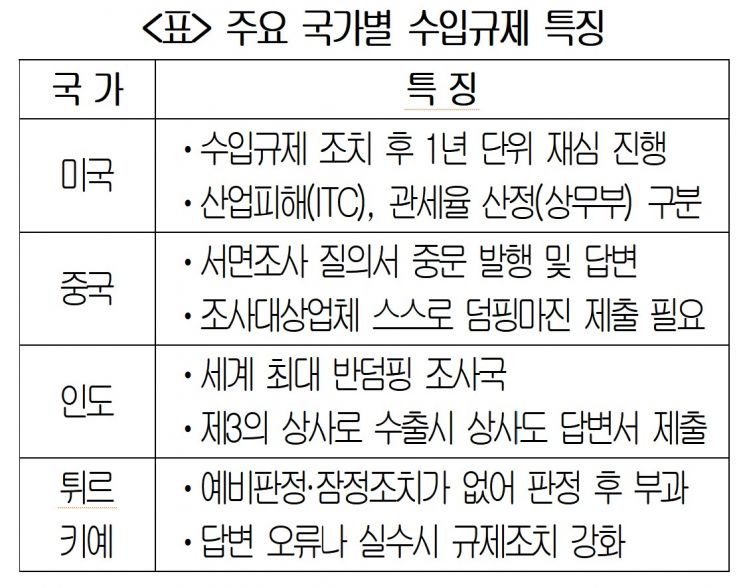
The guidebook summarizes the characteristics of import regulation measures in representative countries such as the United States, China, India, and Turkey.
First, the United States conducts annual reviews on existing measures. It imposes actual dumping duty rates on quantities imported during the review period each year, whereas other countries impose tariffs based on past standards. It is also characteristic that the International Trade Commission (ITC) investigates domestic industry damage, while the Department of Commerce handles tariff rate calculations.
China conducts written investigations in Chinese, and investigated companies must calculate and submit dumping margins themselves. India, the world’s largest anti-dumping investigation country, requires that if exports are made through trading companies other than affiliates, those trading companies must also submit response documents. Turkey imposes anti-dumping duties after the final determination without preliminary determinations or provisional measures. Companies should be cautious as even minor errors or mistakes in response documents can lead to strengthened import regulation measures.
Lee Sungwoo, head of the International Trade Division at KCCI, said, “Not only developed countries but also emerging countries are using import regulations under the pretext of protecting their domestic industries, and the procedures and content are becoming more complex and stringent, increasing the burden on our companies. As import restrictions diversify, including anti-dumping and countervailing duty measures, supply chain restructuring, and carbon policies due to climate change, we hope this guidebook will greatly help strengthen our companies’ response capabilities.”
Meanwhile, KCCI will hold a seminar titled “Global Import Regulation Trends and Response Cases” on the 25th to discuss import regulation trends in detail and explore response strategies. For detailed inquiries or applications regarding the seminar and import regulations, please contact the KCCI International Trade Division.
© The Asia Business Daily(www.asiae.co.kr). All rights reserved.
![Clutching a Stolen Dior Bag, Saying "I Hate Being Poor but Real"... The Grotesque Con of a "Human Knockoff" [Slate]](https://cwcontent.asiae.co.kr/asiaresize/183/2026021902243444107_1771435474.jpg)












