본문 바로가기
bar_progress

Text Size

Close

"Short Selling Drives Stock Prices Down" Profitability Analysis Shows... 'Negative News' Stocks Take Direct Hit

Analysis of Cumulative Short Selling Transactions

Samsung Electronics' Short Selling Hits 4.6 Trillion Won This Year... Stock Price Down 32%
KakaoBank's Stock Price Falls 66% Despite Less Short Selling Than Samsung Electronics

Short Selling Does Not Necessarily Lead to Stock Price Decline
Short Selling Fuels Stock Price Drop in Negative News Stocks
"Short Selling Drives Stock Prices Down" Profitability Analysis Shows... 'Negative News' Stocks Take Direct Hit

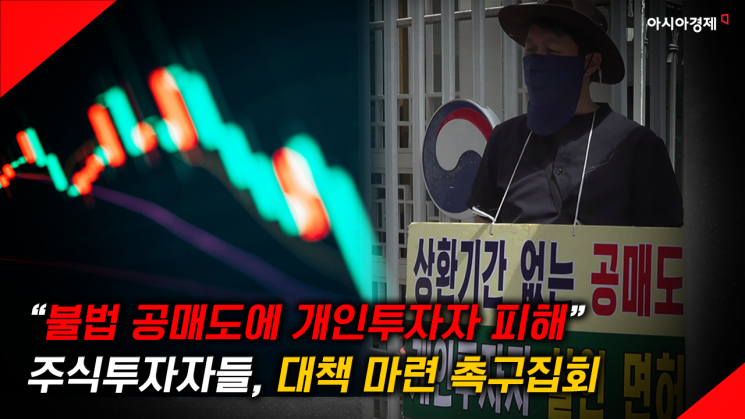
[Asia Economy Reporters Ji Yeon-jin, Lee Jung-yoon] #On the 4th of this month, Naver's corporate value plummeted by more than 8%. On that day, Citi Securities downgraded its investment opinion on Naver to 'sell' and halved the target price from 328,000 KRW to 170,000 KRW. JP Morgan also lowered its target price from 270,000 KRW to 220,000 KRW. Short selling of Naver reached 37.6 billion KRW, making it the top short-selling stock by transaction amount that day. Compared to 3.5 billion KRW on the previous trading day, this was an increase of more than tenfold. Short selling was identified as the main culprit driving down the stock price.


Does a stock with a high volume of short selling see a decline in corporate value? To conclude, stocks with heavy short selling do not necessarily experience a significant drop in stock price. However, short selling had a negative impact on stocks facing specific adverse factors.


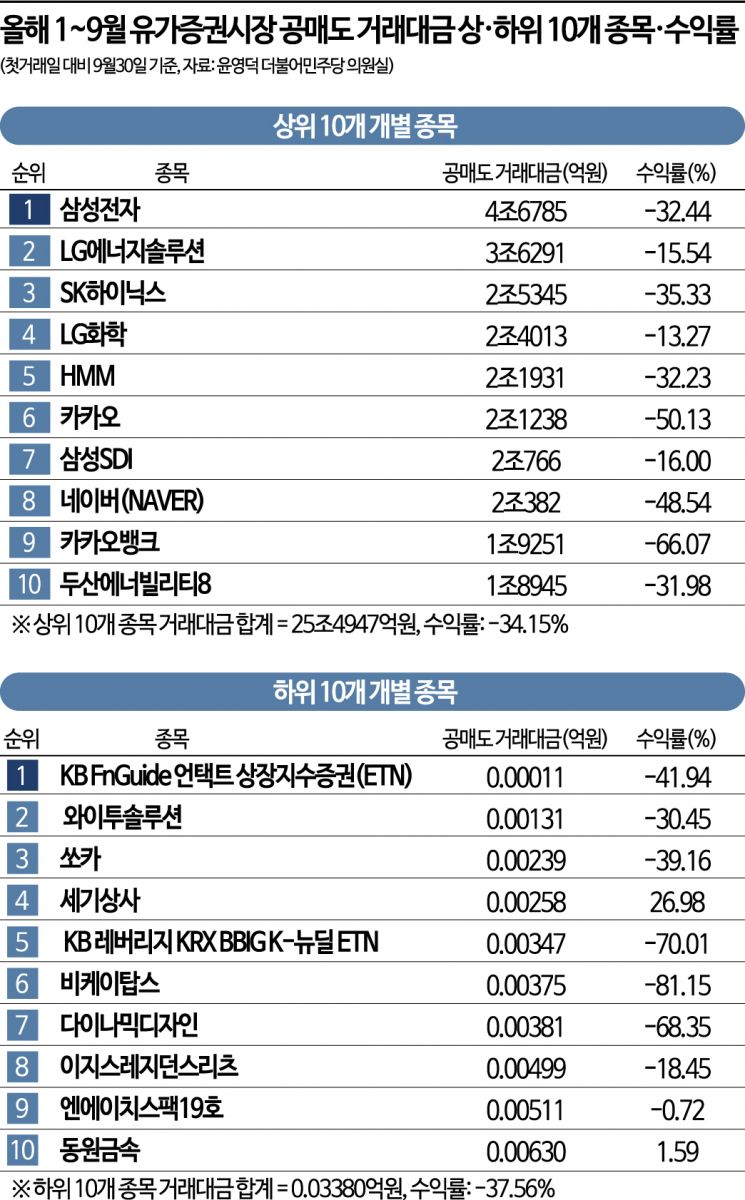
On the 16th, an analysis of the cumulative short selling transactions for all listed stocks this year, received from National Assembly member Yoon Young-deok of the Democratic Party, showed that from January to September this year, the top 10 stocks by short selling transaction amount in the KOSPI market fell by an average of 34.15% compared to the beginning of the year. In contrast, the bottom 10 stocks with the least short selling recorded an average return of -37.56%, indicating that stocks with less short selling experienced a larger decline.


The situation was similar in the KOSDAQ market. The top 10 stocks by short selling transaction amount had an average return of -28.88%, while the bottom 10 stocks had -29.38%.


During this period, the stock with the highest short selling in the KOSPI market was Samsung Electronics (4.6785 trillion KRW), which recorded a return of -32.44% compared to the beginning of the year. LG Energy Solution also saw short selling worth approximately 3.6291 trillion KRW, with a return of -15.54% since listing. In contrast, KakaoBank (1.9251 trillion KRW), which had less short selling than Samsung Electronics, plummeted by 66.7%, and Kakao (2.1238 trillion KRW) also halved (-50.13%).


"Short Selling Drives Stock Prices Down" Profitability Analysis Shows... 'Negative News' Stocks Take Direct Hit


In the KOSDAQ market, EcoPro BM (2.694 trillion KRW) had the largest short selling transaction amount, falling 24.95% compared to the beginning of the year, while Wemade (850 billion KRW), which had less short selling, dropped by 75.10%.


The poorer stock returns of stocks facing adverse factors are interpreted as the cause. Among the top short selling stocks, KakaoBank, which had the worst returns, soared to the 10th largest market capitalization on the KOSPI right after its listing last year, but doubts about its growth followed. KakaoBank's net profit in Q2 this year was 57 billion KRW, down 14.3% from the previous quarter. Additionally, controversies over stock option sell-offs by executives and employees earlier this year and concerns about overhang due to a block deal with Kookmin Bank became negative factors.


Among the top short selling stocks in KOSDAQ, Wemade, which experienced the largest stock price drop (-74.26%), also appears to have seen its stock price plunge exacerbated by short selling due to adverse factors. Wemade showed high growth by reflecting revenue related to its issued cryptocurrency WEMIX in its earnings, but faced public criticism for undisclosed sales of 108 million WEMIX tokens (approximately 227.1 billion KRW).


Professor Seo Ji-yong of the Department of Business Administration at Sangmyung University explained, "When there are adverse factors for a particular stock, if institutions or foreigners with relatively more information engage in short selling, individual investors tend to benchmark their investment patterns on them, which can cause the stock price to fall further. Since short selling is meaningful data, it certainly influences investment behavior."


© The Asia Business Daily(www.asiae.co.kr). All rights reserved.


Join us on social!

Top














