First Quantification of Negative Impact
Barun ICT Research Institute Announces Study Results
Opportunity Cost of Lost Happiness 28.9 Trillion
Impact of COVID-19 and Solo Platforms
Actual Criminal Punishments Only 10%
[Asia Economy Reporter Cha Min-young] The victim's great uncle, Mr. A, of the 'Sindang Station Clerk Stalking Murder Case' appeared on CBS Radio's 'Kim Hyun-jung's News Show' last month to express his pain caused by malicious comments. Mr. A said, "Most people left many positive comments, but I saw one or two very heartbreaking malicious comments like 'What reason could there be for a Han-nyeo to die?'" He added, "I wondered if these were really citizens who breathe the same air and live in the same space." Despite online portals and social networking service (SNS) companies waging a 'war against malicious comments' for years, concerns remain that the damage is still severe.
Malicious Comments, Is It This Serious... Side Effects Such as Depression Treatment Cost at Least 30 Trillion Won
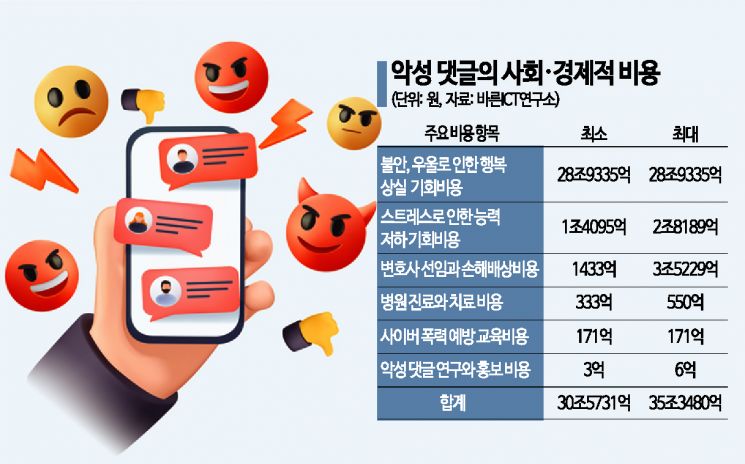
A study revealed that the social and economic costs caused by malicious comments exceed at least 30 trillion won annually. This is the first time the negative impact has been quantified.
The Barun ICT Research Institute at Yonsei University announced these findings at the 'I Saw Malicious Comments - National Assembly Forum to Strengthen Digital Media Literacy Competence for Malicious Comments' held on the 17th at the National Assembly Members' Office Building, hosted by People Power Party lawmaker Hwang Bo-seung-hee.
The biggest harm caused by the increase in malicious comments was the opportunity cost of lost happiness due to anxiety and depression, estimated at about 28.93 trillion won. The opportunity cost of decreased ability due to stress ranged from 1.4 trillion to 2.82 trillion won, and legal fees for hiring lawyers and compensation costs reached between 140 billion and 3.52 trillion won.
The Barun ICT Research Institute stated, "Since 2009, the popularization of smartphones and social media has been a catalyst for malicious comments," adding, "People tend to post malicious comments due to low empathy and self-control, dissatisfaction and stress in real-life relationships, group conformity phenomena, and lack of awareness of the harmful effects of malicious comments."
Malicious Comments and Cyber Insults Increased Further After COVID-19
Malicious comments have recently surged rapidly and are more persistently destroying individuals' daily lives. The Barun ICT Research Institute cited the following reasons for the increase in malicious comments: ▲Digital transformation during the COVID-19 period ▲Increase in one-person platforms ▲Spread of smart devices ▲Platforms and social environments where personal opinions can be freely written and shared ▲Anonymity online. The number of cyber defamation and insult cases announced by the National Police Agency also more than doubled from 8,880 cases in 2014 to 19,388 cases in 2020.
There were also criticisms that current laws lack sufficient legal measures to protect victims of malicious comments. According to a survey conducted by the Barun ICT Research Institute targeting internet users, 54.8% of respondents wanted stronger legal punishment for commenters to solve the malicious comment problem, but only 10.3% of actual victims proceeded with criminal prosecution.
At the forum, more effective solutions to eradicate malicious comments were sought, including improvements in comment policies and systems by internet portal operators, strengthening of legal punishments, and enhancement of digital media literacy. From the government side, Choi Yoon-jung, Director of Internet User Policy at the Korea Communications Commission, attended.
Lawmaker Hwang Bo-seung-hee said, "It would be most effective to encourage users themselves to recognize the seriousness and risks of malicious comments and to create a positive ecosystem," adding, "To solve the problem, it is necessary to foster a healthy environment through digital media literacy education."
© The Asia Business Daily(www.asiae.co.kr). All rights reserved.

















