Danan Systems Holds Technology for Remote Measurement Devices and Data Link Devices
Produces Essential Equipment Not Only for Missile Launchers but Also for Aircraft
[Asia Economy Yang Nak-gyu, Military Specialist Reporter] As North Korea's missile provocations continue, attention is also focused on our response weapons. Not only warhead loading but also launch vehicle technology, which determines missile performance, has become important. In the domestic defense industry, in order to respond quickly to missiles, the development of solid-fuel launch vehicles as well as securing technology to remotely measure various information while the launch vehicle is flying is emerging as a core issue.
Both launch vehicles and flying objects such as missiles must communicate with ground control towers. From launch until just before impact, state information such as flight speed, altitude, attitude control, and vibration status must be collected and sent to the ground control center, which requires the installation of telemetry devices. South Korea is one of the few countries that possess this technology independently.
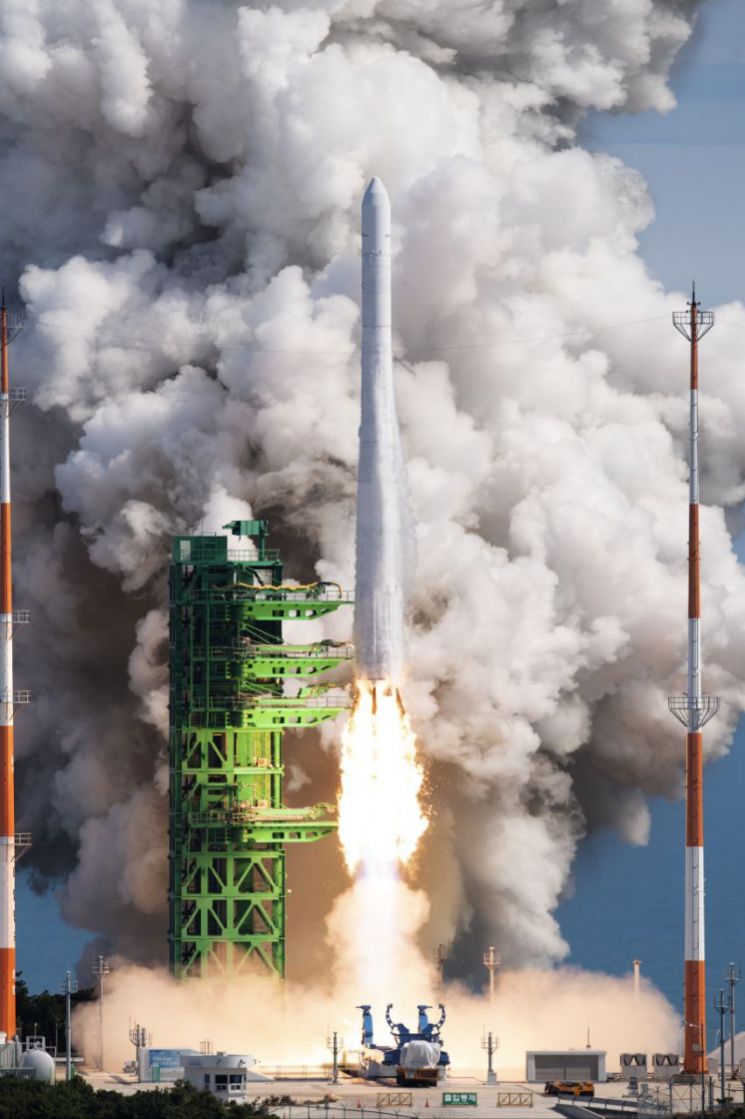
Recently visited domestic defense company Danam Systems gained attention by participating in the Nuriho launch process. The telemetry device made by Danam Systems also detected unusual measurement values in the first stage oxidizer tank during the Nuriho launch suspension in June.
The company is equipped with an electronic warfare test site to test telemetry devices and others. This place, called a chamber, measures 8m wide, 4m long, and 4m high. Hundreds of carbon fiber electromagnetic wave absorbers, resembling thorns growing on tree branches, are attached to the inner walls.
A company official explained, "This place hides the know-how accumulated since 1993 when we first developed the scientific rocket (KSR-I), the first observation rocket, together with the Korea Aerospace Research Institute (KARI)."
Various mockups of missiles are prepared around the test site. These are for experimenting with various types of telemetry devices.
Going underground, temperature, vibration, and shock tests were underway in a composite chamber. Equipment installed inside the launch vehicle must withstand up to 70°C. A company official explained, "To protect antennas mounted outside the launch vehicle, they must withstand up to 500 degrees Celsius, and we possess the only domestic technology for this."
In addition, development of data link devices is also in full swing. While telemetry devices are unidirectional communication, data link devices enable bidirectional communication. Data link devices are installed on drones and missiles and are used to change flight direction or strike points after launch. The key technology is how accurately transmission and reception can be performed over long distances, and the company claims that transmission and reception are possible over 200 km without a relay.
One reason why the long-range surface-to-air missile (L-SAM), called the Korean THAAD (Terminal High Altitude Area Defense), is gaining attention overseas is because of its data link device. L-SAM is linked via data link with ballistic missile operation control centers (KTMO-CELL), central air defense control centers (MCRC), and others. The U.S. representative interceptor missile SM-3 has a similar system, but L-SAM is known to have a longer operation time than the SM-3.
The anti-jamming device, which Danam Systems focuses on, also contributes to the popularity of "K-Defense." Anti-jamming prevents satellite navigation devices from being disabled by jamming signals. Interest in anti-jamming technology increased after the Saudi Arabian state-owned oil company Aramco's production facilities were helplessly destroyed by hostile drone attacks in 2019.
Park Hoon, head of the division, explained, "It is based on the principle that a blinking incandescent light (radio wave) can be seen from a long distance without being confused with other lights (jamming)," adding, "We possess unique anti-jamming technology."
Danam Systems was selected this year as the lead research and development institution for a new project in the small launch vehicle field under the Space Pioneer program. The Space Pioneer program aims to localize 16 key technologies for small launch vehicles and satellites by 2030 with a total investment of 211.5 billion KRW. With core technologies from domestic small and medium enterprises, the launch of military small satellites also seems imminent.
The history of missile launch technology in the domestic defense sector now exceeds 50 years. The Agency for Defense Development (ADD), launched in August 1970 under the banner of self-reliant defense, promoted the domestic missile development project called the "Baekgom Project." This project, conducted in three stages?copy development, performance improvement, and independent weapon development?was carried out in strict secrecy. After numerous efforts and trials, the first flight test was conducted in April 1978. In September of the same year, a public demonstration was successfully completed at the Anheung test site. With this development success, South Korea became the seventh country in the world to possess missile technology. Baekgom later became the foundation for the development of the Hyunmoo series surface-to-surface guided missiles and also laid the groundwork for the Nuriho launch.
The military authorities plan to launch small satellites into low Earth orbit by 2025 using solid-fuel propulsion space launch vehicles. Although solid propulsion is somewhat less accurate than liquid propulsion, it has the advantage of being able to be launched quickly by pre-loading fuel into the launch vehicle. This is why North Korea has been steadily developing solid propulsion methods. The military evaluates that domestic solid propulsion launch vehicle technology is at a world-class level and ahead of North Korea.
© The Asia Business Daily(www.asiae.co.kr). All rights reserved.

















