Conflicting Views on Causes of Global Economic Crisis
Western Countries and Russia Clash... Economic Recession Outlook Rises
Member States Say "G20-Level Cooperation Needed"
The adoption of the joint communiqu? at the Group of Twenty (G20) Finance Ministers' Meeting and the International Monetary and Financial Committee (IMFC) meeting failed once again. This was due to differing opinions among countries on the causes of the global economic crisis amid the prolonged Russia-Ukraine war. Deputy Prime Minister and Minister of Economy and Finance Choo Kyung-ho attended the meeting and emphasized that countries must maintain consistency between tight monetary policies and sound fiscal policies to respond to rising inflation.
Deputy Prime Minister Choo attended the "4th G20 Finance Ministers and Central Bank Governors Meeting" held on June 12-13 (local time) in Washington, D.C., USA. The Ukrainian Finance Minister participated as a special invitee for the second and third meetings and again this time, while the Russian Finance Minister attended via video conference. The meeting was conducted in six sessions covering the global economy, international financial system, financial regulation, infrastructure, sustainable finance, and international taxation.
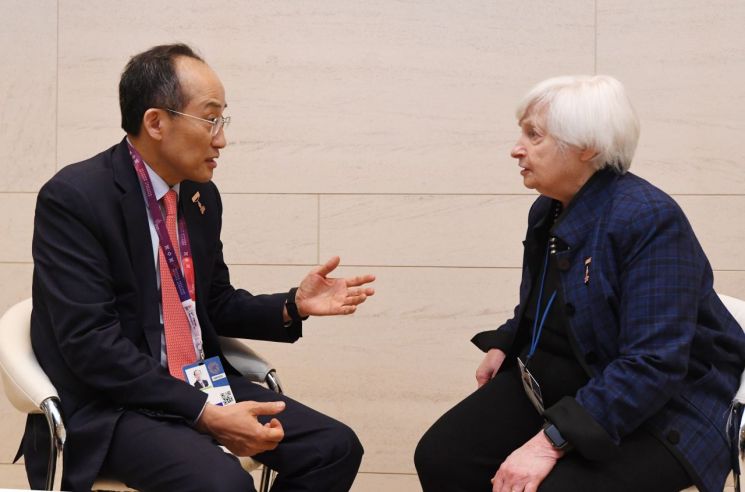 Deputy Prime Minister and Minister of Economy and Finance Choo Kyung-ho is meeting with U.S. Treasury Secretary Janet Yellen on the 13th (local time) at the International Monetary Fund (IMF) headquarters in Washington, USA. (Photo by Ministry of Economy and Finance)
At the global economy session, Deputy Prime Minister Choo stated, "The prolonged inflation, along with uncertainties such as war, supply chain restructuring, and climate change, make it difficult for countries to find the optimal policy mix." He added, "While tight monetary policy is inevitable to stabilize prices, the resulting increased volatility in global financial markets must also be fully considered."
Deputy Prime Minister Choo emphasized, "Fiscal policy should support growth and vulnerable groups while maintaining consistency with monetary policy to minimize market disruption," and stressed the need for "smooth labor supply from the supply side, a swift end to the war, and the restoration of a rules-based multilateral trading system."
During the international financial system session, it was explained that monetary tightening has increased volatility in capital flows and caused financial instability in both advanced and developing countries. The session also pointed out the need to complete the 16th International Monetary Fund (IMF) quota review by December next year and to strengthen the role of multilateral development banks.
Many member countries agreed at this meeting that the global economic outlook has darkened further due to the war, rising inflation, monetary tightening by major countries, and supply chain disruptions, and concurred on the need for G20-level cooperation to resolve food and energy issues. Policy-wise, there was consensus on the necessity of monetary tightening to address inflation and on focusing support for vulnerable groups.
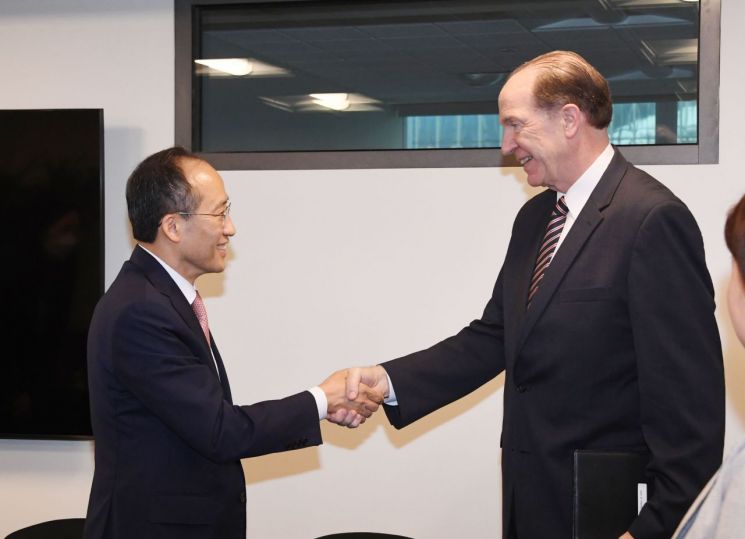 Deputy Prime Minister and Minister of Economy and Finance Choo Kyung-ho, who is visiting Washington DC, USA to attend the G20 Finance Ministers Meeting and the IMF/WB Annual Meetings, is taking a commemorative photo with David Malpass, President of the World Bank (WB), after a meeting at the World Bank headquarters on the 12th (local time). (Photo by Ministry of Economy and Finance)
Failure to Adopt Joint Communiqu?... Disagreement on Causes of Global Economic Crisis
At this G20 meeting, the adoption of a joint communiqu? was again unsuccessful, following the third meeting. Many countries insisted that Russia's invasion of Ukraine should be included as a cause of the global economic deterioration, but Russia opposed this, leading to conflict.
Instead, after additional written consultations among member countries, the communiqu? will be replaced by a Chair's summary. The IMFC joint declaration was also replaced by a Chair's statement due to disagreements among member countries over wording related to the Russia war, preventing full consensus.
Deputy Prime Minister Choo, who attended the IMFC, emphasized the need to secure consistency between tight monetary policy to combat inflation and sound fiscal discipline, and to supplement fiscal policy for economic recovery and protection of vulnerable groups. He also supported various IMF efforts to expand assistance to vulnerable countries and urged the prompt operation of the Recovery and Sustainability Trust (RST), a long-term fund for vulnerable country support.
Many member countries expressed concerns not only about the food and energy crises and supply chain disruptions caused by the Russia war but also about inflation and the resulting economic uncertainty. In the Chair's statement, they identified economic activity contraction, increased volatility in capital flows and exchange rates due to the Russia war as key risk factors.
Washington D.C. ? Reporter Moon Je-won
© The Asia Business Daily(www.asiae.co.kr). All rights reserved.
![Clutching a Stolen Dior Bag, Saying "I Hate Being Poor but Real"... The Grotesque Con of a "Human Knockoff" [Slate]](https://cwcontent.asiae.co.kr/asiaresize/183/2026021902243444107_1771435474.jpg)
















