Japanese Government to Support Electricity and City Gas Fees
Singapore to Cover Increased Living Costs
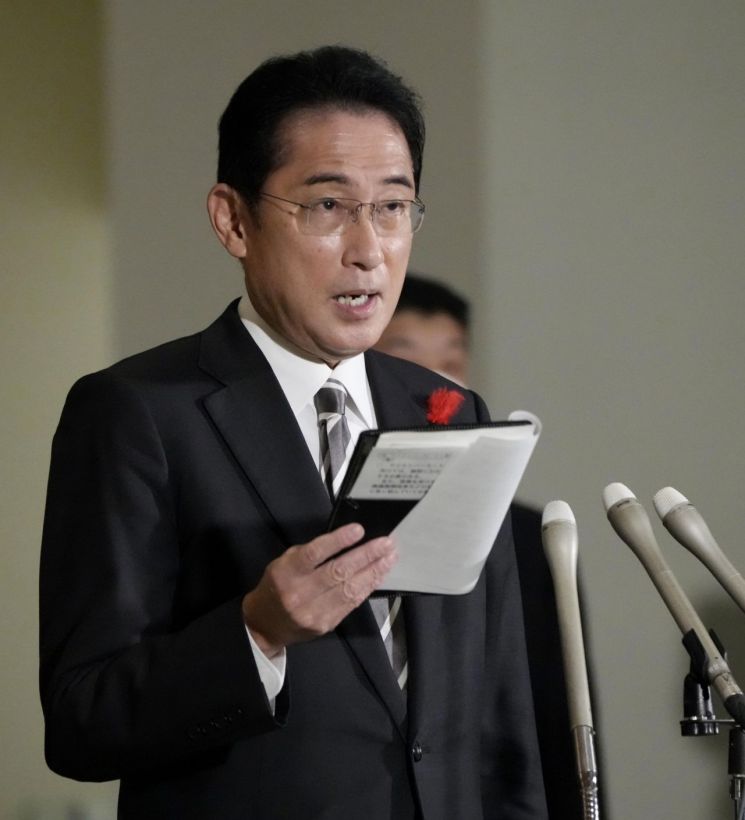 Japanese Prime Minister Fumio Kishida is explaining to reporters on the 14th about support measures for electricity and city gas charges after a meeting with Natsuo Yamaguchi, leader of the Komeito Party. Photo by Kyodo News
[Asia Economy Reporter Kim Hyunjung] As inflation soars day by day causing global distress, the governments of Japan and Singapore have begun formulating countermeasures. According to local media reports such as Yomiuri and Nihon Keizai Shimbun on the 15th, Japanese Prime Minister Fumio Kishida held talks with Natsuo Yamaguchi, leader of the coalition partner Komeito, on the 14th and decided to prepare measures to ease the burden of electricity and city gas charges.
After the meeting, Prime Minister Kishida told reporters at the Prime Minister's Office, "Energy prices continue to rise, and electricity bills could increase by 20-30% all at once after next spring," adding, "We intend to devise relief measures that will be felt in the monthly electricity bills." He further stated, "The support amount will correspond to the average increase in burden." Regarding gas charges, he said appropriate measures would be taken considering the balance with electricity charges.
In addition, the Prime Minister and Yamaguchi agreed to extend the current subsidy system for petroleum monopoly companies, which aims to curb the rise in gasoline prices, beyond January next year. However, they decided to adjust the subsidy cap. Detailed information on this will be included in the government's comprehensive economic measures to be formulated at the end of this month.
The Singapore government will provide a total of 1.5 billion Singapore dollars (approximately 1.5169 trillion Korean won) in living subsidies. According to major foreign media on the 14th (local time), the Singapore Ministry of Finance announced that it will cover the full increase in living expenses for low-income households and more than half of the increase for middle-class households. The support will be provided in various forms, including cash, vouchers, and public transportation subsidies. Singapore's inflation rate has reached its highest in 14 years, prompting the Monetary Authority of Singapore to implement its fourth monetary tightening policy this year alone.
There are also voices calling for tax cuts and restrictions on support for low-income groups to curb inflation. According to the Wall Street Journal (WSJ) on the 12th (local time), the International Monetary Fund (IMF) recently released a report stating that governments worldwide need to reduce spending to suppress inflation. To do so, they should increase additional revenue instead of tax cuts and limit support measures such as subsidies for low-income groups.
The report estimated that as subsidy support policies implemented during the COVID-19 pandemic have been discontinued, the ratio of national debt to gross domestic product (GDP) in countries worldwide, including the United States, is declining but remains higher than pre-pandemic levels. In the case of the United States alone, fiscal deficits and government debt surged for several years due to various subsidies related to COVID-19.
This year, the global government debt amounts to 91% of world GDP, which is much lower than the record high of 256% in 2020 but 7.5 percentage points higher than before the pandemic. Amid this, the IMF lowered its global economic growth forecast for next year from 2.9% to 2.7% on the 11th.
© The Asia Business Daily(www.asiae.co.kr). All rights reserved.
![Clutching a Stolen Dior Bag, Saying "I Hate Being Poor but Real"... The Grotesque Con of a "Human Knockoff" [Slate]](https://cwcontent.asiae.co.kr/asiaresize/183/2026021902243444107_1771435474.jpg)















