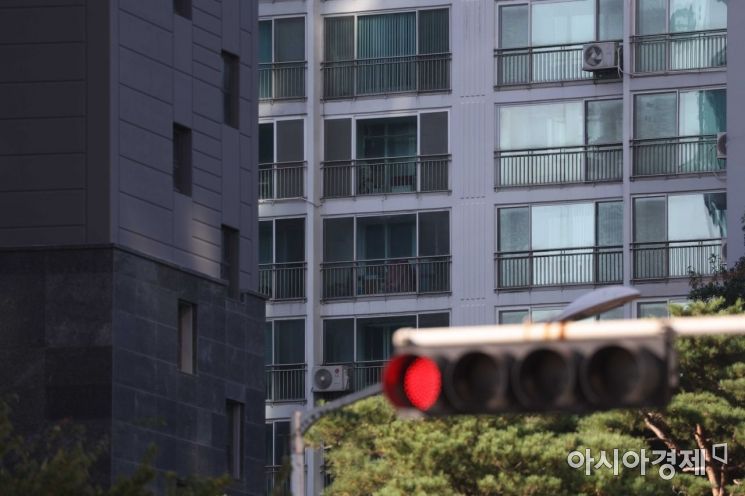
[Asia Economy Reporter Ryu Tae-min] As house prices continue to decline due to consecutive interest rate hikes, the Seoul apartment sales supply-demand index has hit its lowest point in 3 years and 4 months. Following Seoul, the entire metropolitan area’s sales supply-demand index has also fallen below the 80 mark. In particular, the sales supply-demand index in the 'Nodogang' (Nowon, Dobong, Gangbuk districts) area, where 'Yeongkkeul' demand surged last year, has been steadily declining, raising concerns that it may fall below the 70 level.
According to the Korea Real Estate Board on the 14th, this week’s Seoul apartment sales supply-demand index recorded 76.9, down 0.8 points from last week’s 77.7. This is the lowest level in 3 years and 4 months since the second week of June 2019 (76.0).
The sales supply-demand index being below the baseline of ‘100’ means that there are more people wanting to sell houses than those wanting to buy. The Seoul apartment sales supply-demand index has been declining for 23 consecutive weeks since the first week of May (91.1). Since it fell below the baseline of 100, recording 99.6 in the survey on November 15 last year, the market has been in a ‘seller’s advantage’ situation for 45 weeks.
By region, the northeastern area, which includes the ‘Nodogang’ region, dropped from 71.0 last week to 70.4, the lowest among the five major regions. It is effectively on the verge of breaking below the 70 level. The northwestern area, including Mapo, Eunpyeong, and Seodaemun districts, fell from 71.7 to 70.7, and the central area, including Yongsan and Jongno districts, decreased from 71.0 to 70.8.
The southwestern area, including Yangcheon, Yeongdeungpo, and Gangseo districts, declined from 84.8 to 84.2, while the southeastern area, including Gangnam, Seocho, Songpa, and Gangdong districts, dropped from 82.8 to 81.5. Gyeonggi Province (81.3) and Incheon (77.7) also saw their indices fall compared to last week. As a result, the overall metropolitan area sales supply-demand index fell to 79.4, breaking below the 80 mark. This is the lowest level in 9 years and 6 months since the first week of April 2013 (77.2).
This is interpreted as a contraction in buying sentiment due to consecutive interest rate hikes. On the 12th, the Bank of Korea’s Monetary Policy Committee implemented a ‘big step’ by raising the base interest rate by 0.5 percentage points at once, pushing the base rate up to 3.0%. With the base interest rate rising to the 3% level for the first time in 10 years, expectations that house prices will continue to fall have increased, reducing buying demand.
Meanwhile, this week’s nationwide apartment jeonse (long-term lease) supply-demand index was 86.7, marking the lowest point in about 3 years since the first week of October 2019 (86.1). Among these, Seoul’s apartment jeonse supply-demand index was 81.7, the lowest in 3 years and 3 months since the second week of July 2019 (81.6).
© The Asia Business Daily(www.asiae.co.kr). All rights reserved.