Prototype Production and Installation Completed Next Year, Demonstration Evaluation and Group Standard Revision Finished by 2024
"Elevator Association-Led Technology Development Shared with SMEs... A Signal for SME Revival"
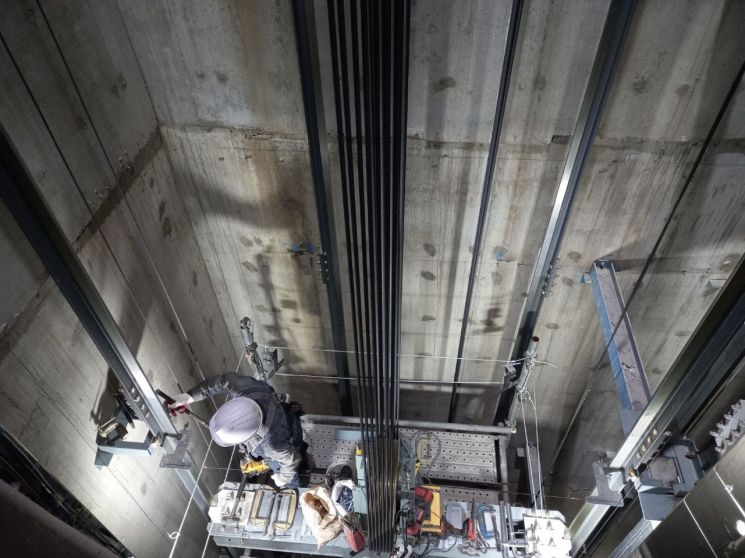 Elevator company employees are performing installation work in the elevator shaft of a high-rise building.
 [Photo by Korea Elevator Industry Cooperative]
[Asia Economy Reporter Kim Jong-hwa] The Korea Elevator Industry Cooperative has embarked on the development of a 'used medium-to-high-speed elevator specialized for small and medium-sized enterprises (SMEs).' This initiative aims to support SMEs' entry into the medium-to-high-speed elevator market.
According to the Elevator Cooperative on the 12th, the cooperative was selected last month on the 30th for the '2022 Performance-Sharing Common Technology R&D Project' announced by the Ministry of SMEs and Startups. It signed an agreement with the Small and Medium Business Technology Information Promotion Agency (TIPA), a specialized R&D support institution, to develop a '17-passenger medium-to-high-speed elevator strategic model with a speed of 2.5 m/s specialized for SMEs.' The project budget totals 1.1 billion KRW, including 880 million KRW in government subsidies, with a project duration of two years.
The Elevator Cooperative plans to complete the development of the medium-to-high-speed drive and the production and installation of prototypes next year, and by 2024, finish the demonstration evaluation of the 17-passenger medium-to-high-speed elevator and revise the group standards. Under the leadership of the Elevator Cooperative, Saehan Elevator Co., Ltd. will manufacture the finished products and produce soundproof and vibration-proof structures; Vision Motor Co., Ltd. will develop compact gearless drives; Express Lift Co., Ltd. will handle smart control systems; Korea Elevator University will conduct structural analysis and safety reviews of key parts; and the Korea Elevator Association will be responsible for remote management systems and system integration.
Survival Hinges on Technology Development... Medium-to-High-Speed Technology Essential for Super High-Rise Buildings
The primary reason the Elevator Cooperative is developing medium-to-high-speed elevator technology is that the survival of SMEs is under threat. The domestic elevator market is worth about 4 trillion KRW, with five major companies?TK Elevator (formerly ThyssenKrupp), Otis, Mitsubishi, Schindler, and Hyundai Elevator?holding 85% of the market, while approximately 1,900 SMEs compete for the remaining 15%.
Recently, with the rapid increase of buildings over 30 floors due to urban population concentration, the high-speed and ultra-high-speed elevator market has expanded. However, SMEs lacking technology and capital have not even had the opportunity to compete. As a result, the market share of SMEs, which exceeded 30% before 2000, has dropped to 15% in just 20 years?half of what it was. Their survival now depends on whether they can develop technology.
Elevator technology is classified by speed as low-speed (0.75 m/s), medium-low-speed (1.0?1.75 m/s), medium-to-high-speed (2.0?3.5 m/s), high-speed (4.0?5.0 m/s), and ultra-high-speed (6.0 m/s or more). Generally, large companies have handled medium-to-high-speed, high-speed, and ultra-high-speed elevators, while SMEs have been responsible for low-speed and medium-low-speed elevators. However, recently, large companies have begun encroaching on the medium-low-speed elevator market, traditionally the domain of SMEs. SMEs without technology are helpless.
The '2.5 m/s strategic model' elevator that the Elevator Cooperative has started developing is essential technology for SMEs to enter the elevator market for super high-rise buildings over 30 floors. Elevators in super high-rise buildings taller than 120 meters must reach the top within one minute; if it takes longer, passengers may feel uneasy. The technology to cover 120 meters within one minute falls within the 'medium-to-high-speed' category.
Another reason SMEs must master medium-to-high-speed elevator technology is to restore trust. Since 2012, with the government's relocation to Sejong City and the relocation of public enterprises in the metropolitan area to provinces, demand for elevators in the public sector has surged. However, quality issues with some Chinese-imported products installed by certain SMEs have led to a decline in trust in SME products.
"If It Becomes a Competitive Product for SMEs, It Could Signal the Revival of SMEs"
The Elevator Cooperative expects that once the medium-to-high-speed elevator development is completed, SMEs will share technology, improve quality, restore trust, and secure technological competitiveness. Choi Kang-jin, Chairman of the Elevator Cooperative, said, "We plan to reflect the requirements of demand organizations from the early stages of development so that passenger elevators under 120 meters per minute ultimately become competitive products among SMEs." He added, "The cooperative will devote itself to resolving quality issues raised so far and restoring reliability through the localization of key components, using this project agreement as an opportunity."
Medium-to-high-speed elevators are produced in small quantities with many varieties and are products that integrate mechanical, electrical, electronic, and IT fields, requiring significant capital and highly skilled technical personnel for development. This is why the cooperative has taken the initiative.
Chairman Choi explained, "SMEs are disadvantaged in technology and financial power, making it difficult for individual companies to respond. Therefore, the Elevator Cooperative must take preemptive action to provide the developed technology and products for joint use by many companies."
Could the development of medium-to-high-speed elevators be a signal for the revival of SMEs? The elevator industry explains that the global elevator market is maintaining steady high growth of over 10% annually due to the rise of the Chinese market, urbanization in emerging developing countries, and development in Southeast Asia and Central Asia. The global market size is expected to grow from $60 billion in 2012 to $150 billion by 2025.
An industry official said, "China and Japan are actively supported by their governments to secure future markets in emerging Southeast Asian countries such as Indonesia, Myanmar, and Vietnam," adding, "Technology development is urgently needed to compete with these countries."
The industry forecasts that the medium-to-high-speed elevator market will grow from 240 billion KRW in 2020 to 360 billion KRW in 2030. If the SME competition category for elevators, designated in 2012, is raised from medium-low-speed to medium-to-high-speed, SMEs could secure 30% of the medium-to-high-speed market, with an additional annual market size of about 90 billion KRW.
Another industry official said, "The Elevator Cooperative has led the technology development and shared it with many SMEs, overcoming the difficulties of developing medium-to-high-speed elevators," adding, "Standardizing products also helps suppress manufacturing cost increases. The development of medium-to-high-speed elevators will be a signal for the revival of SMEs."
© The Asia Business Daily(www.asiae.co.kr). All rights reserved.
![Clutching a Stolen Dior Bag, Saying "I Hate Being Poor but Real"... The Grotesque Con of a "Human Knockoff" [Slate]](https://cwcontent.asiae.co.kr/asiaresize/183/2026021902243444107_1771435474.jpg)















