Ministry of Foreign Affairs Emphasizes Compensation and Apology from Japanese Defendant Company
"No Set Deadline, but Will Seek Solutions with Urgency"
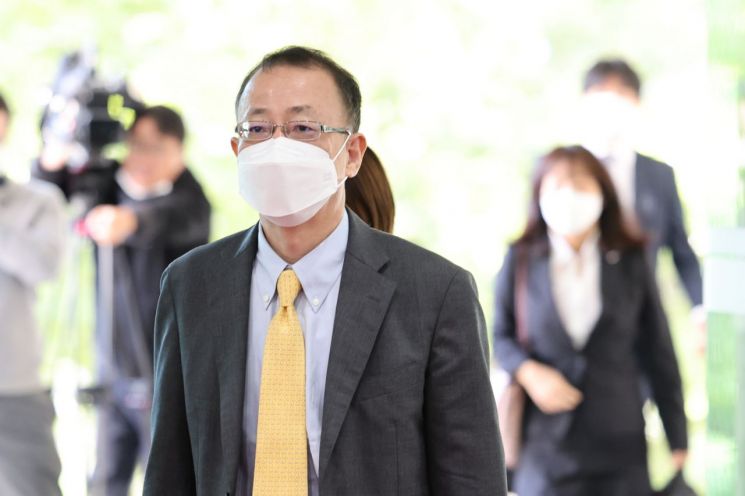 Takehiro, Director-General of the Asian and Oceanian Affairs Bureau at the Japanese Ministry of Foreign Affairs, attending the Korea-Japan Director-General level talks on the 11th.
 [Image source=Yonhap News]
[Asia Economy Reporter Jang Hee-jun] The diplomatic authorities of South Korea and Japan held director-general level talks to discuss solutions regarding issues such as compensation for forced labor.
On the morning of the 11th, Lee Sang-ryeol, Director-General of the Asia-Pacific Bureau at the Ministry of Foreign Affairs of South Korea, held director-general level consultations with Takehiro Funakoshi, Director-General of the Asia and Oceania Bureau at Japan’s Ministry of Foreign Affairs, at the Ministry of Foreign Affairs building in Jongno-gu, Seoul, focusing intensively on the forced labor compensation issue, which is considered the biggest challenge in bilateral relations.
The South Korean side conveyed matters raised during the four rounds of public-private consultative meetings to the Japanese side. In particular, they repeatedly emphasized key issues such as direct negotiations between victims and Japanese defendant companies, participation of defendant companies in arranging compensation funds, and apologies, urging Japan for a sincere response.
Above all, they highlighted that this issue arose within the South Korean judicial system and should be resolved within that framework, a point with which the Japanese side reportedly expressed sympathy.
This is interpreted as excluding arbitration procedures under the Claims Agreement from the solutions and seeking ways to resolve the issue through subrogation or concurrent assumption of debt. Concurrent assumption of debt means that the forced labor debtor’s obligation remains, but a third party newly assumes the same obligation. This approach is attracting attention as a solution because it does not require separate consent from the victims.
An official from the Ministry of Foreign Affairs told reporters on the day, “Both countries have conducted several consultations intensively in a good flow.” However, when asked if there was concrete progress in deriving a solution, the official replied, “Rather than interpreting it as a sign of resolution, I would say that we are seriously consulting.”
The official added, “There is no set deadline for (finding a solution), but I think we can say that we want to achieve results with a sense of urgency,” emphasizing, “Fundamental values and such must be sufficiently upheld.” This is interpreted as a willingness not to reach an agreement that does not sufficiently reflect the intentions of victims and others while focusing on finding a solution.
The South Korea-Japan director-general level talks were held for the first time in a month and a half since the Tokyo talks on August 26. During the talks, opinions were also exchanged on ways to advance security cooperation between the two countries in response to the escalating nuclear threat from North Korea. Takehiro Funakoshi, who is also Japan’s chief representative on North Korean nuclear issues, is scheduled to hold South Korea-Japan chief representative talks on North Korean nuclear issues with Kim Gun, Director-General of the Ministry of Foreign Affairs’ Peace Negotiations Headquarters on the Korean Peninsula, on the morning of the 12th.
© The Asia Business Daily(www.asiae.co.kr). All rights reserved.
![Clutching a Stolen Dior Bag, Saying "I Hate Being Poor but Real"... The Grotesque Con of a "Human Knockoff" [Slate]](https://cwcontent.asiae.co.kr/asiaresize/183/2026021902243444107_1771435474.jpg)















