If Intentional 'No-Show' Proven, Punishable as Obstruction of Business by Deception
"Fines of a Deterrent Level Must Be Imposed to Prevent Recurrence of No-Shows"
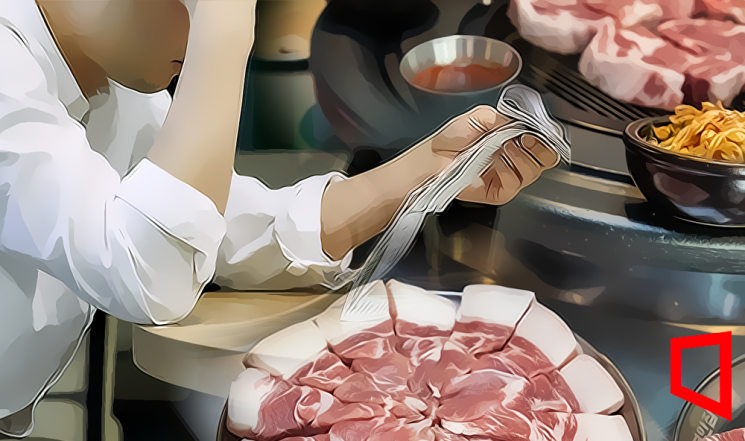 Stories of self-employed people suffering damages due to "No-Shows" (reservation no-shows) are continuously emerging.
[Asia Economy Reporter Park Hyun-joo] The damage to self-employed business owners is increasing due to so-called 'No-Shows'?people who make group reservations but do not show up at the restaurant. Experts believe that to prevent repeated no-shows, punitive fines should be imposed for malicious and premeditated no-show actions.
Recently, a story was posted on an online community about suffering losses after ordering 1.1 million KRW worth of Samgyeopsal (pork belly) and not showing up. According to the poster, Mr. A, his parents received a phone call from a man ordering 50 servings of Samgyeopsal and prepared the table, but the man never appeared. While preparing the table, they called the man who placed the order, but the call kept going unanswered. When they finally connected, the man demanded a 200,000 KRW deposit and then disappeared.
No-show damages are no exception even for celebrities. Broadcaster Kim Jun-hee, who runs an online shopping mall, lamented on her Instagram last month that she suffered losses due to customers who promised to purchase luxury goods but then cut off contact. She said, "I really won’t do live flea markets anymore," and added, "There were so many people who wanted to buy, but because some who said they would buy didn’t even contact us, we all wasted our efforts."
Chef Choi Hyun-seok, well known through broadcasts, also expressed his frustration over no-show customers. In 2018, he posted on his Instagram, "No-shows have been happening too frequently lately. I am really very angry," and stated, "I will no longer stand by silently. A reservation is a promise. You should be truly ashamed."
If someone intentionally places a false food order and causes damage to a store, they can be punished with up to five years in prison or a fine of up to 15 million KRW for obstruction of business by deception. This is because falsely ordering food and preventing other customers from being served is considered interference with the store’s business.
In fact, earlier this month, the prosecution filed a summary indictment with a 3 million KRW fine against a man in his 50s, Mr. B, who reserved 40 kimbap rolls in July and did not show up, on charges of obstruction of business by deception. He is accused of using someone else’s phone number to make a false reservation for kimbap and ultimately not appearing. Investigations revealed that Mr. B had repeatedly committed no-shows at clothing stores, cafes, and Chinese restaurants. The damage was mainly concentrated on small stores where the owner or staff worked alone.
 If the intentionality of a no-show act is proven, it can be punished as obstruction of business by deception. The photo is unrelated to the specific content of the article. [Image source=Pixabay]
Researcher Seung Jae-hyun of the Korea Institute of Criminal Justice Policy also believes that malicious and premeditated no-shows should be punished. He explained, "No-shows do not involve acquiring financial gain for the person involved, so it is not fraud but obstruction of business by deception. Unlike situations where schedules change inevitably and the order is canceled with sufficient notice, no-shows are malicious plans not to appear at the store from the start."
Researcher Seung said, "(In the case of the 40 kimbap rolls no-show incident, the 3 million KRW fine) was appropriate because the fine was much higher than the damage suffered by the business owner," and added, "Even if the fine is imposed summarily, it should be of an amount sufficient to have a deterrent effect so that such incidents can be prevented from recurring in the future."
© The Asia Business Daily(www.asiae.co.kr). All rights reserved.
![Clutching a Stolen Dior Bag, Saying "I Hate Being Poor but Real"... The Grotesque Con of a "Human Knockoff" [Slate]](https://cwcontent.asiae.co.kr/asiaresize/183/2026021902243444107_1771435474.jpg)
















