442 KOSPI and KOSDAQ Stocks
Market Cap of 600 Trillion Won Evaporated Since the Beginning of the Year
[Asia Economy Reporters Kwon Jaehee and Lee Myunghwan] A cool autumn breeze is blowing through the domestic stock market. Numerous stocks have hit their all-time lowest prices since listing. The market capitalization of domestic listed companies has evaporated by more than 600 trillion KRW as of the end of September compared to the beginning of the year.
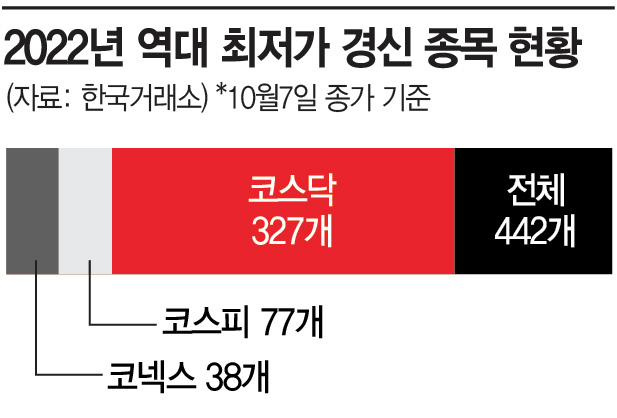
According to the Korea Exchange on the 11th, as of the market close on the 7th, a total of 442 stocks listed on the domestic markets including KOSPI, KOSDAQ, and KONEX recorded their all-time lowest closing prices since listing this year. Considering that the total number of listed companies as of the 7th was 2,656, this means that 16.64% of the stocks have broken their all-time low price records since listing.
Breaking down the stocks that set new all-time lows by market, 77 were on KOSPI and 327 on KOSDAQ. The proportion by market shows that 8.17% of KOSPI-listed companies hit new all-time lows, while on KOSDAQ, the figure was as high as 20.55%.
The dates when these stocks hit their lowest prices were concentrated at the end of September and early October. Among the 442 stocks that set new all-time lows this year, 311 stocks, accounting for 70%, recorded their lowest prices during September and October. During this period, the domestic stock market experienced a continuous decline due to the strong dollar, recession concerns, and inflation fears, with KOSPI hitting yearly lows.
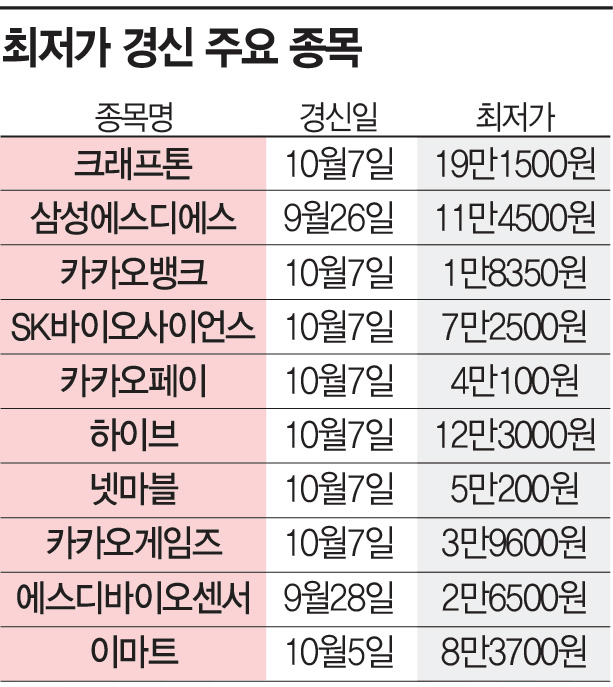
Looking closely at the stocks that have fallen to their lowest levels since listing, Kakao affiliates stand out. Kakao Bank, Kakao Pay, and Kakao Games all simultaneously recorded their all-time lowest prices on the 7th. Recently, Kakao’s subsidiaries have shown weak stock performance amid negative outlooks from the securities industry. Kakao Games experienced a decline due to controversies over poor management of its new title ‘Uma Musume’ and the split listing controversy involving its subsidiary Lionheart Studio.
The full-scale onset of the endemic phase appears to have affected biotech companies. SK Bioscience, which produces Korea’s first COVID-19 vaccine, and SD Biosensor, which produces diagnostic kits, recorded all-time lows. Additionally, gaming stocks such as Krafton and Netmarble, as well as entertainment stocks like HYBE and DearU, also hit new lows.
Besides these, most stocks have struggled throughout the year. According to the Korea CXO Research Institute, among 2,435 listed companies, 2,033 companies, or 83.5%, saw their market capitalization decrease between the beginning of the year (January 3) and the end of September (30). The total market capitalization of the entire stock market was 2,575 trillion KRW at the start of the year, which dropped to 2,506 trillion KRW by the end of the first quarter (March), then to 2,095 trillion KRW by the end of the first half (June), and further down to 1,942 trillion KRW by the end of the third quarter (September). Over the third quarter alone, the market capitalization shrank by more than 633 trillion KRW.
The number of companies in the 1 trillion KRW market cap club also decreased by more than 70 during the third quarter. At the beginning of the year, 288 companies were in the 1 trillion KRW club, which dropped to 273 by the end of the first quarter (January), 226 by the end of the second quarter (June), and further down to 213 in the third quarter.
However, some analysts suggest that since the domestic stock market has already fallen significantly, it could rebound even with minor positive news. Lee Kyungmin, a researcher at Daishin Securities, advised, "Given the recent situation, there is still room for the market to react sensitively to even small positive factors. It is important to manage risks thoroughly and increase the proportion of dividend stocks and defensive stocks (such as telecommunications and food & beverage) in the portfolio, while leaving room for short-term trading strategies."
© The Asia Business Daily(www.asiae.co.kr). All rights reserved.


















