Park Hong-geun "Will Request Lee Jae-myung to Activate Units for Public Opinion Gathering on Election System Deliberation"
Focus on Specific Plans for Linked and Regional Proportional Representation... Aiming for Nationwide Party in April Next Year General Election
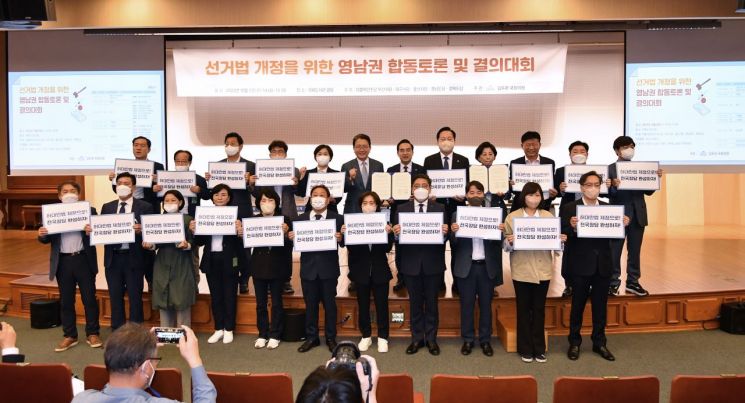
[Asia Economy Reporter Naju-seok] The Democratic Party of Korea is expected to establish a body within the party to facilitate public discussion for revising the Public Official Election Act before April next year. The election system, which former President Roh Moo-hyun emphasized as being more politically significant than gaining power once by stating, "Changing the electoral district system for National Assembly members brings much greater political development," has remained unchanged for a long time. Attention is now focused on whether this opportunity will finally bring about change.
Park Hong-geun, the floor leader of the Democratic Party, said at the recent 'Joint Discussion and Resolution Meeting for Election Law Revision in the Yeongnam Region' held at the National Assembly, "The Special Committee on Political Reform in this National Assembly will be fully operational by November," adding, "To present our party's stance first, we must promptly establish a related public discussion body and opinion-gathering unit within the party." He further promised, "I will request that the party leader and leadership quickly activate a public discussion and opinion-gathering unit to organize the Democratic Party's position on political reform, especially regarding election system improvements."
This declaration indicates that the Democratic Party intends to proceed with a formal process to consolidate party consensus on election system reform. Notably, this promise was made to the Yeongnam regional chairpersons, where the Democratic Party has been at a disadvantage following the presidential and local elections.
Park said, "Democratic Party leader Lee Jae-myung also pledged at the party convention to achieve a genuine and practical nationwide party status," adding, "For this not to remain a slogan, institutional support is absolutely necessary."
Park also appeared to show considerable sympathy for the idea of proportional representation by region. He stated, "It is time for South Korean politics to change, and for the National Assembly to change, we must first alter the framework of vested interests, which I am convinced is the most direct path to breaking down the walls of regionalism," and added, "I believe the voices of those who feel firsthand how difficult it is in the most challenging regions due to regionalism, and who experience political and livelihood hardships, must be properly reflected and incorporated."
Furthermore, Park revealed, "Nam In-soon, the chairperson of the Special Committee on Political Reform, has requested the party to establish an opinion-gathering process to receive concrete party positions." The idea of preparing a specific proposal on the election system is not Park's alone but is being pursued in consultation with the Special Committee on Political Reform.
Nam said, "Since the public needs to understand the meaning of this system and there are aspects of reform that require a certain political culture to be established, I hope that alongside the public discussion process, a position of the Democratic Party will be formed."
The discussion also symbolically carries the legacy of the late Heo Dae-man, former chairman of the Democratic Party's Gyeongbuk Provincial Party Committee, who devoted his life to overcoming regionalism in Daegu and Gyeongbuk, areas that were once barren ground for the Democratic Party. Having challenged seven times for National Assembly and mayoral positions but repeatedly frustrated by the barriers of regionalism, he passed away at 53. It is a call to honor his spirit by pushing for institutional reform. Kim Du-kwan, a Democratic Party lawmaker who hosted the discussion, also proposed an amendment to the Public Official Election Act bearing Heo’s name.
The Democratic Party had previously adopted election law reform as party policy. In February, ahead of the presidential election, the party held a caucus and adopted the 'Political Reform Plan for National Integration' as party policy. The reform plan included introducing a National Assembly recommendation system for the Prime Minister, establishing a 'Policy Cooperation Committee among the ruling party, opposition, and government' to formulate the basic national plan, forming a bipartisan National Security Council, and creating a Social Grand Bargain Committee for national integration government. It also proposed constitutional amendments for a four-year single term with a runoff election system and election district reforms. The pledges included introducing a mixed-member proportional representation system and regional proportional representation to prevent satellite parties, and significantly enhancing proportionality in local elections with multi-member districts of three or more seats.
Although these pledges were made ahead of the presidential election, the Democratic Party reaffirmed its commitment to complete reforms through the 'Resolution for National Integration and Political Change' at the 8.28 party convention (the 5th Regular National Delegate Convention).
Kim Dong-yeon, governor of Gyeonggi Province and chairman of the Democratic Party’s Political Change Promotion Committee, declared, "We will complete institutional reforms, including revising the current election law and relinquishing the privileges of National Assembly members, by April next year," adding, "We will also revise the Political Parties Act and Political Funds Act, which weaken the grassroots foundation of party politics." This clearly sets the target timeline for election system reform and outlines the direction for institutional improvements.
Park expressed his determination to approach election system reform with a different attitude this time. He said, "Looking back, special committees on political reform were always formed before elections, but sensitive and contentious issues mostly failed to reach consensus, with only minor matters agreed upon," adding, "Now is the time for South Korean politics to change, and for the National Assembly to change, I am convinced that changing the framework of vested interests is the path to breaking down the walls of regionalism."
Democratic Party lawmakers have submitted bills including regional proportional representation and the introduction of a mixed-member proportional representation system to prevent satellite parties. In particular, Kim Du-kwan proposed an amendment to the Public Official Election Act to elect proportional representation members of the National Assembly by dividing the country into six metropolitan regions instead of a single nationwide constituency. The core idea is to introduce open-list proportional representation to lower the barriers for politicians active in local areas to overcome regionalism.
Lee Sang-min, a Democratic Party lawmaker, recently proposed an election law amendment to introduce multi-member districts electing four to five members per district and to implement an equal number of regional proportional representatives. This amendment, which attracted attention as it was attended by lawmakers from five parties, proposes reducing the current 253 single-member districts to 127, introducing 127 regional proportional representatives, and 46 nationwide proportional representatives.
© The Asia Business Daily(www.asiae.co.kr). All rights reserved.

















