"Simple malfunctions can be repaired the same day, but major breakdowns take time due to parts supply"
No escalator production factories in Korea... Factories moved to China after losing price competitiveness
Vertical transportation network for public convenience requires protection of domestic industry
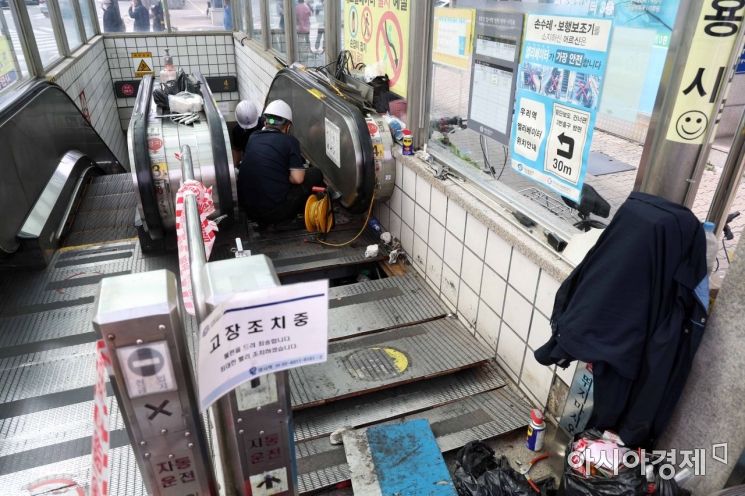 Maintenance company employees are repairing a broken escalator at Amsa Station on Seoul Metro Line 8. Photo by Moon Honam munonam@
[Asia Economy Reporter Kim Jong-hwa] Jang Soon-yi (78), who has to take the subway from Sangdo Station twice a week to go to the hospital, finds it difficult to climb the steep stairs due to her leg problems. If she walks about 500 meters from her home, she can see an escalator. Although an elevator is more convenient, she usually uses the escalator because she has to cross a street to get to the elevator. Jang complained, "The escalator stops too often and is inconvenient, and some places are still broken."
Seoul Metro stated, "We try to repair as quickly as possible, even on the same day, but if important parts need to be replaced, it inevitably takes some time," expressing their difficulty. Even if only one escalator stops, complaints flood in. Some elderly people even verbally abuse or spit at the maintenance workers during repairs. Oh Jae-won, Deputy Director of the Technical Headquarters at Seoul Metro, added, "If there is a major malfunction requiring replacement of the steps or step chains, we place an order with the contractor and have to wait for the parts to arrive before repairing, so we cannot determine how long the repair will take."
Due to flooding caused by typhoons and heavy rain in August, elevators and escalators at seven subway stations in Seoul (including overlaps) have been out of service for over a month, causing great inconvenience to subway users.
According to data submitted by Seoul Metro to Rep. Jung Woo-taek of the National Assembly’s Public Administration and Security Committee, as of the 11th, 89 escalators at 62 stations and 45 elevators at 36 stations were damaged due to flooding. Fifteen escalators at five stations and three elevators at three stations remain unrepaired. Seoul Metro announced that elevator repairs and replacements could be completed by October, and escalators by November. This means subway users will not be able to use escalators at the affected stations for another two months at the latest, until November.
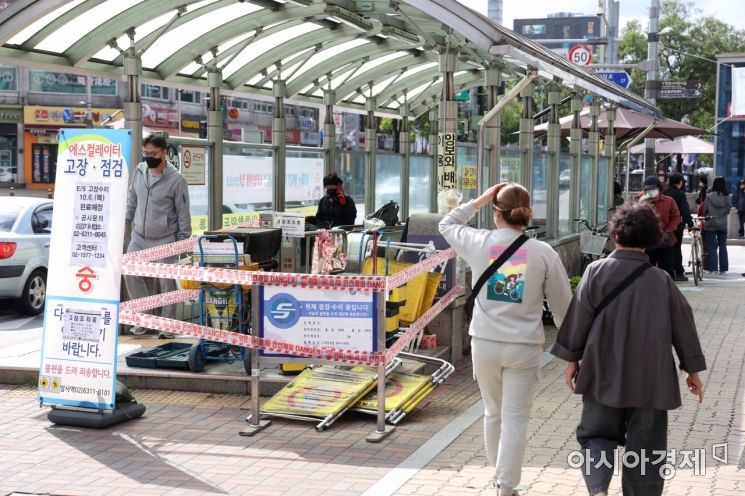 At Amsa Station on Seoul Metro Line 8, subway passengers are detouring to other exits as a broken escalator is being repaired. Photo by Mun Ho-nam munonam@
Delays in Supply and Quality Issues of Chinese-Made Escalator Parts
The main reason for the delayed escalator repairs is the unstable supply of Chinese-made parts. The root of the problem is that there are no escalator manufacturing plants in Korea. According to data received by Rep. Jung from the Korea Elevator Safety Agency, the domestic production ratio of escalators is only 32.3%.
The elevator industry, which imports, maintains, and repairs escalators, argues that even this ratio is excessively high. A representative from the Korea Elevator Industry Cooperative stated, "Escalator finished products are 100% Chinese-made," and added, "Even considering that some parts are produced by one or two companies upon order, the localization ratio should be considered close to zero."
In response, a representative from the Elevator Safety Agency rebutted, "The figures are accurate as they are based on certified data of domestically produced parts." Although finished products are not produced domestically because components such as motors, control panels, and drive chains are custom-made to escalator specifications for other industrial uses, some parts are produced domestically.
Escalator finished products are imported from China in two or three sections and assembled on-site in Korea. Since escalators require many parts proportional to operating hours and are prone to frequent breakdowns, replacement parts must be continuously supplied for maintenance. However, Chinese parts are not only difficult to supply smoothly but also have inferior quality.
Factories Moved to China, Causing Serious Time and Cost Wastage
After the International Monetary Fund (IMF) financial crisis, global companies such as Otis and ThyssenKrupp established factories in China in the early 2000s and dominated the domestic market with low-cost Chinese products. Even Hyundai Elevator, which had maintained domestic factories, completely moved its escalator parts production base to China in 2014, leaving no production bases in Korea.
Lee Ki-rang, CEO of Daeryun Ellis, recalled, "In fact, for about 20 years since the early 2000s, all parts have been imported from China," adding, "At that time, Chinese workers’ wages were about one-eighth of ours, so price competitiveness was unmatched. Hyundai Elevator, the only domestic company left, also moved its factory to China."
The domestic production ratio reaching 32.3% was also due to increased inconvenience from importing all parts from China. Lee Kyung-ryeol, CEO of Samjeong Elevator, explained, "Korean and Chinese inspection agencies do not have mutual agreements, so the KS mark and CCC mark are not recognized reciprocally. Therefore, after import, parts must be re-certified, causing serious time and cost wastage. As a result, some parts with lower costs have started to be produced domestically again."
China’s COVID Lockdowns Delay Domestic Construction Site Deliveries by Two Months
The lockdown of Shanghai, China, due to COVID-19 in April and May last year served as a wake-up call for the domestic elevator industry. When production stopped in China, domestic construction sites became chaotic. CEO Lee Ki-rang said, "Workers couldn’t go to work, and factories cut off electricity, halting production. Escalator delivery was delayed by one to two months, resulting in penalty payments. When typhoons hit, ships couldn’t sail, and factories closed for long periods during holidays or National Day, so to meet delivery deadlines domestically, all demands must be met," expressing the difficulties.
The negative effects of an industry without competition are also severe. CEO Lee Kyung-ryeol said, "Korea made a foolish mistake. Too much technology was leaked, and now that manufacturing has stopped, technology has deteriorated and must be relearned. Even now, China will increasingly demand whatever they want," diagnosing the situation. CEO Lee Ki-rang also said, "The escalator industry has a promising future, but damages due to difficulties in parts supply must be endured. Over the past 20 years of monopolizing without competitors, quality has declined and prices have soared, but there is no other way," lamenting.
According to the industry, the average price per escalator was 70 million KRW last year, rose to 80 million KRW last month, and is now quoted at 82 million KRW this month. China is also raising escalator prices due to a downturn in the construction market. Due to the US-China conflict, raw material supply has become difficult, causing raw material prices to increase by 30% this year, and costs including shipping and exchange rates have risen by 60% compared to a year ago.
Need to Protect Domestic Industry Despite Declining Price Competitiveness
Escalators, along with elevators, are vertical transportation means installed and operated in public places such as subways, department stores, and shopping malls, which are complex multi-user locations. As of the end of August, there are 32,978 escalators installed domestically. Since even a brief stoppage causes public inconvenience, experts advise that escalators should be included in the national transportation infrastructure.
Professor Kang In-gu of the Elevator Engineering Department at Korea Elevator University argued, "Although the escalator industry has declining price competitiveness, government-level management is necessary to maintain the escalator industry to protect the domestic industry." He added, "Just as large corporations operate both profitable and less profitable product lines to maintain a full lineup, the escalator industry is necessary for large corporations’ product range. If supported by government policy, the industry can continue under the pretext of supplying public convenience facilities."
Both the industry and experts agree that the ‘lowest bid system’ should be improved for the development of the elevator industry, including escalators and elevators. CEO Lee Kyung-ryeol said, "The escalator industry is an industry that must be brought back someday," adding, "It is ironic to emphasize safety while bidding at the lowest price and wanting the highest specifications." Professor Kang said, "If the government allows bidding based on price competition for public convenience facilities such as government-managed stations or subways, domestic companies cannot win. Improvement of the lowest bid system seems necessary."
© The Asia Business Daily(www.asiae.co.kr). All rights reserved.



















