Stabilization of Quarantine Indicators... COVID-19 Risk Level 'Low' for 2 Consecutive Weeks
Issue: Successive Emergence of New Omicron Variant Lineages
"New Variants Evading Immunity Emerging as Natural Infection and Vaccination Increase"
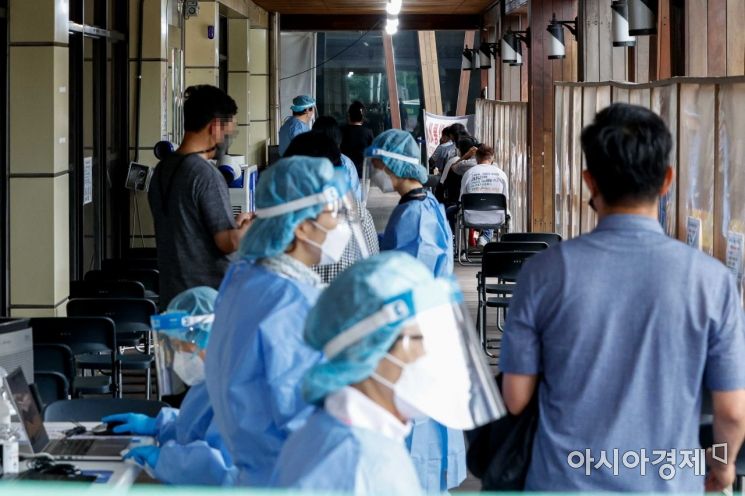 On September 14, when 93,981 new COVID-19 cases were reported, citizens visiting the screening clinic set up at Songpa-gu Public Health Center in Seoul are waiting to get tested. Photo by Jinhyung Kang aymsdream@
[Asia Economy Reporter Yoon Seul-gi] Although the transition to the COVID-19 endemic phase (where the infectious disease becomes endemic) is becoming visible, the emergence of new Omicron lineage COVID-19 variants continues, posing a variable for resurgence.
According to Seoul Metropolitan Government and other local governments, from midnight to 9 p.m. on the 5th, the number of people confirmed with COVID-19 nationwide across 17 cities and provinces was 27,679, which is 5,909 fewer than the same time the previous day (33,588). This is 2,411 fewer than a week ago on the 28th of last month (30,090) and 3,785 fewer than two weeks ago on the 21st of last month (31,464).
The COVID-19 risk level was assessed as 'low' for two consecutive weeks. The Central Disease Control Headquarters (CDCH) announced on the 5th that the weekly COVID-19 risk level for the last week (4th week of September, September 25 to October 1) was evaluated as 'low' nationwide, in the metropolitan area, and in non-metropolitan areas. Regarding the 'low' rating following the 3rd week of September (September 18 to 24), the CDCH explained, "The number of new confirmed cases, critically ill patients, and deaths is decreasing, and medical response capacity is being stably maintained."
The effective reproduction number (Rt) was 0.80, remaining below 1 for six consecutive weeks. The effective reproduction number quantifies how many people one infected person infects; a value above 1 indicates epidemic spread, while below 1 indicates epidemic suppression.
The numbers of critically ill patients and deaths also decreased. Last week, the number of new critically ill patients was 248, a 26.0% decrease compared to the previous week (335). Deaths numbered 305, down 14.8% from the previous week (358).
As various quarantine indicators show stability and the COVID-19 endemic phase accelerates, the issue remains that new Omicron lineage variants continue to emerge. The CDCH announced on the 5th that the BF.7 variant, which has been increasing globally recently, was detected 15 times domestically (7 cases locally, 8 imported cases).
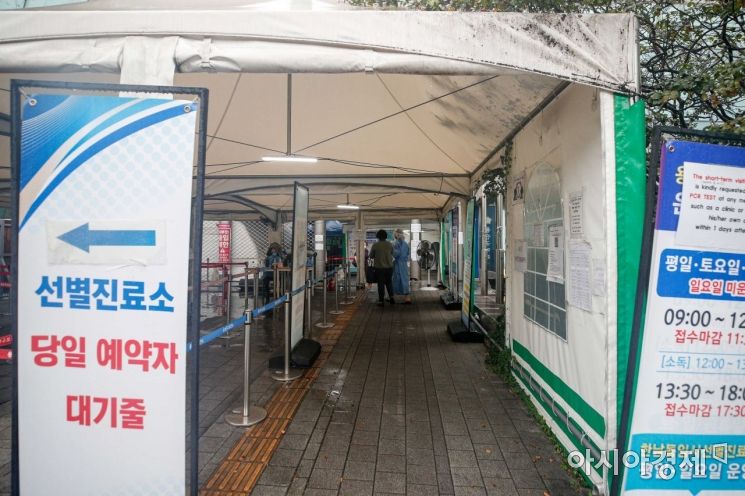 On the 3rd, the screening clinic set up at Yongsan-gu Public Health Center in Seoul showed a quiet scene as 12,150 new COVID-19 cases were reported, marking the lowest Monday count in 13 weeks. Photo by Jinhyung Kang aymsdream@
The BF.7 variant is a subvariant of BA.5, the currently dominant Omicron subvariant in Korea. Since it was recently classified, there are not many related research results, but compared to BA.5, it is understood that an additional mutation has occurred in one spike protein. Lim Sook-young, head of the CDCH Situation Management Division, stated, "We will strengthen monitoring of virus characteristic information and closely observe domestic and international occurrence status."
In some European countries, new confirmed cases are increasing due to the impact of BF.7. Lim explained, "The overseas occurrence had been decreasing for seven consecutive weeks. However, in the United States, Germany, France, and Belgium, where the BF.7 variant, a subvariant of BA.5, is spreading, recent (confirmed case) occurrences are increasing."
Previously, another new variant derived from the BA.2.75 Omicron sublineage, BA.2.75.2, was first detected on August 18 (confirmed on August 6) and has been identified 35 times domestically (3 local cases, 32 imported cases). BA.2.75.2 has three additional mutations in the spike protein compared to the BA.2.75 variant.
Experts analyze that the frequent emergence of COVID-19 variant viruses is inevitable. According to the U.S. internet media Axios, Anthony Fauci, director of the U.S. National Institute of Allergy and Infectious Diseases (NIAID), said on the 4th (local time) at the University of California Annenberg Health Journalism Center event that it would not be "strange" if a new COVID-19 virus variant emerges in winter, and it is natural to expect new variants that evade immunity from previous infection or vaccination.
However, Fauci pointed out that since COVID-19 has not been completely eradicated, vigilance should not be relaxed. He said, "I think it would be somewhat insensitive to suddenly say that COVID-19 is completely over," adding that although COVID-19 deaths have decreased in recent months, it is not yet a level to be fully reassured.
© The Asia Business Daily(www.asiae.co.kr). All rights reserved.
![Clutching a Stolen Dior Bag, Saying "I Hate Being Poor but Real"... The Grotesque Con of a "Human Knockoff" [Slate]](https://cwcontent.asiae.co.kr/asiaresize/183/2026021902243444107_1771435474.jpg)
















