Sharp Reactions Emerge from the White House... Spokesperson: "Saudi Arabia Has Sided with Russia"
Biden Signals Push for NOPEC Law Providing Grounds to Sue OPEC for Market Collusion
Announces Plan to Release 10 Million Barrels from Strategic Reserves... Also Eases Sanctions on Venezuela
[Asia Economy Reporter Park Byung-hee] On the 5th (local time), the Organization of the Petroleum Exporting Countries Plus (OPEC+) decided on a massive oil production cut of 2 million barrels per day, contrary to the wishes of the United States, which is expected to worsen the relationship between the U.S. and Saudi Arabia to its worst state.
U.S. President Joe Biden visited Saudi Arabia in July, humbling his pride to request an increase in production, but this production cut decision means that Saudi Arabia, the leader of OPEC, completely ignored President Biden's request. With the midterm elections approaching in November and price stability being the top priority, President Biden’s reputation has also been damaged.
Saudi Arabia Ignores Biden’s Humiliating Diplomacy
The traditionally allied relationship between the U.S. and Saudi Arabia fractured after the assassination of Saudi journalist Jamal Khashoggi in August 2018. President Biden distanced himself from Saudi Arabia citing the Khashoggi incident, but as oil prices surged and inflation worsened, he humbled his pride and visited Saudi Arabia for the first time since taking office in July to request increased production. At that time, Biden’s humiliating diplomacy sparked controversy.
After his visit, President Biden mentioned, "I am looking forward to what will happen in the coming months," but OPEC+ instead began cutting production last month, wounding Biden’s pride.
The White House reportedly pressured oil-producing countries through various channels to prevent the production cut ahead of the OPEC+ meeting. Economic media CNBC cited sources saying the Biden administration made every effort to persuade oil-producing countries to oppose the cuts, but ultimately, the White House’s demands were completely ignored.
Foreign media analyze that this OPEC+ production cut decision will further widen the rift between the U.S. and Saudi Arabia. The British financial newspaper Financial Times assessed that this decision will be a significant turning point in the 75-year energy alliance between the U.S. and Saudi Arabia.
The White House’s response after the production cut decision revealed the U.S. government’s resentment toward Saudi Arabia. On the same day, National Security Advisor Jake Sullivan and National Economic Council (NEC) Chairman Brian Deese issued a joint statement saying, "The President is disappointed by OPEC+’s short-sighted production cut decision, which comes as the global economy is responding to the negative impacts of Putin’s invasion of Ukraine." White House spokesperson Jen Psaki harshly criticized Saudi Arabia for siding with Russia.
There are also criticisms that Saudi Arabia undermined Western efforts to cut off funding for Russia’s war in Ukraine. The massive production cut decision by OPEC+ was announced right after the European Union (EU) agreed on the 8th round of sanctions against Russia, which includes a price cap on Russian oil. The U.S. New York Times (NYT) evaluated, "OPEC and Russia’s production cuts will deal a blow to the West."·
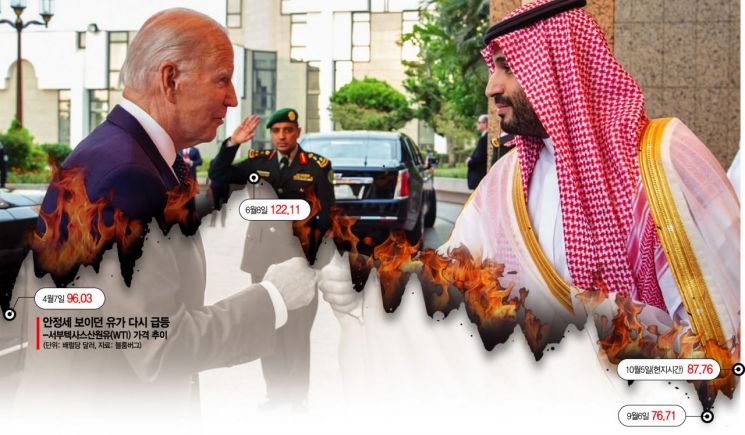 U.S. President Joe Biden met with Crown Prince Mohammed bin Salman, the de facto ruler of Saudi Arabia, at Al Salman Palace in Jeddah, Saudi Arabia, on July 15 (local time), exchanging fist bumps. Biden, who had distanced himself from Saudi Arabia due to the Jamal Khashoggi assassination case, visited Saudi Arabia for the first time since taking office and requested an increase in oil production to address inflation.
 Jeddah (Saudi Arabia) = UPI·Yonhap News
Will the U.S. Move to Check OPEC+ Collusion?
President Biden also issued a statement expressing his intention to work with Congress to weaken OPEC’s control over energy prices. This is interpreted as a willingness to push forward the ‘No Oil Producing and Exporting Cartels Act (NOPEC)’ bill, known as the anti-OPEC legislation. The NOPEC bill reportedly includes provisions allowing the U.S. government to sue OPEC member countries for manipulating the energy market.
Bill Farren-Price, an analyst at consulting firm Enverus, pointed out, "Saudi Arabia’s founding of OPEC itself signifies a clash with the free world." He added, "Saudi Arabia sided with Russia under the pretext of protecting control over the oil market, but for consumers worldwide, it only means a fierce battle against inflation and living costs," and warned, "There will be political consequences for Saudi Arabia."
Following the EU agreement, there is also speculation that the Russian oil price cap could be extended to other OPEC+ member countries in the future.
U.S. Releases Strategic Reserves... Also Eases Sanctions on Venezuela
Since oil price fluctuations could negatively impact the midterm elections on November 8, the U.S. government is expected to take active measures. The U.S. government immediately announced plans to release 10 million barrels from the Strategic Petroleum Reserve. Just a day earlier, spokesperson Psaki had said, "We are not considering releasing strategic reserves," but the position was abruptly reversed.
The Wall Street Journal reported that the U.S. government plans to ease sanctions on Venezuela in response to OPEC+’s massive production cut. As a result, U.S. refiner Chevron is expected to resume oil production in Venezuela. This opens the way for Venezuelan oil to be exported again to the U.S. and Europe.
Venezuela was one of the major oil-producing countries with daily production exceeding 3.2 million barrels in the 1990s. However, due to a decade of underinvestment, corruption, and operational failures, Venezuela’s oil industry is now on the brink of collapse. Currently, Venezuela’s daily oil exports are reportedly only about 450,000 barrels.
Therefore, while easing sanctions on Venezuela may provide psychological stability to the oil market, it is analyzed that it will not significantly help increase production. The details of the agreement between the U.S. and Venezuela are expected to be clarified later this month.
© The Asia Business Daily(www.asiae.co.kr). All rights reserved.
![Clutching a Stolen Dior Bag, Saying "I Hate Being Poor but Real"... The Grotesque Con of a "Human Knockoff" [Slate]](https://cwcontent.asiae.co.kr/asiaresize/183/2026021902243444107_1771435474.jpg)
















