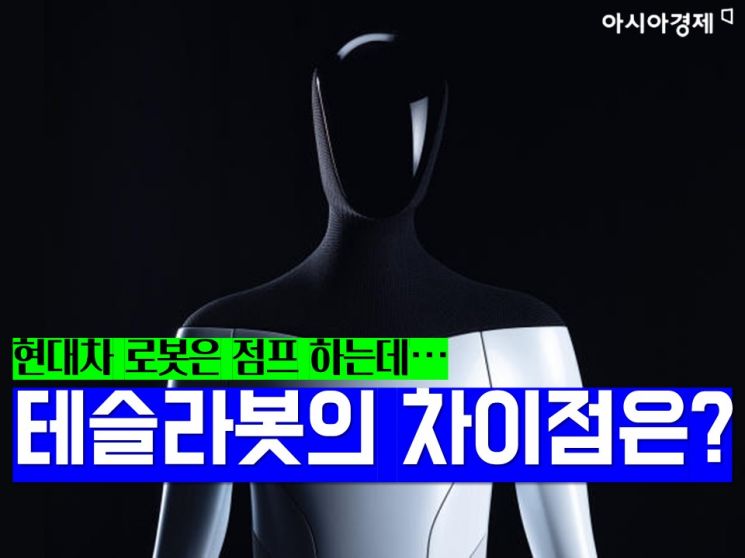
 Tesla's humanoid robot 'Optimus,' unveiled in the United States on the 30th of last month (local time), is being compared to Boston Dynamics' 'Atlas,' which is under Hyundai Motor Group. / Photo by Song Hyundo, Asia Economy intern reporter
[Asia Economy Reporter Lim Juhyung, Intern Reporter Song Hyundo] Tesla's humanoid robot 'Optimus,' unveiled on the 30th of last month (local time), has drawn criticism among some netizens. Optimus's movements have been pointed out as slower compared to 'Atlas,' a robot developed by Boston Dynamics under Hyundai Motor Group. While Optimus was limited to walking around the event venue, Atlas demonstrated running and jumping motions back in 2018. So, is Tesla's robot technology really lagging behind Boston Dynamics?
Optimus was first revealed at Tesla's headquarters in Palo Alto, California, during the 'AI Day' event on the 30th of last month. Tesla showcased Optimus's walking motion, heavy object lifting, and pathfinding AI, demonstrating its robotics capabilities. Nani Cook, a professor of robotics at Arizona State University, told the U.S. economic media outlet CNBC, "Walking and dancing motions are tasks that have already been completed before. It's not very impressive." Similarly, skeptical reactions emerged domestically, such as "The robot seems sluggish," and "It doesn't seem to meet the level of completion that was boastfully claimed."
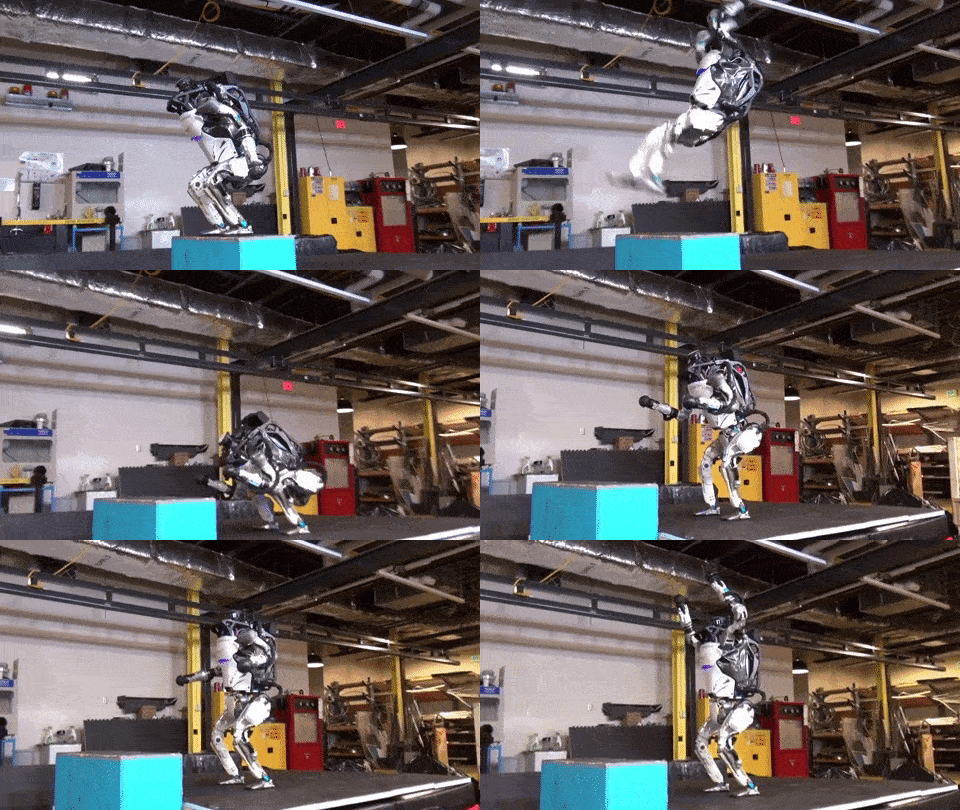 Humanoid robot Atlas from Boston Dynamics, a subsidiary of Hyundai Motor Company, performing advanced movements / Source=Boston Dynamics YouTube
Atlas, the humanoid robot developed by Boston Dynamics under Hyundai Motor Group, also drew renewed attention. Atlas, which has a similar shape and size to Optimus, had already successfully demonstrated running, jumping, obstacle overcoming, and parkour through its YouTube channel in 2018. This is why there is suspicion that Tesla's robotics technology is at least four years behind Atlas.
However, it is difficult to hastily conclude that Atlas is clearly a superior robot to Optimus. This is because the two robots have different development environments and concepts.
Laboring Robot Optimus vs Athletic Robot Atlas
The difference between Optimus and Atlas starts with their weight. Optimus stands 170cm tall and weighs 73kg. Atlas is about 20cm shorter at 150cm but weighs much more at 89kg. The relatively high weight of Atlas compared to its size is due to its heavier battery. Atlas is equipped with a large-capacity 3.7kWh battery, whereas Optimus carries a relatively smaller 2.3kWh battery.
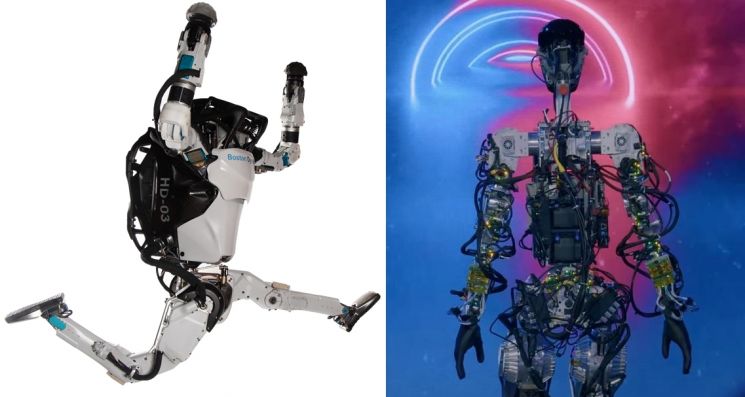
Atlas also consumes much more power than Optimus. It can operate for one hour at maximum charge. Tesla claims that Optimus can operate for 8 hours on a single charge.
The agile and flexible movements of a robot come from the power supporting its joints. Atlas is equipped with powerful hydraulic motors in its leg joints, providing a level of power far beyond other humanoid robots. This results in high power consumption but makes it suitable for various motions such as jumping, running, and dancing.
On the other hand, Optimus uses electric actuators (motors that rotate in a specific direction upon receiving electrical signals) derived from Tesla electric vehicles in its joints. Although the force is much weaker than hydraulic systems, it offers higher endurance and greater efficiency. In fact, the output is very impressive for an actuator, capable of lifting a grand piano weighing several hundred kilograms.
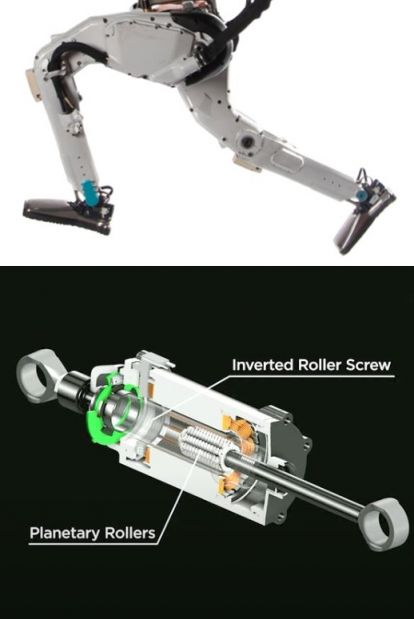 Hydraulic system (above) enhancing Atlas's output and actuators mounted on Optimus joints. / Photo by Boston Dynamics homepage, Tesla YouTube capture
These differences stem from the development concepts of the two robots. Optimus is a robot designed to replace laborers. Therefore, success is measured by repetitive task performance, pathfinding in dense terrains, and delicate hand movements. Conversely, according to Boston Dynamics' official website, Atlas is a research platform "aimed at pushing the limits of human body mobility," focusing all efforts primarily on leg movements above all else.
Optimus is Mass-Produced, Atlas is a Research Platform
The development environment is also a factor that creates differences between the two robots. CEO Musk announced that the retail price of Optimus would be set at $20,000 (approximately 28.4 million KRW). Therefore, all parts of Optimus are made from off-the-shelf components suitable for mass production. For example, the actuators in the finger and knee joints are derived from Tesla's existing vehicle parts, and the head is equipped with the same computer chip used in Tesla vehicles. The pathfinding AI was redesigned from the autonomous driving software 'FSD.'
In contrast, Atlas is a pure research project that applies only the best technology without considering mass production. Regarding this, Boston Dynamics emphasized in an essay posted on its blog that "it would be difficult to prove commercial applications for a robot performing backflips," and "Atlas is a research platform, not a product."
Tesla also emphasizes the 'practicality' rather than the 'performance' of Optimus. CEO Musk said, "Since the robot is a prototype, there are many problems to solve," but added, "Optimus is equipped with AI, can receive human instructions, and solve problems." He continued, "Optimus will be mass-produced and available for purchase at $20,000 within 3 to 5 years," emphasizing, "An era is coming when you can order a robot workforce at less than a third of the price of an electric car."
© The Asia Business Daily(www.asiae.co.kr). All rights reserved.



















