'Jeonaek Management System' Implemented for 2 Years 9 Months... Seoul City Survey Shows 90.8% of Transport Operators and 64.7% of Workers Oppose
69% of Taxi Companies and Only 36% of Taxi Drivers Participated in Survey
Preference for Incentive Wage Structure over Lease System and Fixed Fees
[Asia Economy Reporter Lim Cheol-young] The Seoul Metropolitan Government is set to improve the so-called 'monthly salary system,' introduced in 2020 to provide taxi drivers with stable wages, by establishing a wage structure that allows drivers to fully retain excess earnings. Since the implementation of the monthly salary system in 2020, both corporate taxi drivers and taxi companies have expressed dissatisfaction, with particular concern that this system is a major factor driving corporate taxi drivers away from the taxi industry.
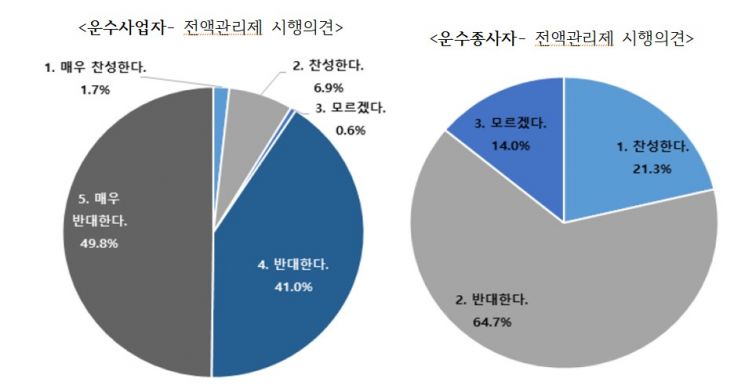
On the 5th, Seoul City announced the results of the 'Full Management System Implementation Survey,' revealing that about 91% of transportation operators and 64% of transportation workers oppose the full management system. The full management system has been in effect since January 2020, introduced alongside the monthly salary system. However, after approximately two years and nine months of implementation, it was found that indirect costs such as the four major insurances increased and real income decreased due to taxation. Seoul City claims this has led to about 10,000 corporate taxi drivers quitting, resulting in a shortage of taxis.
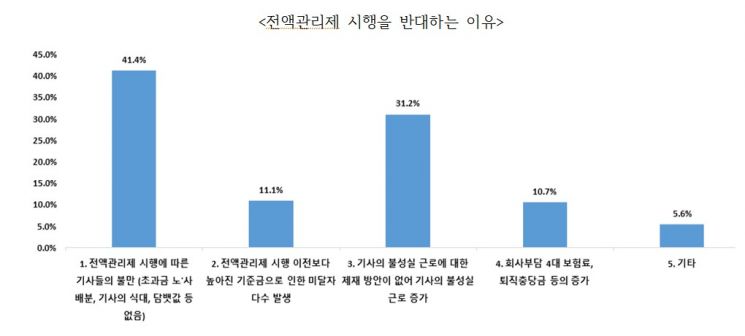
The full management system is limited to corporate taxis and prohibits corporate taxi companies (drivers) from collecting (paying) the entire transportation revenue on the day of work and from setting a fixed amount based on transportation revenue for collection (payment). Seoul City explained, "Contrary to the initial intent, both workers and operators have experienced a decrease in real income," adding, "Complaints from workers have increased due to the higher standard amount compared to the previous deposit system, leading to decreased motivation for diligent work, downward leveling of transportation revenue, difficulties in preventing insincere work, and resulting labor-management conflicts."
The survey was conducted in September among 254 corporate taxi companies and 20,397 workers in Seoul, with responses from 175 companies (68.9%) and 7,414 workers (36.3%). According to the survey, 60% of taxi companies are implementing the full management system, and among respondents, 90.8% (159 companies) of transportation operators (taxi companies) and 64.7% (4,797 workers) of workers expressed opposition to the full management system.
Reasons for opposing the full management system included, for taxi companies, drivers' complaints about changes in income, standard amounts, and indirect cost burdens after implementation, as well as an increase in insincere work. Taxi drivers cited the distribution of excess earnings between labor and management, high standard amounts, and increased indirect costs as reasons for opposition.
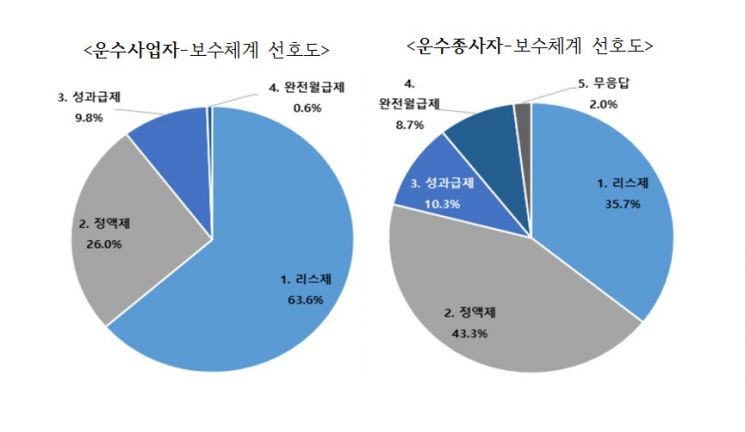
Additionally, in response to the survey question, "Regardless of support or opposition to the full management system, what do you think is the appropriate compensation system to attract manpower?" transportation operators ranked the 'lease system' first and the 'deposit system' second. Workers ranked the 'deposit system' first and the 'lease system' second. Among transportation operators, 89.6% preferred the lease system and fixed amount system (deposit system), while 79% of transportation workers preferred the fixed amount system (deposit system) and lease system. Operators favored the lease system and fixed amount system (deposit system) to increase manpower inflow, whereas transportation workers preferred the fixed amount system (deposit system) and lease system to increase performance-based income.
In response, Seoul City judged that it is necessary to establish a wage structure with various compensation systems suited to the realities of the taxi industry, allowing drivers to fully receive incentives earned through diligent work. The city plans to propose improvements to the full management system to the Ministry of Land, Infrastructure and Transport. Seo In-seok, head of the Seoul Taxi Policy Division, stated, "Following the Ministry of Land, Infrastructure and Transport's recent announcement to form a consultative body to review measures such as the lease system for corporate taxis limited to late-night hours and improvements to the full management system to alleviate the late-night taxi shortage, Seoul City also plans to actively participate in the consultative body and submit opinions."
© The Asia Business Daily(www.asiae.co.kr). All rights reserved.
![Clutching a Stolen Dior Bag, Saying "I Hate Being Poor but Real"... The Grotesque Con of a "Human Knockoff" [Slate]](https://cwcontent.asiae.co.kr/asiaresize/183/2026021902243444107_1771435474.jpg)

















