Second Highest Death Toll
Fan Club Called 'Mania'
78 Deaths So Far Due to Aggressive Cheering Culture
Police Overreaction Using Tear Gas Against Regulations
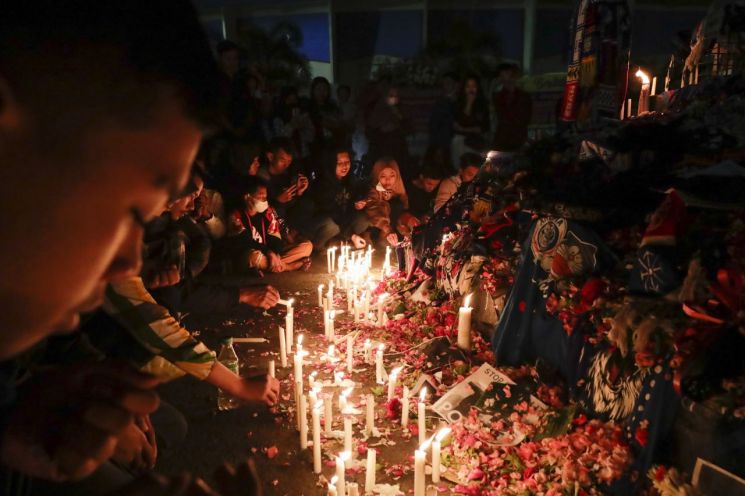 Residents are gathering around Kanjuruhan Stadium in Malang, East Java, Indonesia, where the tragedy occurred, lighting candles to mourn the victims of the accident.
 [Image source=Yonhap News]
[Asia Economy Intern Reporter Kim Gun-chan] A tragedy occurred at an Indonesian soccer stadium where a large number of deaths resulted from fans storming the field. The causes of the disaster are attributed to the aggressive cheering culture of soccer fan clubs and excessive police suppression. The death toll from this incident is reported to be the second highest in history, and similar stadium disasters have frequently occurred in the past.
On the 1st (local time), a tragedy occurred at an Indonesian professional soccer stadium where 125 people died due to fans storming the field. According to Antara News Agency and the daily Kompas on the 3rd, the death toll was confirmed to be 125, with more than 320 injured. Among the 125 deceased were 17 children.
The incident took place around 10 p.m. after a match between Arema FC and Persebaya Surabaya in the Indonesian professional soccer first division league (BRI Liga 1) at the Kanjuruhan Stadium in Malang Regency, East Java, Indonesia.
When the home team Arema FC lost 2-3 to the visiting team Persebaya Surabaya for the first time in 23 years, some angry spectators stormed the field to protest to the players and team officials. The police responded by firing tear gas to suppress the crowd packed inside the stadium. Thousands of spectators rushed toward the exits to escape, causing a crush that led to a large-scale fatal accident.
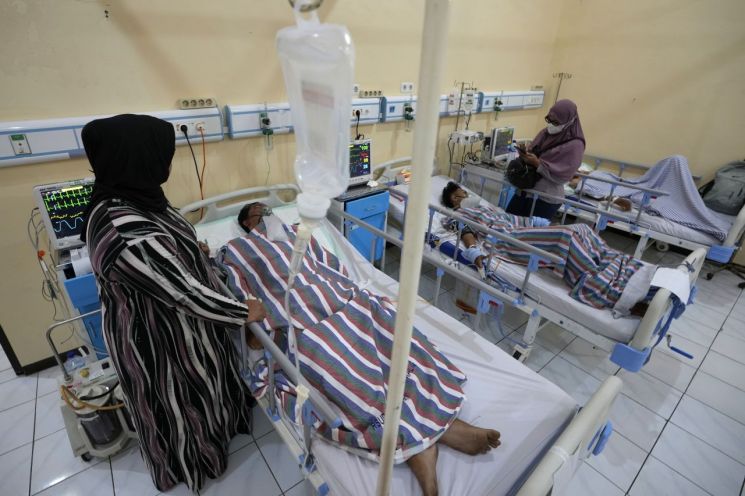 Victims of the Indonesian stadium disaster are receiving treatment at a hospital in Malang, East Java, on the 3rd (local time). [Image source=Yonhap News]
Analysis suggests that this tragedy is related to the aggressive cheering culture of Indonesian professional soccer fans. According to footage from the day of the accident on the 1st, spectators climbed over iron fences set up in the stands and poured into the stadium, throwing objects resembling fireworks at the police trying to stop them. Police vehicles stationed inside and outside the stadium were also set on fire. It is reported that at least two police officers who were trying to stop the protesters were among the deceased.
The 18 teams in Indonesia’s professional soccer first division league, Liga 1, are known to have fanatic fan clubs called "mania." A representative example is the fan club "Jakmania" of Persija Jakarta, a soccer club based in the capital city Jakarta.
The cheering culture of these fan clubs called "mania" is known to be rough. They actually fire flares during matches and throw water bottles or stones at opposing players when their supported team is at a disadvantage. During matches between regional rivals, clashes between the two teams’ cheering squads sometimes result in bloodshed. In 2019, a fatal incident occurred when home fans of Persib Bandung, based in Bandung, collectively assaulted visiting fans.
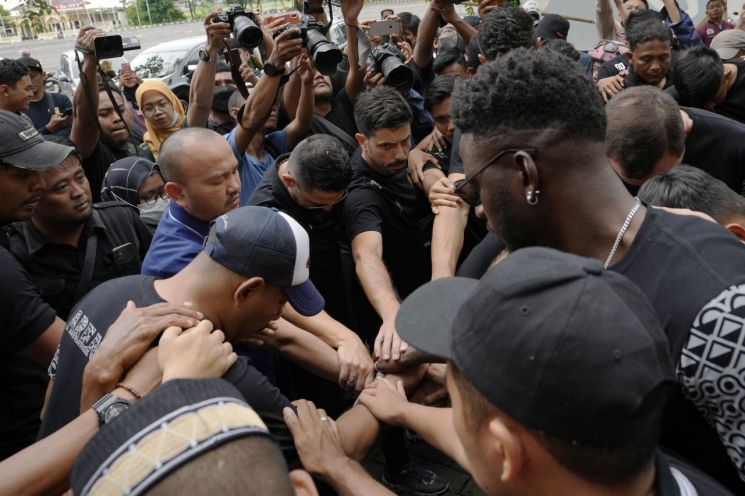 Fans and officials of Indonesian football club Arema FC are paying tribute to the victims of the Kanjuruhan Stadium disaster on the 3rd (local time) in Malang Regency, East Java.
 [Image source=Yonhap News]
The Indonesian Football Association and police prohibit visiting team supporters from entering during matches between regional rivals and deploy riot police and suppression vehicles at major games to prevent accidents inside stadiums. In the match where this tragedy occurred, the visiting team Persebaya Surabaya’s supporters were banned from entry, and riot police were deployed.
According to the NGO "Save Our Soccer (SOS)," which campaigns for the improvement of soccer culture in Indonesia, since the professional league began in 1994, 78 people had died due to this kind of aggressive soccer cheering culture before this recent tragedy.
Some critics argue that the police violated FIFA regulations by using tear gas and engaging in excessive suppression, which led to the large-scale accident. According to Article 19 of FIFA’s "Stadium Safety and Security Regulations," police may be deployed inside and around stadiums to protect players and officials and maintain public order. However, possession or use of "crowd control gas" such as firearms or tear gas is prohibited.
The death toll of this stadium disaster is understood to be the second highest in history. Similar stadium tragedies have occurred multiple times in the past.
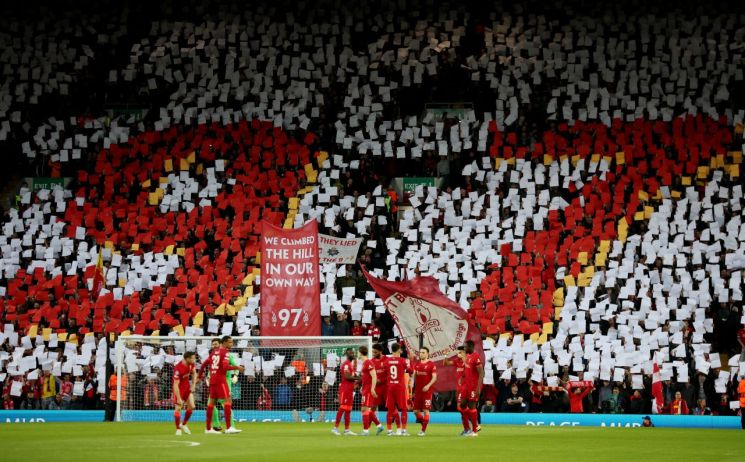 Liverpool fans hold a banner commemorating the Hillsborough disaster, where 97 people were crushed to death at the home stadium Anfield last April.
 [Image source=Reuters Yonhap News]
The deadliest incident occurred in 1964 at the National Stadium in Lima, Peru, during the 1964 Tokyo Olympic qualifying match between Peru and Argentina. Peru, trailing 0-1, scored a dramatic equalizer just before the end of the match, but the referee disallowed the goal. Enraged Peruvian spectators stormed the stadium, resulting in about 320 deaths and over 1,000 injuries.
A well-known stadium disaster in the soccer world is the "Hillsborough Disaster." In 1989, a tragedy occurred at Hillsborough Stadium in Sheffield, England. During the FA Cup semi-final between Liverpool and Nottingham Forest, an excessive crowd caused 97 Liverpool fans trapped between metal barriers and the crowd to be crushed to death, with over 700 injured.
More recently, in January, during the Africa Cup of Nations round of 16, when Cameroon defeated Comoros 2-1 to advance to the quarterfinals, excited fans rushed into the stadium, resulting in 6 deaths and dozens injured.
© The Asia Business Daily(www.asiae.co.kr). All rights reserved.
![Clutching a Stolen Dior Bag, Saying "I Hate Being Poor but Real"... The Grotesque Con of a "Human Knockoff" [Slate]](https://cwcontent.asiae.co.kr/asiaresize/183/2026021902243444107_1771435474.jpg)

















