The government has decided to lift the designation of regulated areas for all local regions except Sejong City, resulting in Gwangju Metropolitan City also being removed from the list of regulated areas. Consequently, expectations are rising that the housing market in Gwangju will become more active.
According to the results of the Residential Policy Deliberation Committee announced by the government on the 21st, a total of 41 areas, including some parts of the metropolitan area, the five major metropolitan cities of Busan, Daegu, Gwangju, Daejeon, and Ulsan, as well as Cheongju in Chungbuk, Cheonan, Nonsan, and Gongju in Chungnam, and Jeonju in Jeonbuk, were removed from the regulated areas.
The industry predicts that the lifting of the regulated area designation will serve as a turning point, leading to an active influx of demand in the housing market. This is because regulations on loans, taxes, and other aspects have been eased, allowing not only genuine buyers but also outside investors to enter the market.
When an area becomes non-regulated, buyers can receive loans up to 70% LTV and 60% DTI when purchasing a house, and the burden of various taxes such as acquisition tax and comprehensive real estate tax is reduced. Furthermore, in non-regulated areas, multi-homeowners are not subject to the increased capital gains tax rates. In regulated areas, owners of two homes face a 20% surcharge on the basic tax rate, and owners of three homes face a 30% surcharge, but in non-regulated areas, no surcharge rates apply, and only the basic tax rate of 6-45% on capital gains is applied.
An industry official stated, “We expect an active influx of demand in the Gwangju housing market following the lifting of the regulated area designation,” adding, “Especially since Gwangju recorded a rise in housing prices this year unlike other metropolitan cities, it is expected to quickly regain vitality.”
The ‘Rapent Hill’ complex, located in Wolgye-dong, Gwangju Metropolitan City, will benefit from the non-regulated premium following Gwangju’s removal from the regulated area list. The complex will consist of two buildings ranging from three basement floors to 22 above-ground floors, with a total of 72 units sized between 201 and 244 square meters. The construction company is Hyundai Engineering & Construction.
Notably, ‘Rapent Hill’ offers a benefit of interest-free interim payments, alleviating concerns about rising interest rates. Since the project owner pays the interest on interim loans on behalf of the contract holders, buyers bear no interest burden and can reduce their housing purchase costs by the amount of interest. Additionally, balcony expansion costs are included in the sale price, resulting in relatively fewer additional expenses.
The complex is also attracting attention from asset owners due to its high future value. The Gwangju Cheomdan District, where the complex is located, is transforming into a trendy area with the emergence of well-known brand stores such as ‘Our Bakery’ and ‘Lounge OIC,’ and the supply of ‘Rapent Hill’ is expected to mark the beginning of its transformation into a new affluent neighborhood.
Significant development benefits are also ongoing. A new station on Gwangju Urban Railway Line 2 is scheduled to open near the complex, and a research and industrial complex centered on an AI-based science and technology startup cluster is planned within the nearby Cheomdan 3 District, promising additional benefits as a hinterland complex.
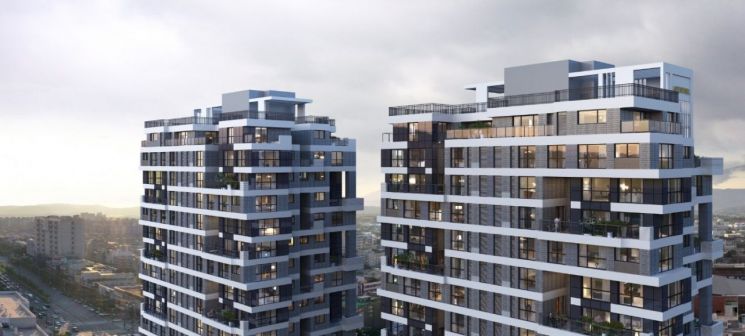
The interior and exterior of the complex are planned to enhance everyday aesthetics through sophisticated design and interior decoration. The tall twin towers have a substantial presence, and the luxurious curtain wall facade and protruding terrace design boast a three-dimensional and aesthetic exterior.
The interior will feature refined imported furniture typically seen only in luxury homes or hotels. Renowned European furniture brand Febal Casa, Italian sanitary brand Gessi, Italian hood brand Elica, Swiss AXENT, German Duravit, and American Standard from the U.S. are among the famous overseas brands to be installed.
‘Rapent Hill’ offers a private yet spacious lifestyle. Elevators are allocated per line for private use, and each unit has a dedicated elevator hall, allowing residents to live securely in their own space. The interior layout respects privacy by separating the flow between private spaces (bedrooms) and common areas (living room, kitchen) with a modern floor plan.
‘Rapent Hill’ plans to open a private lounge, different from typical model houses, in October and will operate by appointment only.
© The Asia Business Daily(www.asiae.co.kr). All rights reserved.

















