Analysis of Catches from Jeju Coastal Waters 2012-2021
Increased Frequency of Subtropical Fish Species Appearance
"Impact of Rising Water Temperatures Due to Climate Change"
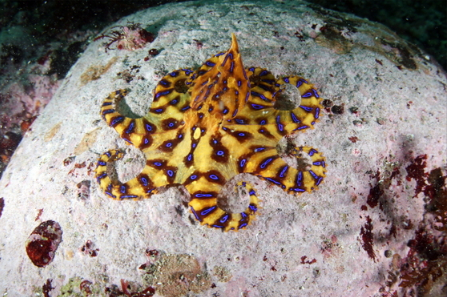 As the sea temperature in Korea rises due to climate change, the frequency of subtropical fish species appearing has increased. The photo shows a blue-ringed octopus, a highly venomous marine creature. [Image source=National Institute of Fisheries Science]
[Asia Economy Reporter Hwang Sumi] The frequency of subtropical fish species appearing in domestic seas is on the rise. This is analyzed to be an effect of rising sea temperatures due to climate change.
According to Yonhap News on the 2nd, the National Institute of Fisheries Science (NIFS) analyzed catches caught using traps and gillnets in the waters around Jeju from 2012 to 2021. This was conducted to understand the occurrence of subtropical fish species along the Jeju coast.
As a result, over 10 years, 177 species and 25,446 individual fish were caught along the Jeju coast. Among them, subtropical fish accounted for 42% (74 species, 100,266 individuals). By species, there were pumpkinseed fish (hobakdom), long-spined porcupinefish (dokgasichi), yellowtail rockfish (hwangnollaegi), longtail snapper (ginkkori beng-e-dom), striped beakfish (gangdamdom), soxgam-peng, blue-striped sea bream (cheongjuldom), benjari, spotted yellowtail rockfish (mujeomhwangnollaegi), golden-striped tentacle (geumjulchoksu), two-striped tentacle (dujulchoksu), and striped sea bream (beomdom), among others.
By year, the number of subtropical species appearing was highest at 35 species in 2013, 2019, and 2020. In particular, in 2020, the proportion of subtropical fish among the total fish caught reached 47%, marking the highest recorded level.
The reason for the recent increase in subtropical fish species in Korean waters is attributed to the rise in sea temperatures caused by climate change. According to the NIFS report, the surface water temperature in Korea rose by 1.35 degrees Celsius over 54 years from 1968 to 2021. Compared to the global average sea temperature increase of 0.52 degrees during the same period, this is 2.5 times higher.
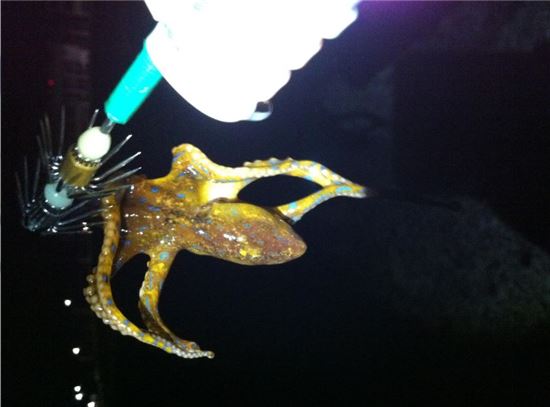 As the sea temperature in Korea rises due to climate change, the frequency of subtropical fish species appearing has been increasing.
 [Image source=National Institute of Fisheries Science Subtropical Fisheries Research Center]
NIFS expects that sea temperatures in Korean waters will continue to rise until 2100. Accordingly, the occurrence rate of subtropical fish species along the southern sea, East Sea, and the coast near Dokdo is also expected to gradually increase, NIFS forecasted.
In fact, subtropical species are appearing in areas other than Jeju as well. According to NIFS, an experiment conducted at Geumodo Island, Yeosu, Jeollanam-do, showed that only 5 subtropical species were recorded between 2008 and 2015. However, by 2021, this number had increased to 13 species.
The appearance of highly venomous marine organisms native to the subtropical South Pacific Ocean is also increasing. A representative example is the blue-ringed octopus, which possesses venom more than 10 times stronger than cyanide. First discovered in northern Jeju in 2012, its range has expanded to the southern coast of the South Sea and the southern coast of the East Sea. Reports have been received of 9 individuals found in Jeju, 4 in Busan, 2 in Ulsan, and 1 in Yeosu, Jeollanam-do, up to last year. On the 13th of last month, it was also spotted on the rocky shore of Soesokkak in Seogwipo City. Additionally, the highly venomous broad-banded sea snake was first captured off the coast of Seogwipo, Jeju, in 2017.
© The Asia Business Daily(www.asiae.co.kr). All rights reserved.
















