Private Insurance Including Automobiles Applies Differently According to Risk
Assemblyman Yu Kyung-jun: "Guarantee Rates Should Be Set Proportionally to Risk"
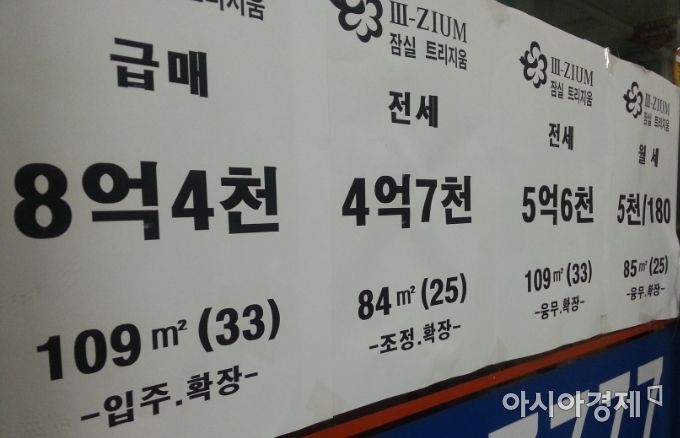 Tenants' anxiety is increasing due to "Kkangtong Jeonse." Jeonse deposit insurance is a product that can alleviate tenants' worries about losing their Jeonse deposit. The photo shows a real estate listing posted at an agency in Jamsil, Seoul. Photo by XXX
As the number of 'empty-can jeonse' cases?where the jeonse deposit approaches the sale price of the house?increases, claims have been raised that low-risk subscribers are excessively bearing the losses caused by high-risk subscribers who have signed up for the jeonse deposit return guarantee. There are calls to adjust the insurance premium rates according to the level of risk.
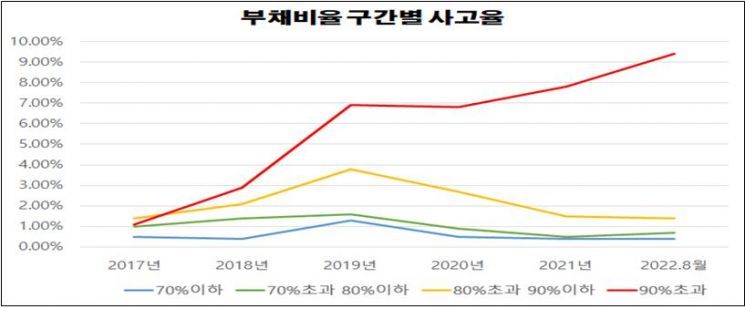
On the 2nd, Yook Kyung-joon, a member of the People Power Party, analyzed data on 'Jeonse Deposit Guarantee Subscriptions and Accident Status by Debt Ratio Range' submitted by the Housing and Urban Guarantee Corporation (HUG), revealing that about 30% of the houses subscribed to the jeonse deposit return guarantee are at risk of empty-can jeonse with a debt ratio exceeding 90%.
The proportion of houses with a debt ratio exceeding 90% among HUG's jeonse deposit guarantee subscriptions has gradually increased from 17% in 2018 to 18.4% in 2019, 22.4% in 2020, and 26.3% in 2021.
Looking at the accident rates by debt ratio, the rates were only 0.4% for debt ratios below 70%, 0.7% for 70-80%, and 1.4% for 80-90%, but the accident rate for high-risk empty-can jeonse houses (debt ratio over 90%) was 9.4%, which is at least 7 times and up to 24 times higher than other ranges.
The problem is that there is almost no difference in the guarantee premium rates according to the debt ratio, resulting in a situation where low-risk subscribers bear the losses caused by high-risk subscribers.
In the general private insurance industry, insurance premiums vary according to the level of risk. For example, in automobile insurance, premiums increase with more traffic violations or accidents, while discounts are given for long accident-free periods or low mileage.
Under such systems, the difference in discount and surcharge application can be as much as 162%.
In contrast, HUG's jeonse deposit return guarantee premium rates range from a minimum of 0.115% to a maximum of 0.154% per year depending on housing type and debt ratio, with the difference according to debt ratio being only 0.013 to 0.015 percentage points.
As the number of high-risk empty-can jeonse houses increases, the number of guarantee accidents has also risen, causing the amount HUG has paid in subrogation to increase from 3.4 billion KRW in 2017 to 504 billion KRW in 2021, and it is expected to reach 602 billion KRW this year.
Accordingly, HUG's guarantee operation multiplier, which indicates financial soundness, is expected to exceed the legal guarantee limit of 60 times in 2024, reaching 64.6 times,
raising concerns that subscriptions to the 'jeonse deposit return guarantee' may be suspended.
Representative Yook Kyung-joon said, "In the serious situation where HUG's jeonse deposit return guarantee subscriptions may be suspended, establishing a stable guarantee operation base is essential to resolve this. Setting premium rates proportional to the risk according to the debt ratio could be one of the methods."
© The Asia Business Daily(www.asiae.co.kr). All rights reserved.
![Clutching a Stolen Dior Bag, Saying "I Hate Being Poor but Real"... The Grotesque Con of a "Human Knockoff" [Slate]](https://cwcontent.asiae.co.kr/asiaresize/183/2026021902243444107_1771435474.jpg)

















