Need for Establishing Minimum Seat Size Standards for US Aircraft Raised
Consumer Groups and Experts Warn of Potential Health Risks from Cramped Spaces
Airline Industry Opposes, Citing Concerns Over Fare Increases
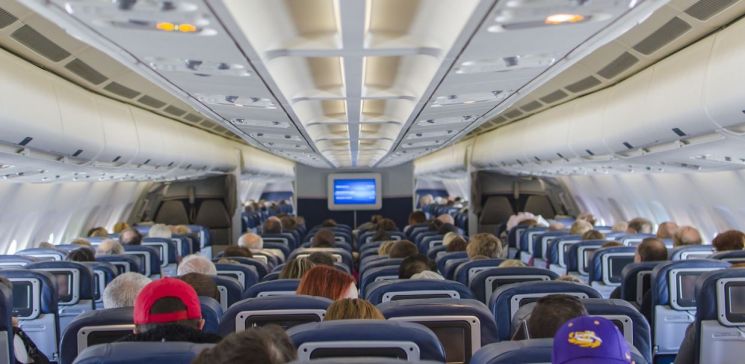 There appears to be a movement in the United States to establish new standards for aircraft seat sizes. The photo is not related to any specific expression in the article. [Image source=Pixabay]
[Asia Economy Reporter Hwang Sumi] There appears to be a movement in the United States to establish new standards regarding aircraft seat sizes. Some voices have raised concerns that such measures could potentially lead to increased airfares.
According to the Washington Post (WP) on the 1st (local time), the U.S. Federal Aviation Administration (FAA) stated that it is considering such measures with the safety and health of aircraft passengers in mind.
Until now, the FAA has not set a minimum standard for airplane seat sizes. The reasoning was that as long as evacuation in an emergency does not take more than 90 seconds regardless of seat size, there is no problem, and discomfort caused by narrow seats is merely a matter between airlines and customers.
However, recently consumer groups and health experts have demanded that the FAA establish seat size standards. They argue that there are potential health risks when passengers sit in cramped spaces for extended periods, and it is inappropriate for the FAA to ignore this.
Mika Endsley, Government Relations Manager at the Human Factors and Ergonomics Society, pointed out, "Safety during normal flight operations is important," adding, "Sitting in narrow seats significantly affects passengers' bodies not only in evacuation situations but also during regular times." She added, "If the FAA does not set minimum seat size standards, seats and personal space may continue to shrink. Establishing common regulations can prevent them from becoming smaller than the set standards."
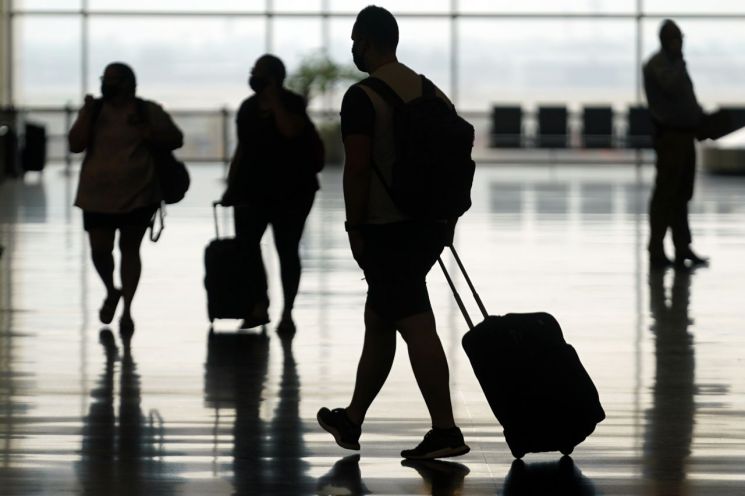 Travelers are moving at Salt Lake City International Airport in the United States. The photo is not related to any specific expression in the article. Photo by AP Yonhap News
In fact, over the past several decades, while Americans' bodies have grown larger, airplane seats have become smaller. According to the U.S. Centers for Disease Control and Prevention (CDC), the average weight of American men is currently about 90 kg, an increase of 13.6 kg since the 1960s, and women have also increased by 13.6 kg to 77 kg.
Meanwhile, during the same period, the width of airplane seats has actually narrowed from 47 cm to 43.2 cm. The average distance between front and back seats has also decreased from 89 cm to 78.7 cm. In some aircraft, the distance between front and back seats has drastically reduced to as little as 71 cm.
In response, since August, the FAA has been conducting a survey to gather passenger complaints about narrow airplane seats. Currently, over 12,000 opinions have been submitted, and most of them expressed the view that the FAA should establish minimum seat size standards, according to WP.
However, there were also opposing views stating that the current seat sizes are appropriate. Especially within the aviation industry, there was an attitude that the current spacing between airplane seats meets FAA safety standards and thus poses no problem.
The airline group 'Airlines for America' stated, "Although seat sizes have continued to shrink, current seats still meet safety standards," adding, "Airlines continue to invest in innovative technologies to maximize personal space in the cabin while maintaining the level of comfort passengers expect."
Some have also raised concerns that establishing seat size standards could lead to increased airfares. It is argued that if the FAA implements regulations on seat size and spacing, low-cost carriers in particular may raise airfares to offset revenue losses caused by fewer seats.
© The Asia Business Daily(www.asiae.co.kr). All rights reserved.
![Clutching a Stolen Dior Bag, Saying "I Hate Being Poor but Real"... The Grotesque Con of a "Human Knockoff" [Slate]](https://cwcontent.asiae.co.kr/asiaresize/183/2026021902243444107_1771435474.jpg)

















