CDS Premium Rising Reflects External Credibility
Concerns Over Credit Crisis Amid Soaring Exchange Rates
Still Much Lower Compared to Financial Crisis
Potential Asian Risks Including China and Japan Due to US Tightening
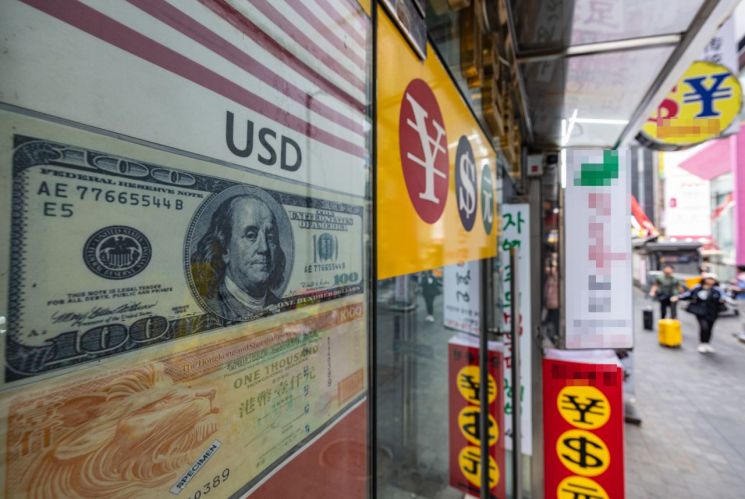
The credit default swap (CDS) premium, which reflects South Korea's external creditworthiness, has recently surged sharply, raising concerns about the potential capital outflow from the domestic financial market. Amid the US's aggressive tightening monetary policy and fears of recession in major economies, the won-dollar exchange rate has surpassed 1,400 won. If Korea's credit risk also spreads, there are forecasts that the financial market shock could intensify.
According to the international financial market on the 1st, the Korean CDS premium (5-year) traded in New York recorded 57.30 basis points (bp) on the 29th (local time), maintaining a high level compared to the beginning of the year. The CDS premium is a fee paid by bondholders to the principal guarantor to secure principal recovery in case of bond default, functioning as a kind of insurance premium against bond default risk. Therefore, the lower the CDS premium, the lower the credit risk of the bond issuer, and the higher the premium, the higher the credit risk, making it one of the representative indicators showing the issuer's creditworthiness.
Korea's CDS premium was around 32bp until early this month but showed an upward trend by rising for eight consecutive trading days since the 16th (33.19bp). On the 28th, it soared to 57.98bp, surpassing the year's highest level recorded on July 6 (55.15bp). This indicates increased default concerns over the foreign exchange stabilization bonds issued by the Korean government.
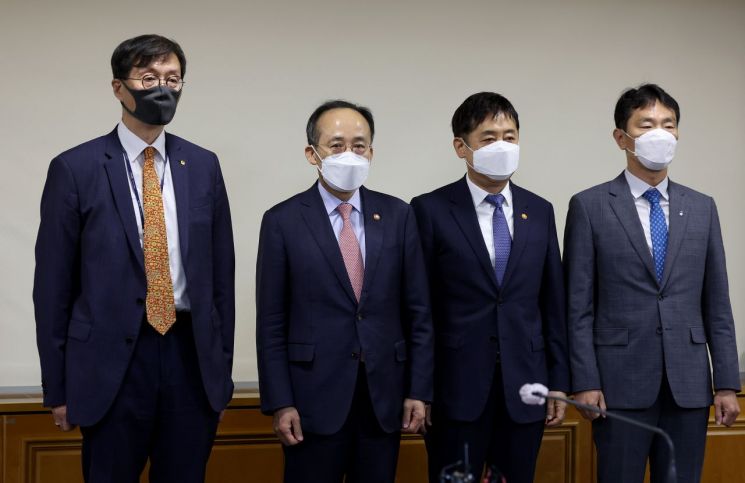 Deputy Prime Minister and Minister of Economy and Finance Choo Kyung-ho and heads of financial authorities are taking a commemorative photo before the Emergency Macroeconomic and Financial Meeting held on the morning of the 22nd at the Bankers' Hall in Jung-gu, Seoul. From the left, Lee Chang-yong, Governor of the Bank of Korea; Deputy Prime Minister Choo; Kim Ju-hyun, Chairman of the Financial Services Commission; Lee Bok-hyun, Governor of the Financial Supervisory Service.
 [Photo by Yonhap News]
The foreign exchange authorities have so far been confident about external soundness based on relatively stable CDS premiums despite the rise in the won-dollar exchange rate and the widening interest rate gap between Korea and the US. On the 27th, Deputy Prime Minister and Minister of Economy and Finance Choo Kyung-ho said in a special lecture at the 'Small and Medium Enterprise Leaders Forum,' "Currently, major currencies such as the euro and yen are also depreciating, and the CDS premium, an external soundness indicator, is lower than during the financial crisis," suggesting there is no need for excessive concern. Bank of Korea Governor Lee Chang-yong also emphasized at the National Assembly's Planning and Finance Committee meeting on the 26th that "high external creditworthiness is being maintained, and foreign currency funding conditions are favorable."
Nevertheless, the recent sharp rise in Korea's CDS premium is due to the global risk-averse sentiment caused by the US's tightening policy. Rising tensions between Russia and Ukraine have increased fears of 'nuclear use,' and the explosion of the Nord Stream gas pipeline has intensified the Eurozone energy crisis, significantly stimulating safe-haven demand.
The sharp depreciation of the currencies of China and Japan, the economic pillars of Asia, also burdens the Korean economy. Since China and Japan have significant influence on Asian trade and finance, their currency weakness and economic concerns accelerate domestic market instability. Additionally, the accumulation of Korea's trade deficit and the possibility of a current account deficit are also increasing credit risk.
Park Sang-hyun, a researcher at Hi Investment & Securities, pointed out, "The deepening simultaneous decline in stock prices, bond prices, and the won's value in the domestic financial market may signal that domestic credit crisis risks are emerging," adding, "In fact, the Korean CDS premium and credit spread, which had been quiet until now, are showing a steep upward trend."
The won-dollar exchange rate rising to the highest level since the financial crisis is in the same context. The exchange rate has broken its intraday high 11 times this month alone, pushing the upper limit higher. Some market forecasts even suggest the exchange rate will soon exceed 1,500 won.
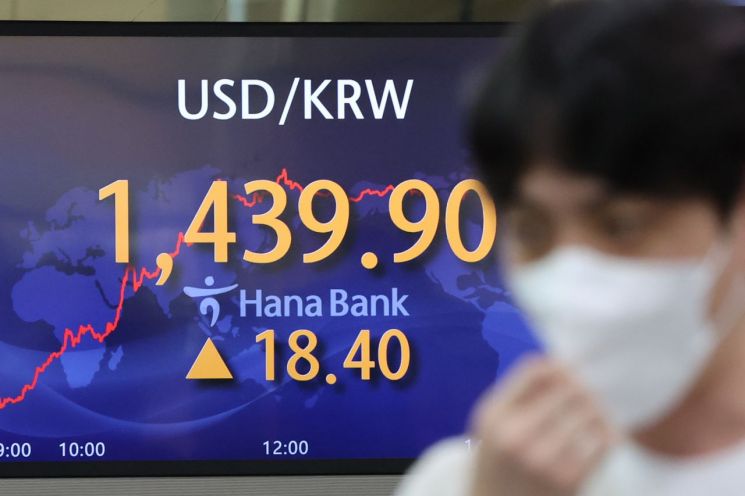 On the afternoon of the 28th, the won/dollar exchange rate was displayed on the dealing room screen of Hana Bank in Jung-gu, Seoul. [Image source=Yonhap News]
However, many opinions still hold that Korea's credit is not yet at a worrisome level. The foreign exchange authorities maintain this stance as well. Although the CDS premium has risen significantly recently, it remains much lower compared to the financial crisis period. During the 2008 financial crisis, the CDS premium rose to 650.04bp (October 24).
The rise in CDS premiums is not unique to Korea. The UK's CDS premium, which caused the pound's collapse due to tax cut policies, surged from 28.23bp on the 15th to 48.52bp, and the US (26.80bp), Japan (27.18bp), and Germany (24.00bp) have also shown recent increases, though still lower than Korea's. China's CDS premium, Korea's largest trading partner, rose to 111.16bp, and India (118.29bp), Thailand (88.47bp), and Spain (64.84bp) are also maintaining high levels.
Jung Yong-taek, a researcher at IBK Investment & Securities, explained, "Some have expressed concerns that the recent CDS spread rose sharply from the 40bp range in July to around 50bp, but looking at a longer time series, the CDS spread was around 400bp when the won-dollar exchange rate exceeded 1,300 won," adding, "This is too low and stable to explain a situation leading to the 1997 foreign exchange crisis."
© The Asia Business Daily(www.asiae.co.kr). All rights reserved.
![Clutching a Stolen Dior Bag, Saying "I Hate Being Poor but Real"... The Grotesque Con of a "Human Knockoff" [Slate]](https://cwcontent.asiae.co.kr/asiaresize/183/2026021902243444107_1771435474.jpg)


















