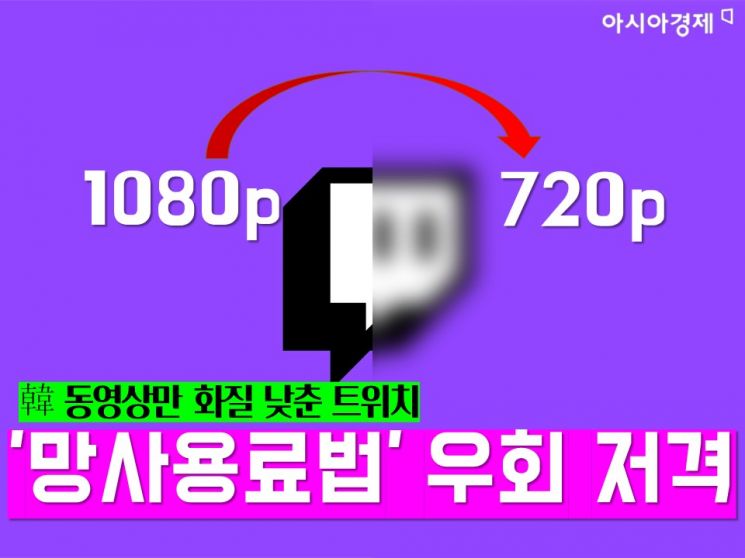
 Twitch is lowering the maximum viewing quality in Korea to 720p.
 Photo by Song Hyundo, Asia Economy intern reporter
[Asia Economy Intern Reporter Song Hyundo] The world's largest game streaming platform, Twitch, announced on the 29th of last month that it will limit the maximum resolution for domestic broadcasts. The company explained that this was due to the burden of service costs, but some suggest that this is an indirect expression of dissatisfaction with the recently proposed 'Network Usage Fee Act' in the National Assembly. Overseas content companies, including Twitch, are in conflict with the Korean government over network usage fees.
Through a notice posted on its blog that day, Twitch stated, "We plan to adjust the original quality for viewers residing in Korea," adding, "The maximum video quality in Korea will be 720p going forward." Previously, Twitch's maximum quality was 1080p.
The reason Twitch made this decision is due to high service costs. Twitch explained, "We have continuously complied with local regulations and requirements in Korea and have faithfully paid all network fees and other related costs, but as the cost of providing the service is increasing, an alternative solution is needed."
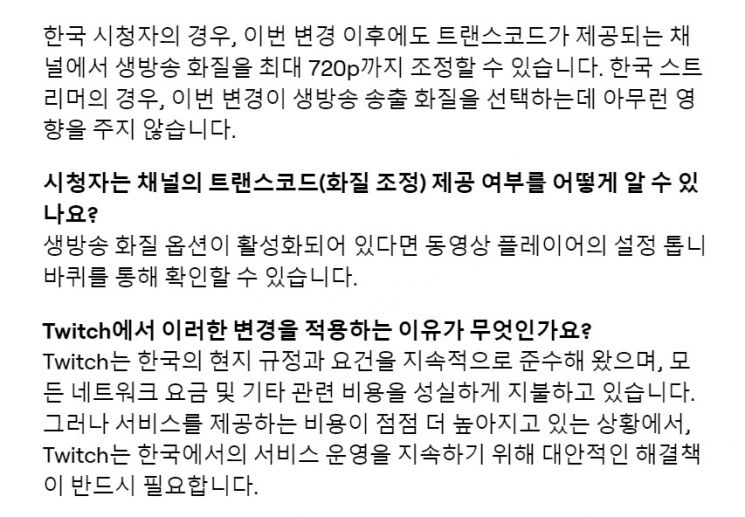 Twitch explained on its blog that the reason for the quality limitation is due to network costs.
 /Image= Screenshot from Twitch blog
Twitch users immediately expressed dissatisfaction. On social media platforms such as Twitter, protest posts appeared saying, "Isn't this effectively discrimination against Korea?" and "Why should innocent consumers suffer?"
Network usage fees refer to the charges that content providers (CPs) such as Netflix, YouTube, and Twitch pay to domestic internet service providers (ISPs) like KT and SK. Domestic IT companies Naver and Kakao pay annual network usage fees of 70 billion KRW and 30 billion KRW, respectively. Several bills for the legalization of network usage fee payments have been proposed in the National Assembly, and the Science, Technology, Information and Broadcasting and Communications Committee (STIBC) has even held its first public hearing to review them.
The conflict over network usage fees has also led to disputes between CPs and ISPs. Last year, SK Broadband requested mediation from the Korea Communications Commission, arguing that "due to the significant traffic surge caused by Netflix's domestic network usage, Netflix should bear network usage fees under the joint management obligation."
In response, Netflix argues that since it has directly invested in its own server network for content delivery, charging network usage fees amounts to double taxation. It is known that Netflix has installed 14,000 servers in 142 countries worldwide at a cost of about 1 billion USD. Netflix also claims that its own research shows that this has reduced traffic burden by about 95%, so it does not impose a burden on domestic internet.
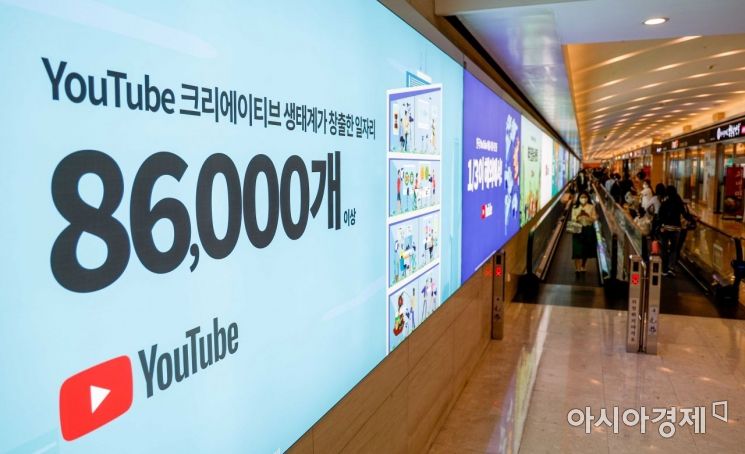
Another overseas CP, YouTube, has also launched an internet protection campaign to safeguard so-called 'net neutrality' and engaged in public opinion battles. Net neutrality is the concept that ISPs should not discriminate based on content type, provider, or content. YouTube stated, "The network usage fee bill could have a significant negative impact on the domestic internet ecosystem, the Korean creator community, and YouTube operations," and encouraged petitions opposing the National Assembly's network usage fee law. Amid this, Twitch's decision to degrade service quality citing network costs is expected to further intensify the controversy.
As a result, fierce disputes over network usage fees are expected to continue at the first National Assembly audit of the Yoon Seok-yeol administration scheduled for the 4th. Lawmakers from both ruling and opposition parties in the STIBC have requested the testimony of Gautam Anand, Vice President of YouTube Asia-Pacific. This comes six days after YouTube officially expressed its opposition to the network usage fee law.
© The Asia Business Daily(www.asiae.co.kr). All rights reserved.
![Clutching a Stolen Dior Bag, Saying "I Hate Being Poor but Real"... The Grotesque Con of a "Human Knockoff" [Slate]](https://cwcontent.asiae.co.kr/asiaresize/183/2026021902243444107_1771435474.jpg)


















