Busy with Mobile→Autonomous Vehicles→Server System Semiconductor Business
Even Mobile AP Struggles... US Government Faces 'One Mountain After Another' Behind Competing US Companies
"If Breakthrough Design Capability Improvement Is Difficult, At Least Focus on Deal Cost-Effectiveness"
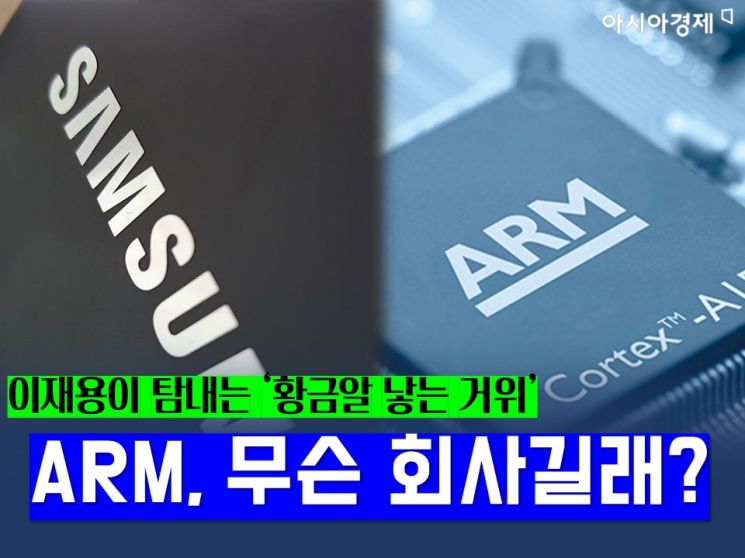
[Asia Economy Reporter Moon Chaeseok] As rumors arise that Samsung Electronics may acquire the UK's world-renowned semiconductor design company (fabless) ARM, voices are emerging that a realistic approach is to secure 'cost-effectiveness' through limited equity investment collaboration.
Last week, when Samsung Electronics Vice Chairman Lee Jae-yong revealed that he would meet with SoftBank Chairman Masayoshi Son, ARM's largest shareholder, next month on his way back to Korea, speculation arose about a 'mega deal' to acquire most of ARM's shares at a sensational price. However, opinions are gradually emerging that it is too expensive relative to its utility. Some believe that Samsung should not make a reckless deal to compensate for Samsung Exynos falling behind U.S. companies in the mobile application processor (AP) sector.
According to market research firm Counterpoint Research on the 2nd, Samsung Electronics' mobile system-on-chip (SoC) sales share in the second quarter was 8%, ranking fourth in the world. It lags far behind Qualcomm (44%) in first place, Apple (23%) in second, and MediaTek (22%) in third. Even Samsung Electronics, which is also a smartphone set (finished product) manufacturer, hesitates to equip its next flagship smartphone Galaxy S23 AP with Samsung System LSI Division's Exynos, instead opting for the U.S. Qualcomm Snapdragon 8 Gen 2. The AP is a component that acts as the brain of a smartphone, making it essential to produce high-quality products.
What is more concerning is that the top one and two are U.S. companies, and their combined market share is 67%. To seize leadership in mobile AP, Samsung must beat U.S. companies, but paradoxically, the 'solution' of acquiring ARM through mergers and acquisitions (M&A) could be blocked by U.S. competition authorities (government). They may cast veto votes considering the maintenance of domestic companies' market dominance.
Considering that Samsung aims to acquire the design asset (IP) company ARM to expand its business areas in the system (non-memory) semiconductor sector from 'mobile → autonomous vehicles → server components,' there is a risk of miscalculation from the early stages of business restructuring.
Although the prevailing view is that it will be difficult to significantly strengthen design capabilities without acquiring a substantial portion of ARM's shares, it is noteworthy that voices inside and outside the industry are gradually calling for evaluating the 'cost-effectiveness (performance relative to price)' of the deal. Acquiring ARM, valued at up to 100 trillion won, entirely is too expensive, and since U.S. companies (such as Qualcomm and Intel) are inevitably mentioned as candidates for the deal consortium, there is a basis for skepticism about whether Korean companies can organize the deal solely as 'Samsung alone' or 'Samsung + SK-centered.' Many analyses also suggest that even if financial issues are resolved, authorities in various countries will not stand idly by.
Currently, Samsung is at a level where even in mobile AP market share competition, let alone autonomous vehicles or servers, 'all remedies are ineffective,' raising concerns in the financial investment industry that Samsung might overpay in the ARM deal. It is expected to generate only minimal synergy far from Samsung's envisioned 'System Semiconductor 2030.'
Kim Hyung-tae, a researcher at Shinhan Financial Investment, recently stated in an analysis report titled 'ARM, Does It Have Significant Meaning If Not Acquired Alone?' that "Besides Intel, Qualcomm, Samsung, and SK Hynix, investment participation from Microsoft, Google, AWS, and Oracle in ARM cannot be ruled out," and analyzed, "If Samsung Electronics only secures a small equity stake in ARM, it will be advantageous in semiconductor IP unit price negotiations but will have to share technology with competitors, and even with such an acquisition, synergy will be limited to the mobile AP sector."
© The Asia Business Daily(www.asiae.co.kr). All rights reserved.
![Clutching a Stolen Dior Bag, Saying "I Hate Being Poor but Real"... The Grotesque Con of a "Human Knockoff" [Slate]](https://cwcontent.asiae.co.kr/asiaresize/183/2026021902243444107_1771435474.jpg)
















