Exclusion of Non-Marital Cohabitation, De Facto Marriage, and Foster Families from Family Policy
Non-Relative Households Increase 11.6% Year-on-Year to 470,000, a Record High
Narrow Scope of Policy Target Families... Need for Legal Revision to Encompass Diverse Families
 On the 19th, as Typhoon Nanmadol is moving northward, citizens are resting against the backdrop of a blue sky at the National Museum of Korea in Yongsan-gu, Seoul. Photo by Mun Honam munonam@
[Asia Economy Reporter Han Jinju] As the Ministry of Gender Equality and Family has reversed its stance to ‘maintain the original draft’ regarding the amendment to the Framework Act on Healthy Families that deletes the legal definition of family, demands are pouring in to amend the law to encompass family diversity.
At a forum held on the 28th at the National Assembly hosted by Yong Hye-in of the Basic Income Party and others for the amendment of the Framework Act on Healthy Families, there were calls to redefine the family definition, which is currently limited to marriage, blood relations, and adoption. This is because various relationships and family compositions such as cohabitation, de facto marriage, and foster families are excluded from policy targets and face discrimination in areas such as support, care, and inheritance. Lee Minju, an activist of the Gender Equality Welfare Team at the Korean Women’s Association United, pointed out, “People who are not legal family members, even if they live together and support each other, are not fully included in the social system in all areas such as taxation, social insurance, housing, and labor. If they are not legal family members, they cannot prove their relationship as ‘guardians’ in situations requiring care such as illness or accidents, making it difficult to provide care. They are also deprived of the rights to care and mourning.”
In housing supply, only blood and marital relationships are set as those needing residential space, and public rental housing applications jointly are limited to marriage or blood relations. Family care leave and parental leave are also limited to cases of caring for legal family members or spouses. The activist said, “Even when there are no regulations or guidelines prioritizing legal family, discrimination appears in attitudes that place legal family members in a superior or preferential position. Victims suffer from prejudice or hatred, and the purpose and sincerity of their relationships are constantly questioned and must be proven.” She emphasized, “The amendment to the Framework Act on Healthy Families is an active expression of the state’s will to change the discriminatory structure that defines family in a limited form and grants privileged status to ‘legal family.’”
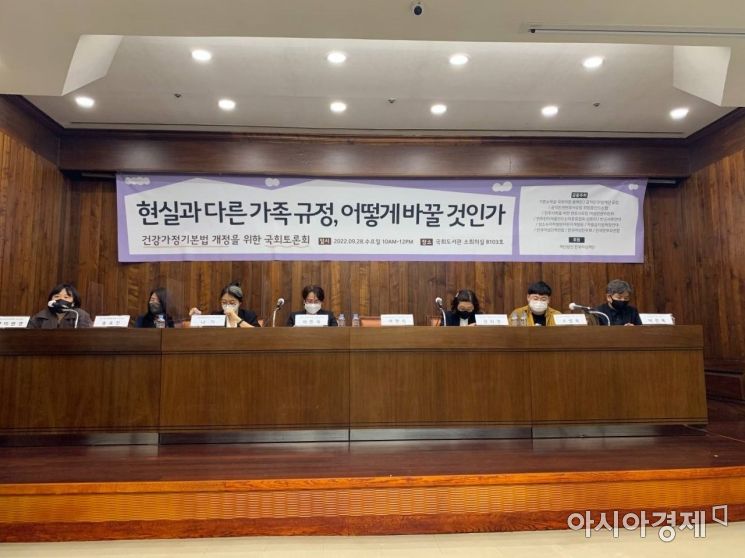 On the 28th, a forum for the amendment of the Construction Technology Promotion Act, hosted by Yong Hye-in, a member of the Basic Income Party, and others, was held at the National Assembly.
According to the 2021 Population and Housing Census, the number of non-relative households nationwide reached a record high of 473,000 households, an increase of 49,000 households (11.6%) compared to the previous year. In contrast, relative households (13.81 million households) decreased by 50,000 households (0.4%) compared to the previous year. Single-person households numbered 7.516 million, an increase of 522,000 households (7.9%) from the previous year. As more people choose family beyond marriage or blood relations and single-person households become common, there are calls for amendments to prevent the law from becoming outdated. In the Family Status Survey, the proportion of single-person households was 30.2% (2019), surpassing households of couples with unmarried children (29.8%).
Attorney Lee Geun-ok of Law Firm Won and the nonprofit organization Sun explained, “Since the enactment of the Framework Act on Healthy Families, it has been criticized for having a narrow scope of family as a policy target and insufficient consideration of a gender-sensitive perspective. The types of relationships beyond marriage and blood relations have been diversifying and their population proportion increasing year by year.” The Ministry of Gender Equality and Family set ‘recognition of family diversity’ as a goal in the ‘4th Basic Plan for Healthy Families’ last April. It specified discovering inconvenience cases caused by marriage- and blood-centered family practices, exploring will and trust systems for alternative families, and establishing systems to protect the rights of alternative families.
Attorney Lee emphasized, “To prevent the Framework Act on Healthy Families from becoming an outdated law that supports only a part of the actual ‘family,’ it must be amended to respect and support communities and individuals formed by diverse citizens, moving beyond exhausting debates.”
Due to such a narrow definition of family, not only de facto marriages, unmarried cohabiting families, and foster families but also group homes, care communities, and residential communities that share livelihood, care, and housing are excluded from the family policy targets under the current Framework Act on Healthy Families. There is no legal basis to support family services for them.
Song Hyo-jin, a research fellow at the Korean Women’s Development Institute, said, “The Framework Act on Healthy Families has dealt with the narrow family concept by adding specific types of families one by one as needed, but this approach itself can be discriminatory. As the basic law underpinning family policy, the Framework Act on Healthy Families should have the status and content befitting a fundamental law of family policy, rather than promoting specific values.”
© The Asia Business Daily(www.asiae.co.kr). All rights reserved.
![Clutching a Stolen Dior Bag, Saying "I Hate Being Poor but Real"... The Grotesque Con of a "Human Knockoff" [Slate]](https://cwcontent.asiae.co.kr/asiaresize/183/2026021902243444107_1771435474.jpg)
















