1.04% of New Cases on the 28th Are Imported
Imported Cases Were 0.31% at Last Month's Resurgence Peak
Detection Rates of BA.2.75 and BA.4.6 Increase, BA.5 Decreases for the First Time
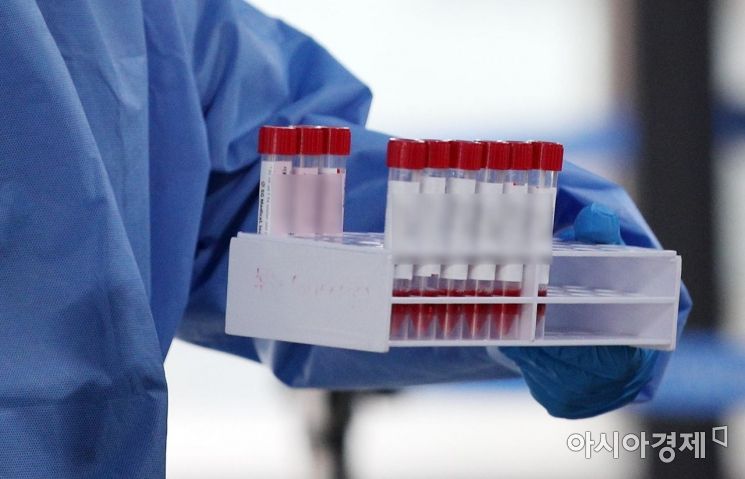 On July 7th, medical staff are transferring specimens from citizens at the screening clinic of Yongsan-gu Public Health Center in Seoul. Photo by Hyunmin Kim kimhyun81@
[Asia Economy Reporter Kim Young-won] While the number of new COVID-19 cases continues to decline daily, the proportion of imported cases among confirmed cases has increased. Along with this, the detection rates of new variants other than BA.5 have also risen.
The proportion of imported cases among new confirmed cases is currently higher than during the peak of the sixth wave. On the 28th, the ratio of imported cases (379) to new confirmed cases (36,159) was approximately 1.04%. When new cases were in the 180,000 range at the peak of this resurgence on July 17, the proportion of imported cases among new cases was 0.31%, about one-third of the current level.
With the lifting of aviation and immigration-related restrictions and the end of social distancing measures, imported cases have been on the rise since July. Overseas travel by air continues to increase steadily. The number of passengers using Incheon Airport rose monthly from 1,262,387 in June to 1,739,247 in July and 1,951,123 in August this year.
As imported cases have consistently occurred, the detection rates of the BA.2.75 and BA.4.6 variants have increased. The detection rate of BA.2.75, known as "Centaurus," rose from 0.8% in the second week of this month to 2.0% in the third week. This was influenced by the increase in imported detection rates from 1.1% to 6.9%. BA.4.6 also saw its imported detection rate increase from 0.0% to 2.1% during the same period, raising its overall detection rate from 0.2% to 0.4%. Consequently, the detection rate of BA.5, the dominant domestic variant, decreased for the first time since the fourth week of June when tracking began.
The United States is also experiencing a gradual decline in BA.5 prevalence, with increases in variants such as BA.2.75 and BA.4.6. According to data from the U.S. Centers for Disease Control and Prevention (CDC) for the week of August 18?24, the prevalence of BA.4.6 in the U.S. rose to 11.9%, up from 10.9% the previous week. BA.2.75 also increased from 1.0% to 1.4% during the same period. A new variant called BF.7 has recently emerged, with its prevalence rising to 2.3%.
Health authorities have stated they will monitor the impact of the increasing detection of new variants. On the 28th, Lim Sook-young, the Situation General Manager of the Central Disease Control Headquarters, said, "Regarding BA.2.75, as announced by the Central Disease Control Headquarters last week, there is no indication of increased transmissibility." She added, "Although BA.4.6 appears to be increasing in the U.S., globally there is no significant change in its growth rate, so we need to continue monitoring to see if it becomes the dominant strain domestically."
Domestic experts also emphasized the need to closely watch BA.4.6, especially in the U.S. Professor Kim Woo-joo of the Department of Infectious Diseases at Korea University Guro Hospital explained, "The fact that multiple variants are co-circulating and competing, with some increasing their share, indicates an advantage in adaptability and strengths. We need to observe the situation in the U.S. going forward."
© The Asia Business Daily(www.asiae.co.kr). All rights reserved.

















