Ministry of Trade, Industry and Energy Announces 'Global Top 3 Strategy for the Automobile Industry'
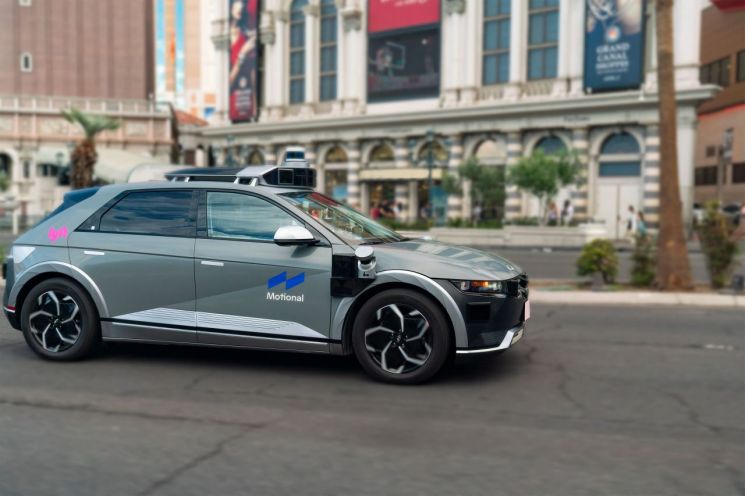 Hyundai Motor Joint Venture Launches Autonomous Driving Robotaxi Ride-Hailing Service in the U.S.
(Seoul=Yonhap News) Motional, a joint venture between Hyundai Motor Group and U.S. autonomous driving company Aptiv, announced on July 17 that it will start the Ioniq 5 autonomous driving robotaxi ride-hailing service with the largest U.S. ridesharing company, Lyft, in Las Vegas. The photo shows the Ioniq 5 robotaxi. 2022.8.17 [Provided by Motional. Redistribution and DB prohibited]
photo@yna.co.kr
(End)
<Copyright(c) Yonhap News Agency, Unauthorized reproduction and redistribution prohibited>
[Asia Economy Sejong=Reporter Lee Jun-hyung] Finished car manufacturers such as Hyundai Motor Company will make investments exceeding 95 trillion won over five years from this year through 2026. The government has decided to focus on supporting large-scale investments in the automotive industry through tax incentives and other measures. The plan is to activate private investment and raise South Korea's global electric vehicle market share from 5% last year to 12% by 2030.
The Ministry of Trade, Industry and Energy announced that Minister Lee Chang-yang held the "Automotive Industry Strategy Roundtable" at the Korea Chamber of Commerce and Industry in Seoul on the afternoon of the 28th. The meeting was attended by numerous automotive industry representatives, including those from Hyundai Motor Company, Kia, Korea GM, and Renault Korea, along with Minister Lee.
The ministry unveiled the "Global Top 3 Automotive Industry Strategy," which aims to elevate South Korea to one of the world's top three automotive powers. The strategy includes four major tasks: ▲leap to global top-tier electrification ▲flexible transition across the ecosystem ▲establishment of a stable supply chain ▲creation of new industries in autonomous driving and mobility.
First, the ministry plans to maximize investments by finished car manufacturers through deregulation and tax support. The finished car industry plans to invest at least 95 trillion won from this year through 2026. The ministry intends to induce additional investments by providing close support to finished car companies.
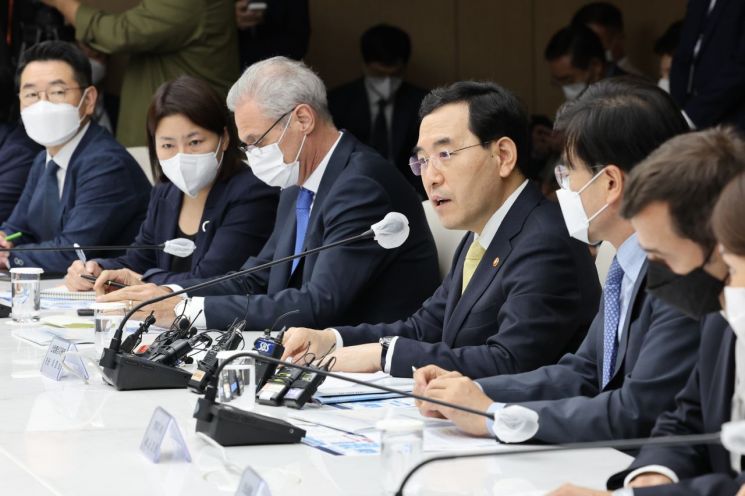 'Discussion on the "Global Top 3 Strategy for the Automobile Industry"'
(Seoul=Yonhap News) Reporter Kim Ju-seong = On the morning of the 28th, Lee Chang-yang, Minister of Trade, Industry and Energy, is presiding over the "Automobile Industry Strategy Roundtable" held at the Korea Chamber of Commerce and Industry in Jung-gu, Seoul.
At the meeting, the government announced the "Global Top 3 Strategy for the Automobile Industry," aiming to increase global electric vehicle production to 3.3 million units by 2030 and expand its global market share from 5% to 12%. 2022.9.28
utzza@yna.co.kr
(End)
<Copyright (c) Yonhap News Agency, Unauthorized reproduction and redistribution prohibited>
Training 10,000 Vehicle Software Personnel... Extending Electric Vehicle Driving Range
With large-scale investments from the finished car industry, the plan is also to raise the global electric vehicle market share from the current 5% to 12% by 2030. The ministry plans to localize core vehicle software such as operating systems (OS) and over-the-air updates (OTA) by 2026 to secure a lead in electrification technology. The future vehicle workforce training project, which was allocated 22.4 billion won this year, will be expanded and reorganized to train about 10,000 vehicle software convergence personnel by 2030. Additionally, a vehicle software certification support center will be established to nurture 300 specialized vehicle software companies by 2030.
The global market share of vehicle semiconductors will also be more than doubled from 3.1% last year to 6.6% by 2030. The ministry plans to focus on developing 16 core items, including power semiconductors, through four main strategies: securing core technologies, internalizing supply chains, ecosystem creation, and corporate support. Furthermore, the electric vehicle single-charge driving range, currently about 500 km, will be extended by 100 km to 600 km by 2025. Hydrogen vehicle fuel efficiency is planned to improve from the current 13 km per kg to 17 km per kg by 2030.
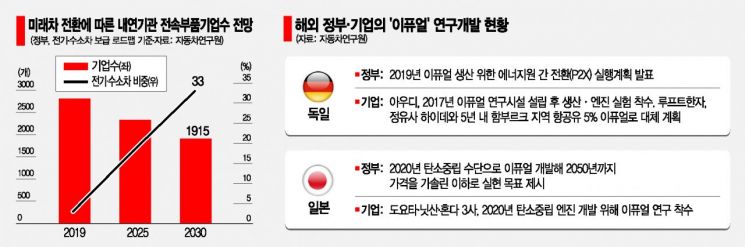
Support will also be provided for business transformation within the internal combustion engine ecosystem. Accordingly, the ministry will prepare "customized policies" according to the types of internal combustion engine parts companies. This year, 22 billion won will be invested to support the development of eco-friendly technologies for internal combustion engine vehicles, and existing internal combustion engine technologies will be advanced. To prepare for unexpected variables such as supply chain crises, development of internal combustion engine vehicles using carbon-neutral fuels will also be pursued.
Full Response to IRA... Level 4 Commercialization Targeted by 2027
Minister Lee shared the results of negotiations with the United States regarding the Inflation Reduction Act (IRA), which has emerged as the biggest issue for the automotive industry. The ministry is committed to fully responding to the IRA, which excludes Korean electric vehicles from subsidy eligibility, to minimize damage to the domestic automotive industry. Accordingly, the ministry plans to continue negotiations with the U.S. to ensure that detailed subsidy conditions, such as North American final assembly and battery requirements, are set favorably for domestic companies. The industry will also take measures such as accelerating local vehicle production in the U.S. and securing batteries that meet IRA requirements early.
Technological independence for 14 key electric and hydrogen vehicle components, which are highly dependent on imports, will be actively pursued. Ultra-high-speed bearings, with a 90% import dependency from Japan, are a representative example. Large motors for electric and hydrogen vehicles currently use 100% German imports. The ministry plans to raise the localization rate of electric and hydrogen vehicle materials from the current 70% to 90% by 2025.
The ministry also plans to commercialize Level 4 fully autonomous driving technology by 2027. It will actively support the development of core autonomous driving technologies to raise the competitiveness of core autonomous driving components from the current 84% compared to advanced countries to 100% by 2027. Additionally, from 2024, a comprehensive research complex for the commercialization of autonomous driving components will be established. The research complex will serve as a demonstration testbed and a training center for research personnel.
To open up the autonomous driving market, regulatory improvements will also be pursued. The ministry plans to establish national standards for autonomous driving data and formulate the "Eco-friendly Mobility Regulatory Innovation Roadmap 2.0" in the first half of next year. The roadmap is expected to focus on improving regulations that restrict market entry of new automotive technologies and new models.
Minister Lee said, "In these challenging times due to the U.S. IRA law and others, it is time for the public and private sectors to come together for our automotive industry to take a leap forward. The strategy announced today provides a broad direction for the automotive industry strategy, and we plan to communicate with the industry to specify policies by sector going forward."
© The Asia Business Daily(www.asiae.co.kr). All rights reserved.
![Clutching a Stolen Dior Bag, Saying "I Hate Being Poor but Real"... The Grotesque Con of a "Human Knockoff" [Slate]](https://cwcontent.asiae.co.kr/asiaresize/183/2026021902243444107_1771435474.jpg)


















