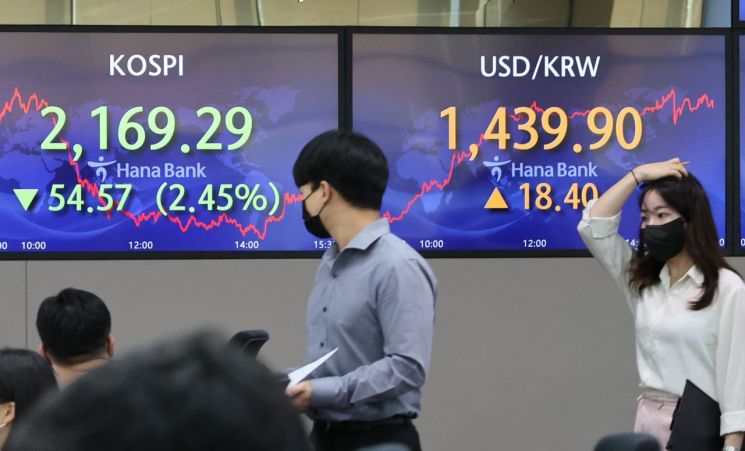
[Asia Economy Reporter Myunghwan Lee] On the 28th, the KOSPI index broke below the 2200 level due to the strong dollar and recession concerns, hitting a new yearly low again. It was the first time in about 2 years and 2 months that the KOSPI closed at the 2160 level. Foreign investors engaged in large-scale selling influenced by the strong dollar.
On that day, the KOSPI closed at 2169.29, down 2.45% (54.57 points) from the previous trading day. The KOSPI opened at 2206.15, down 0.80% (17.71 points), and sharply increased its decline during the morning session.
The last time the KOSPI fell to the 2160 level at closing was on July 9, 2020 (2167.90), about 2 years and 2 months ago.
In the securities market, institutional and foreign investors sold stocks worth 178.2 billion KRW and 149.7 billion KRW respectively, engaging in a 'Sell Korea' trend. In contrast, individual investors bought a net 325 billion KRW.
The strong dollar appears to have affected foreign investors' supply and demand. In the Seoul foreign exchange market that day, the won-dollar exchange rate closed at 1439.9 won, up 18.4 won from the previous trading day. Kyungmin Lee, a researcher at Daishin Securities, noted, "Volatility in the foreign exchange market and the resulting deterioration in foreign investors' supply and demand conditions significantly contributed to the sharp drop in the KOSPI."
Most of the top market capitalization stocks in the KOSPI also closed lower. Samsung Electronics closed at 52,900 won, down 2.40% (1,300 won) from the previous day, falling to the 52,000 won range. LG Energy Solution also ended trading at 433,500 won, down 2.36% (10,500 won). LG Chem (-4.04%), Samsung SDI (-3.92%), Hyundai Motor (-3.49%), and Kia (-3.40%) also saw large declines. Samsung Biologics was the only stock to rise, closing at 767,000 won, up 1.72% (13,000 won) from the previous day.
Apple and semiconductor stocks fell sharply amid concerns over demand contraction following foreign reports that Apple canceled its iPhone 14 production increase plans. LG Innotek closed at 277,000 won, down 10.50% (32,500 won), and BH also closed at 27,150 won, down 6.70% (1,950 won).
Among KOSPI sector indices, only pharmaceuticals rose by 1.10%, while non-metallic minerals (-4.65%), machinery (-3.81%), and chemicals (-3.64%) experienced significant declines.
The KOSDAQ index closed at 673.87, down 3.47% (24.24 points) from the previous day. The index opened at 696.38, down 0.25% (1.73 points), briefly recovered above 700 during the session, but then reversed and widened its losses.
Foreign investors sold 133.3 billion KRW worth of stocks alone in the KOSDAQ market. Meanwhile, institutional and individual investors bought 73.4 billion KRW and 56.2 billion KRW worth of stocks respectively.
Most of the top market capitalization stocks in the KOSDAQ also declined. Ecopro (-7.07%), Pearl Abyss (-7.03%), JYPEnt. (-6.34%), and Kakao Games (-6.16%) fell sharply. Celltrion Healthcare closed slightly higher at 64,100 won, up 0.31% (200 won) from the previous day.
Among KOSDAQ sector indices, telecommunications services (-6.68%), entertainment culture (-5.34%), and IT components (-5.30%) saw significant declines.
The sharp drop in the stock market that day is interpreted as a combined effect of the strong dollar, Apple's cancellation of production increase plans, and the Nord Stream explosion news. Sangyoung Seo, head of the Media Content Division at Mirae Asset Securities, said, "Factors that recently caused stock market declines such as recession, strong dollar, and rapid interest rate hikes all came in at once, leading to an overall contraction in investor sentiment. Although these were known factors, the high levels of the dollar and government bond yields could burden corporate profits, so increased volatility is inevitable for the time being."
Ji-young Han, a researcher at Kiwoom Securities, also said, "Since the September Federal Open Market Committee (FOMC), investor sentiment has deteriorated significantly, and the market is currently overinterpreting negative factors, which is the main cause of the sharp market decline. There is no immediate sign of a dramatic turnaround, but the current market is characterized by irrational panic selling."
© The Asia Business Daily(www.asiae.co.kr). All rights reserved.
![Clutching a Stolen Dior Bag, Saying "I Hate Being Poor but Real"... The Grotesque Con of a "Human Knockoff" [Slate]](https://cwcontent.asiae.co.kr/asiaresize/183/2026021902243444107_1771435474.jpg)















