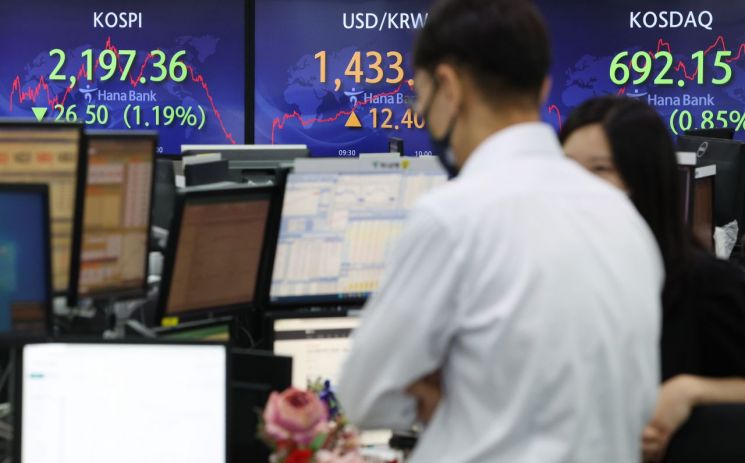
[Asia Economy Reporter Myunghwan Lee] On the afternoon of the 28th, the KOSPI index widened its losses and plunged to the 2150 level in a single stroke. Following the break below the 2200 level in the morning session, the decline expanded to nearly 3%, marking the lowest point in 2 years and 2 months. The KOSDAQ index's decline rate is also approaching 4%.
As of 1:54 PM, the KOSPI stood at 2155.70, down 3.06% (68.16 points) from the previous trading day. This is the first time in 2 years and 2 months since July 10, 2020, that the KOSPI has fallen to the 2150 level. The KOSPI opened the session at 2206.15, down 0.80% (17.71 points), and then sharply increased its losses during the morning session.
In the securities market, individual investors are buying stocks worth 532.2 billion KRW on their own. In contrast, institutional and foreign investors are net sellers, offloading 334.8 billion KRW and 215.7 billion KRW respectively.
Blue lights have turned on for the top market cap stocks on the KOSPI as well. Samsung Electronics dropped 2.77% (1,500 KRW) from the previous day to 52,700 KRW. LG Energy Solution is trading down 3.15% (14,000 KRW) at 430,000 KRW. Samsung SDI (-4.77%), Kia (-4.44%), Hyundai Motor (-4.30%), and LG Chem (-4.22%) are all experiencing declines in the 4% range.
At the same time, the KOSDAQ index is at 670.70, down 3.93% (27.41 points) from the previous day. The index opened at 696.38, down 0.25% (1.73 points), briefly recovered above the 700 level during the session, but soon reversed to a decline. The downward trend has since accelerated sharply.
Individual investors are also buying 155.8 billion KRW worth of stocks in the KOSDAQ market. Institutions are net buyers with 16.2 billion KRW, while foreign investors are net sellers, offloading 168.6 billion KRW worth of stocks alone.
The sharp drop in the stock market today is interpreted as a result of multiple factors acting together, including the strong dollar, Apple's withdrawal of its production increase plan, and news of the Nord Stream explosion. Sangyoung Seo, Head of Media Content at Mirae Asset Securities, said, "Factors that recently caused the stock market decline, such as economic recession, strong dollar, and rapid interest rate hikes, have all come together, leading to an overall contraction in investor sentiment. Although these were known issues, the high levels of the dollar and government bond yields could burden corporate profits, so increased volatility is inevitable for the time being."
Ji-young Han, a researcher at Kiwoom Securities, also stated, "Investor sentiment has been severely damaged since the September Federal Open Market Committee (FOMC) meeting, and the current atmosphere is one of overinterpreting negative factors, which is the biggest cause of the recent sharp market decline. There is no immediate sign of a dramatic turnaround, but right now, it is an irrational panic-selling market."
© The Asia Business Daily(www.asiae.co.kr). All rights reserved.
![Clutching a Stolen Dior Bag, Saying "I Hate Being Poor but Real"... The Grotesque Con of a "Human Knockoff" [Slate]](https://cwcontent.asiae.co.kr/asiaresize/183/2026021902243444107_1771435474.jpg)















