Establishing a Public-Private Partnership Framework for Carbon Neutrality
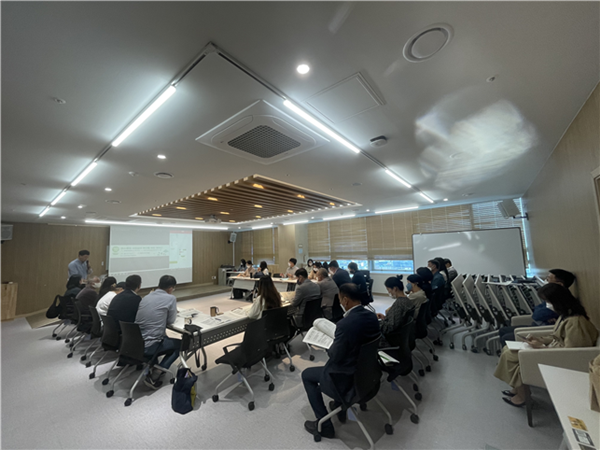
[Asia Economy Honam Reporting Headquarters Reporter Jeong Hyeong-seok] A seminar to expand citizen participation in carbon neutrality to solve environmental problems, hosted by the Jeonnam Regional Problem-Solving Platform and organized by the ‘Freehadang’ Promotion Committee, which was formed to create a Mokpo free from plastics and disposable products, was held on the 27th at the Social Enterprise Growth Support Center Jeonnam.
‘Freehadang,’ formed with the purpose of expanding carbon neutrality practices in Jeollanam-do, aims to promote carbon neutrality and raise awareness and solutions for the climate crisis through activities such as a reuse market to encourage citizens’ reuse, a shopping campaign without using plastics and disposable products, and a market introducing and selling recycled products made from discarded plastics and resources.
This seminar was held ahead of the ‘Freehadang’ event scheduled for the 22nd of next month, with participation from environmental activists, experts, citizens, and administration from other regions to expand citizen participation in carbon neutrality.
Park Shin-hee, manager of the Beautiful Store Mokpo Hadang branch, emphasized in her keynote presentation that for everyday activities to change the world, it is important to improve the participation structure to naturally induce and expand citizens’ involvement in the circulation of daily necessities, and to foster cooperation between the local community and administration.
Additionally, Jeonju’s ‘Bulmojijang’ and Gwangju’s ‘Bojagijang’ presented case studies on environmental markets that generate no waste, highlighting the importance of continuous operation through changes in participants’ awareness.
Furthermore, the case of youth environmental guardianship activities in Naju suggested the importance of environmental creation and proposed ways to expand various participants by combining key local agendas with the environment, as well as the need to discover and nurture social economy enterprises to promote recycling.
Meanwhile, carbon neutrality refers to making the actual amount of carbon dioxide emissions zero by absorbing the carbon dioxide emitted by individuals, companies, and organizations. Since the Paris Agreement came into effect in 2016, 121 countries have joined the ‘Climate Alliance for 2050 Carbon Neutrality,’ making it a global issue. Currently, countries around the world are actively implementing carbon neutrality campaigns to control the emission of carbon dioxide, the main cause of global warming.
© The Asia Business Daily(www.asiae.co.kr). All rights reserved.
![Clutching a Stolen Dior Bag, Saying "I Hate Being Poor but Real"... The Grotesque Con of a "Human Knockoff" [Slate]](https://cwcontent.asiae.co.kr/asiaresize/183/2026021902243444107_1771435474.jpg)















