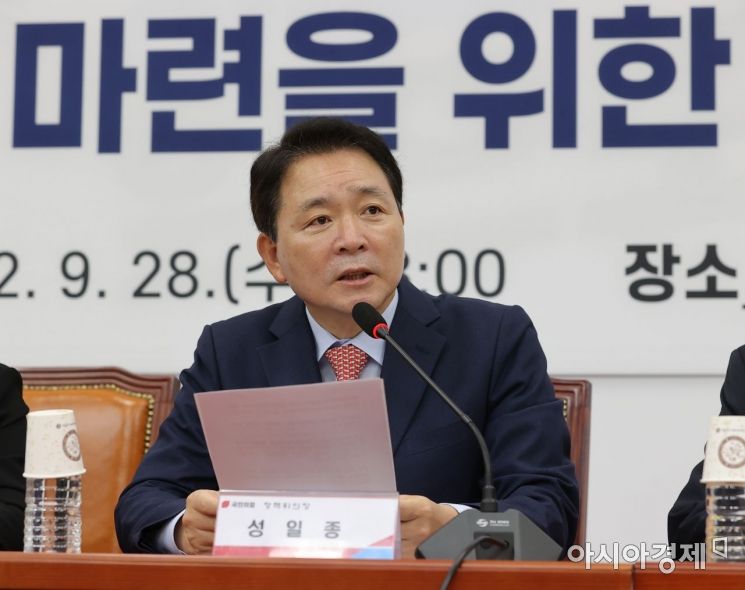
 Seong Il-jong, Chairman of the Policy Committee of the People Power Party, is delivering opening remarks at the party-government meeting held at the National Assembly on the 28th to discuss measures to resolve the late-night taxi shortage. Photo by Yoon Dong-ju doso7@
[Asia Economy reporters Lee Ji-eun, Kim Min-young, Kwon Hyun-ji] The government and the ruling party have agreed to raise the late-night taxi call fee to alleviate the ‘late-night taxi boarding difficulty.’ The regulation of the ‘Tada Prohibition Act’ promoted by the government has ultimately resulted in increased fare burdens for consumers. The ruling party also requested the government to lift taxi restrictions and expand late-night public transportation such as ‘Owl Bus.’
On the 28th, the ruling party and the government held a meeting at the National Assembly to discuss measures to address the late-night taxi boarding difficulty and reached an agreement on these matters. Seong Il-jong, the Policy Committee Chair of the People Power Party, said to reporters immediately after the meeting, "We reached a consensus that easing regulations and adjusting the late-night call fee are necessary to solve the late-night taxi problem."
Accordingly, an increase in the late-night taxi call fee has become inevitable. Chair Seong said, "There must be compensation for those who operate taxis during late-night hours through the call fee," adding, "We concluded that there should be a policy consideration ensuring that the call fee benefits the drivers."
The ruling party also requested the government to lift taxi restrictions, simplify driver employment procedures, promote hourly labor contracts, and expand late-night public transportation. Chair Seong said, "We requested the lifting of taxi restrictions because we believe it would be difficult to solve the late-night taxi problem without regulatory reform," and added, "The government agreed to actively review this." He also added, "We requested the expansion of late-night public transportation such as the Owl Bus to broaden options."
The reason the government and ruling party have taken the ‘late-night call fee increase’ card to resolve the late-night taxi boarding difficulty is due to the recent sharp decline in taxi drivers. They aim to attract manpower to the taxi industry by improving drivers’ working conditions. According to the ‘Taxi Operating Cost Analysis and Fare System Improvement Service’ report, the number of corporate taxi drivers decreased by 42%, from 36,024 in June 2016 to 20,868 last June.
As the COVID-19 pandemic prolonged, passenger numbers decreased, leading to reduced operating revenue, which caused many younger drivers to move to the delivery and courier industries. The further decrease in the number of individual taxi drivers during late-night hours is also a major factor in the taxi crisis. Individual taxis account for 69.3% of the total number of taxis operating in Seoul, but their late-night operation rate after 10 p.m. dropped to as low as 10.1%.
There is also criticism that the current late-night taxi crisis is largely self-inflicted by the government. After the government passed the amendment to the Passenger Transport Service Act (‘Tada Prohibition Act’) two years ago, which blocked the operation of the vehicle call service ‘Tada,’ about 12,000 Tada taxi drivers stopped driving. With the passage of the ‘Tada Prohibition Act’ by the National Assembly, vehicle-sharing services such as Tada and Uber, which could have replaced taxis, also disappeared. The Tada Prohibition Act penalizes transport operators without taxi licenses. Critics argue that the government blocked the market entry of alternative transportation means to cover the insufficient taxi supply and is now shifting the burden of taxi fare increases onto consumers.
The Ministry of Land, Infrastructure and Transport plans to report related measures at a high-level ruling party-government meeting on the 3rd of next month and announce the measures on October 4th. Eo Myeong-so, the 2nd Vice Minister of the Ministry of Land, Infrastructure and Transport, said, "We will boldly improve taxi regulations such as taxi restrictions to expand taxi supply capacity and actively increase late-night public transportation," adding, "We will also actively revitalize customized taxi services and mobility services suitable for the mobility era." Vice Minister Eo stated, "We will review flexible call fee adjustments during late-night hours to reduce passengers’ taxi waiting times and strive to ensure that the call fee practically improves taxi drivers’ working conditions."
© The Asia Business Daily(www.asiae.co.kr). All rights reserved.
![User Who Sold Erroneously Deposited Bitcoins to Repay Debt and Fund Entertainment... What Did the Supreme Court Decide in 2021? [Legal Issue Check]](https://cwcontent.asiae.co.kr/asiaresize/183/2026020910431234020_1770601391.png)