Domestic Violence Accounts for 88%
"Abuse Harms Others' Personality... Various Issues Must Be Examined"
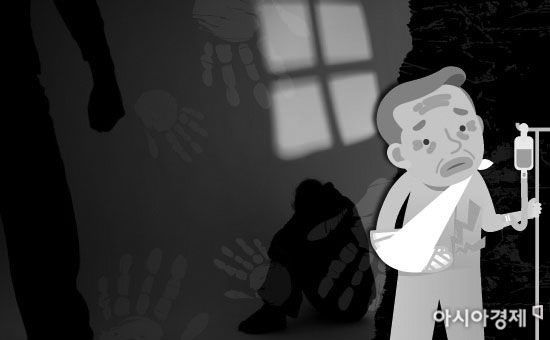
The number of reported elder abuse cases reached approximately 6,000 in the first half of this year alone. Most of the abusers are blood relatives of the elderly, highlighting the need to pay attention to elder human rights.
According to the National Police Agency on the 28th, the number of elder abuse 112 reports in the first half of this year reached 5,958. In 2017, the number of reports was 6,105, meaning this year has already reached that number in just six months. Last year, there were 11,918 cases, showing that the trend of elder abuse is not decreasing.
The perpetrators of elder abuse are the closest blood relatives. Among 1,379 elder abuse perpetrators, 1,328 were spouses and children (including grandchildren), accounting for about 96%. According to the Ministry of Health and Welfare’s “2020 Elder Abuse Status Report,” the place where elder abuse occurred most frequently in 2020 was “within the home,” accounting for about 88% of all cases. This means that elderly people are being subjected to violence by family members inside their homes.
There have been several cases this year where elderly people were abused by their blood relatives. On August 25, Judge Noh Han-dong of Suwon District Court Criminal Division 12 sentenced a man in his 40s, A, to one year in prison for violating the Elderly Welfare Act. A knocked down his mother in her seventies and repeatedly kicked her because she did not give him money for cigarettes. In January, an elderly man in his 80s, B, ran barefoot and without a coat to a supermarket in the middle of winter in Nowon-gu, Seoul, to avoid his son who was drinking and being violent. B was reportedly abused by his son for a long time and expressed a desire to live separately.
As society approaches a super-aged status, elder abuse is emerging as a serious problem. As of July 1, 2020, 109 cities, counties, and districts nationwide had entered super-aged societies. A super-aged society is defined as one where the population aged 65 and over accounts for more than 20% of the total population. On the occasion of Elder Abuse Prevention Day last June, the National Human Rights Commission issued a statement saying, “We must move away from viewing the elderly as objects of charity and see them as subjects of rights,” and emphasized the need for special attention to elder human rights.
Experts say that addressing elder abuse requires looking into various issues such as caregiving stress and elderly poverty. Professor Seok Jae-eun of Hallym University’s Department of Social Welfare said, “While society should alleviate the heavy burden of caregiving, attention must also be paid to the issue of elderly poverty. Abuse harms the dignity of others. It is also necessary to cultivate human rights sensitivity.”
© The Asia Business Daily(www.asiae.co.kr). All rights reserved.
![Clutching a Stolen Dior Bag, Saying "I Hate Being Poor but Real"... The Grotesque Con of a "Human Knockoff" [Slate]](https://cwcontent.asiae.co.kr/asiaresize/183/2026021902243444107_1771435474.jpg)














