KCCI Symposium on 'Issues and Improvement Measures of Recent In-House Subcontracting Rulings'
[Asia Economy Reporter Kiho Sung] Regarding the court's judgment on in-house subcontracting, a claim has emerged stating that "to enhance the global competitiveness of our companies, various production methods such as contracting and dispatching should be freely utilized according to the company's circumstances."
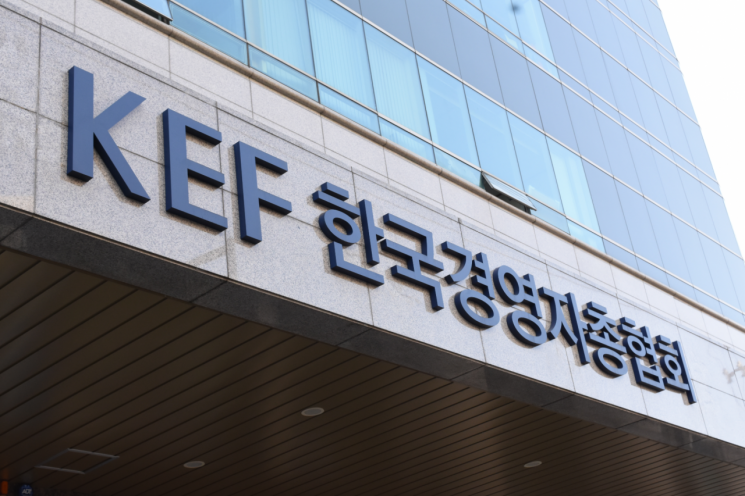
The Korea Employers Federation (KEF) held a symposium on the 28th titled 'Problems and Improvement Measures of Recent In-House Subcontracting Judgments.'
Lee Dong-geun, Vice Chairman of KEF, said in his opening remarks, “Currently, our economic environment demands agile responses from companies more than ever due to the advancement of the 4th Industrial Revolution. Our courts tend to apply stricter standards compared to competing countries, judging the use of in-house subcontracting as illegal dispatch, which raises significant concerns in the industrial field.”
Vice Chairman Lee added, “Unlike competing countries such as Germany and Japan, our Dispatch Act restricts dispatch targets to 32 industries, making it very rigid. Therefore, the distinction between contracting and dispatching needs to be approached more cautiously. Improvements such as shifting the regulation method of permitted dispatch work from the current positive list system to a negative list system are necessary.”
Following this, Professor Lee Jung of the Hankuk University of Foreign Studies Law School presented on the topic ‘Rational Judgment Criteria for Contracting and Dispatching in the Digital Age.’ Professor Lee evaluated, “Recent rulings contain many issues, such as interpreting MES, which is an information provision tool for contracting purposes, as command and control under the Dispatch Act.”
Regarding why only in Korea, unlike Japan, are rulings denying the legality of in-house subcontracting in steel processes issued, he pointed out, “This stems from differences in perspectives on disguised contracting.” He suggested, “In Japan, if dispatch-like elements are detected in a contracting agreement, administrative guidance is the principle for correction and supervision. It would be efficient for Korea as well to resolve disputes surrounding contracting and dispatching through administrative supervision and guidance.”
The second presenter, Attorney Lee Wook-rae of Taepyungyang Law Firm, emphasized, “It is unreasonable to consider sharing the MES system between the primary and subcontractors as worker dispatch.” He stressed, “① Whether there is a function to instruct the individual worker’s task performance itself, ② Whether the contractor retrospectively checks detailed methods and imposes disadvantages if violated, and ③ Whether, as a result, the individual worker belonging to the subcontractor is constrained, all need to be thoroughly examined.”
© The Asia Business Daily(www.asiae.co.kr). All rights reserved.
![Clutching a Stolen Dior Bag, Saying "I Hate Being Poor but Real"... The Grotesque Con of a "Human Knockoff" [Slate]](https://cwcontent.asiae.co.kr/asiaresize/183/2026021902243444107_1771435474.jpg)
















