Top-Level Officials and Relay Talks
Emphasizing the Importance of the Indo-Pacific Strategy
Conveying Intent to Strengthen Cooperation with Talk Countries
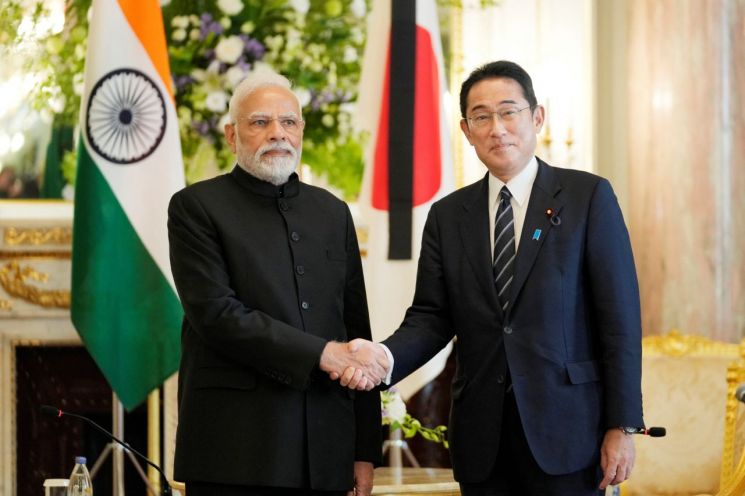 On the 27th, Narendra Modi, Prime Minister of India (left), who visited Japan, shakes hands with Fumio Kishida, Prime Minister of Japan (right), at the Akasaka Palace State Guest House in Tokyo.
 [Image source=Reuters Yonhap News]
[Asia Economy Reporter Lee Ji-eun] Japanese Prime Minister Fumio Kishida held successive talks with foreign leaders, including Indian Prime Minister Narendra Modi, who visited to attend the state funeral of former Prime Minister Shinzo Abe held on the 27th. Prime Minister Kishida emphasized the vision of the "Free and Open Indo-Pacific Strategy" advocated by former Prime Minister Abe and stressed strengthening cooperative relations with the countries he met.
According to Asahi Shimbun and others, Prime Minister Kishida met with top leaders starting with Papua New Guinea Prime Minister James Marape at the State Guest House in Minato-ku, Tokyo, on the same day.
In a meeting with Australian Prime Minister Anthony Albanese, a member of the security cooperation group "Quad," Kishida said, "To realize the Free and Open Indo-Pacific Strategy advocated by former Prime Minister Abe, I want to deepen cooperation with Australia." Albanese responded, "Without former Prime Minister Abe's leadership, we would not have been able to launch the Quad."
During the meeting with Prime Minister Modi, Kishida stated, "I will cooperate with Prime Minister Modi for the Free and Open Indo-Pacific Strategy." Prime Minister Modi also expressed expectations, saying, "Under Prime Minister Kishida's administration, the relationship between Japan and India is highly anticipated."
In talks with former French President Nicolas Sarkozy, remarks were made emphasizing Japan's status in the Indo-Pacific region. Former President Sarkozy said, "The axis of the world has recently shifted eastward from Western countries, and Japan has established itself as a stable axis among them," adding, "In a situation where terrible wars like the Russia-Ukraine war are taking place, a stable axis is very important."
On the same day, Dutch Foreign Minister Wopke Hoekstra, who met with Prime Minister Kishida, conveyed, "The Netherlands will also contribute to the stability of this region built by former Prime Minister Abe."
Prime Minister Kishida plans to spread the concept of the Indo-Pacific Strategy, regarded as a legacy of former Prime Minister Abe, through Abe's state funeral. Earlier, Yomiuri Shimbun quoted a Ministry of Foreign Affairs official saying, "Government officials see this condolence diplomacy as beneficial to national interests," and "It is expected to be an excellent opportunity to inform the international community of the 'Free and Open Indo-Pacific' vision, which the Abe Cabinet promoted as a joint diplomatic strategy with the United States."
Prime Minister Kishida plans to meet with more than 30 foreign leaders by the 28th. The previous day, he held talks with nine leaders, including U.S. Vice President Kamala Harris and Vietnamese President Nguyen Xuan Phuc. On the 28th, he is scheduled to meet with Prime Minister Han Duck-soo and Cambodian Prime Minister Hun Sen, among others.
© The Asia Business Daily(www.asiae.co.kr). All rights reserved.
![Clutching a Stolen Dior Bag, Saying "I Hate Being Poor but Real"... The Grotesque Con of a "Human Knockoff" [Slate]](https://cwcontent.asiae.co.kr/asiaresize/183/2026021902243444107_1771435474.jpg)















