Exports of Eco-Friendly Cars Receiving Subsidies in the US Reach 40,000 in H1
Second Highest Among Overseas Makers Outside the US
Korean Eco-Friendly Car Sales Account for 10%, Subsidies 22%
Industry: "IRA Raises Subsidies by 10 Million Won... Annual Export Disruption of 100,000 Units"
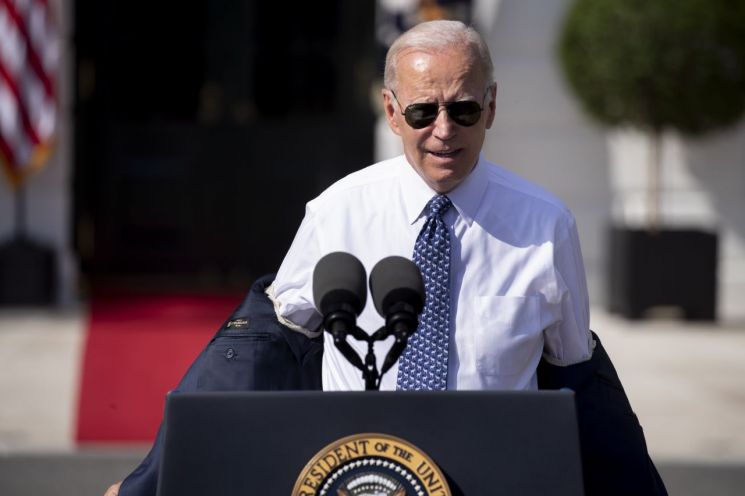 U.S. President Joe Biden is taking off his coat while delivering a speech at the Inflation Reduction Act (IRA) legislative commemoration event held on the South Lawn of the White House in Washington, D.C., on the 13th (local time).
 [Asia Economy Reporter Choi Dae-yeol] Hyundai Motor and Kia have received subsidies exceeding 400 billion KRW while selling eco-friendly vehicles in the United States during the first half of this year. By nationality of automaker, this is the second highest amount after local U.S. manufacturers. According to the U.S. Inflation Reduction Act (IRA), such strong 'allies' are expected to disappear going forward.
According to data obtained on the 27th by Rep. Koo Ja-geun of the People Power Party, a member of the National Assembly’s Industry, Trade, Energy, Small and Medium Enterprises Committee, from the Korea Automobile Manufacturers Association, Hyundai Motor and Kia exported a total of 41,287 eco-friendly vehicles (CV·Clean Vehicle) to the U.S. in the first half of this year. This includes 32,271 pure electric vehicles, 133 hydrogen fuel cell vehicles, and 8,883 plug-in hybrids (PHEV).
Eco-friendly vehicle exports to the U.S. have already far exceeded last year’s total export volume (29,837 units). Last year, the share of eco-friendly vehicles among all models including internal combustion engines was about 3.8%, but in the first half of this year, this share increased significantly to 10.0%.
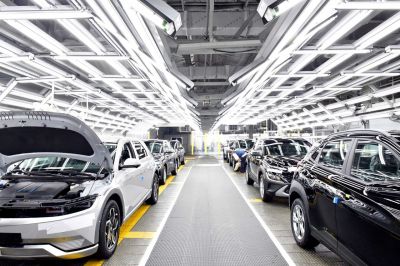 The dedicated electric vehicle Ioniq 5 produced at Hyundai Motor Company's Ulsan plant
 Since the Biden administration took office and began expanding electric vehicle adoption, Hyundai Motor and Kia have greatly benefited. About 420,000 vehicles received electric vehicle subsidies in the U.S. during the first half of this year, of which Korean brands accounted for approximately 44,600 units, ranking second by brand nationality after local U.S. makers with 292,600 units. The market share reached 10.6%.
In particular, Korean-made eco-friendly vehicles received a relatively larger portion of the subsidies. The subsidies paid during this period amounted to about $1.429 billion, of which Korean eco-friendly vehicles received approximately $316.5 million (about 450 billion KRW). While the sales volume was just over 10%, the subsidies accounted for 22.6%.
In Korea, the government directly provides subsidies to automakers for the same vehicles, whereas in the U.S., the system considers the buyer’s income level and provides tax credits at the end of the year, which accounts for the difference. In the U.S., electric vehicles exceeding a certain price or buyers whose income exceeds a certain threshold do not qualify for tax credit benefits.
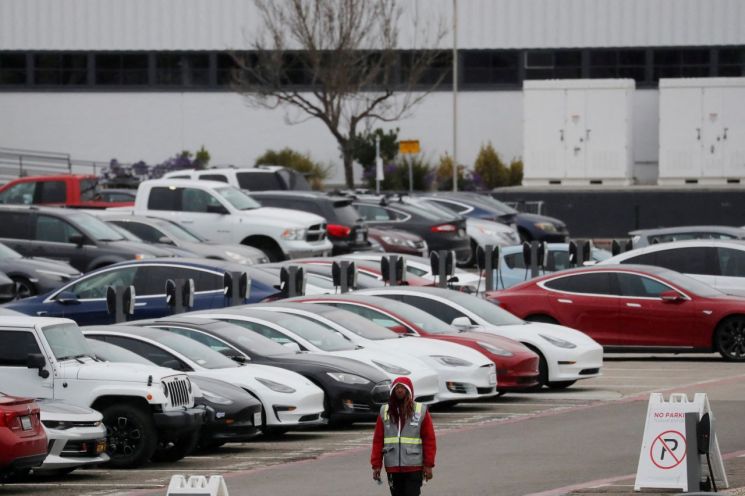
Due to the Inflation Reduction Act, subsidies are only provided for vehicles finally assembled locally (in North America), so Hyundai Motor and Kia’s eco-friendly vehicles no longer qualify for electric vehicle tax credits. The local assembly requirement has been applied since the law’s enforcement, and from next year, the origin ratio of raw materials for key electric vehicle components such as batteries will also be considered. Hyundai Motor and Kia have recently been rapidly increasing the adoption of Chinese-made batteries. This is the background for the expected difficulty in exporting Korean-made electric vehicles to the U.S.
The Korea Automobile Manufacturers Association stated, "With the disappearance of the $7,500 (about 10 million KRW) subsidy per vehicle for Korean-made vehicles, there is a concern that export routes for 100,000 units annually may be blocked," and added, "Meanwhile, U.S. companies such as Ford and General Motors (GM) will gain significant windfall benefits from local production."
Industry insiders emphasize that the U.S. Inflation Reduction Act violates the Korea-U.S. Free Trade Agreement (FTA) and that Korean-made electric vehicles should receive the same benefits as locally produced ones. Rep. Koo said, "The Inflation Reduction Act clearly violates WTO agreements and the Korea-U.S. FTA," and urged, "Since Korean automakers have invested over $13 billion in the U.S. and employ more than 100,000 people, the Ministry of Trade, Industry and Energy should work to resolve the issue from a mutually beneficial perspective between the two countries."
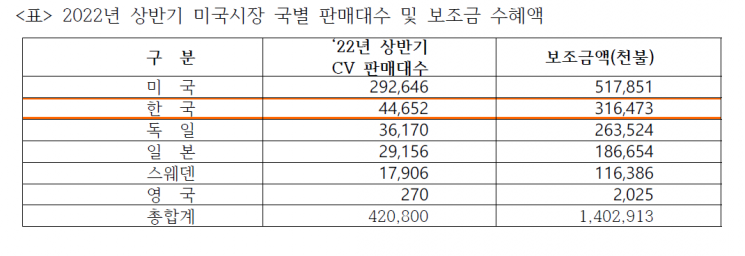 Number of Eco-Friendly Vehicle Sales and Subsidy Receipt Status in the U.S. by Nationality of Completed Car Brands
© The Asia Business Daily(www.asiae.co.kr). All rights reserved.
![Clutching a Stolen Dior Bag, Saying "I Hate Being Poor but Real"... The Grotesque Con of a "Human Knockoff" [Slate]](https://cwcontent.asiae.co.kr/asiaresize/183/2026021902243444107_1771435474.jpg)

















