[Asia Economy Reporter Kim Daehyun] The Supreme Court has ruled that recognition of a work-related injury does not necessarily impose civil liability for damages on the company.
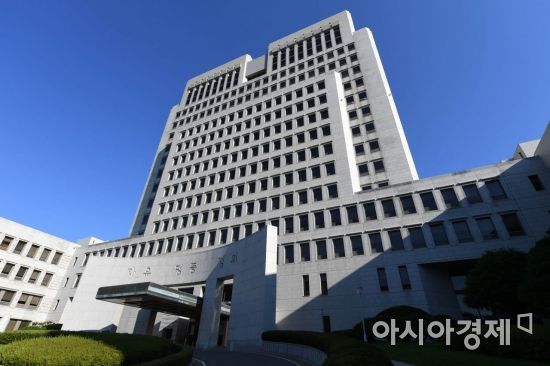
On the 27th, the Supreme Court's First Division (Presiding Justice No Taeak) upheld the lower court's ruling dismissing the appeal filed by the family of Mr. A against B Heavy Industries in a damages claim lawsuit.
Previously, Mr. A joined B Heavy Industries in 1985 and worked as a ship welder. In 2008, he was diagnosed with Parkinson's disease. He applied for medical care benefits from the Korea Workers' Compensation and Welfare Service in 2010 and was recognized through an administrative lawsuit.
After Mr. A passed away in 2015, his family filed a damages claim lawsuit against B Heavy Industries, alleging that the company violated its duty of care, which led to Mr. A contracting Parkinson's disease.
The first trial court dismissed the family's claim. Although it acknowledged the company's breach of duty of care, it found insufficient evidence to establish a causal relationship between the breach and Parkinson's disease.
In the second trial, the family argued that "since the court recognized the work-related injury in the previous administrative lawsuit, the causal relationship between the work and the disease has already been confirmed."
However, the appellate court also rejected their argument. The appellate court held that the administrative court only determined Mr. A's Parkinson's disease as a work-related injury under the Industrial Accident Compensation Insurance Act, but did not recognize the causal relationship. The Enforcement Decree of the Industrial Accident Compensation Insurance Act stipulates that 'if a worker has a history of working in manganese exposure for more than two months and shows symptoms or signs of Parkinson's disease, it is considered an occupational disease.'
The Supreme Court agreed with this judgment. Furthermore, the Supreme Court upheld the lower court's ruling dismissing the family's damages claim lawsuit against the welding rod manufacturer, stating it was difficult to recognize a defect in the product.
A Supreme Court official stated, "The lower court's judgment that recognition of a work-related injury in an administrative lawsuit does not necessarily mean that the causal relationship between breach of duty of care and damages must be recognized in a civil lawsuit is not problematic."
© The Asia Business Daily(www.asiae.co.kr). All rights reserved.
![Clutching a Stolen Dior Bag, Saying "I Hate Being Poor but Real"... The Grotesque Con of a "Human Knockoff" [Slate]](https://cwcontent.asiae.co.kr/asiaresize/183/2026021902243444107_1771435474.jpg)















