Video Conference of Directors and Senior Officers from Four Countries
Domestic Companies in China Hard to Overlook
[Asia Economy Reporter Han Yeju] On the 27th (local time), the first working-level meeting of the U.S.-led semiconductor alliance 'Chip4 (Korea, U.S., Japan, Taiwan)' was held, marking the beginning of full-scale discussions.
As China continues to express opposition to Korea's participation, domestic companies caught between major powers are facing increasing difficulties. The domestic semiconductor industry plans to seek practical benefits through Chip4 cooperation in line with the government's policy, but they are anxious as damage is inevitable if China acts stubbornly over the negotiation results.
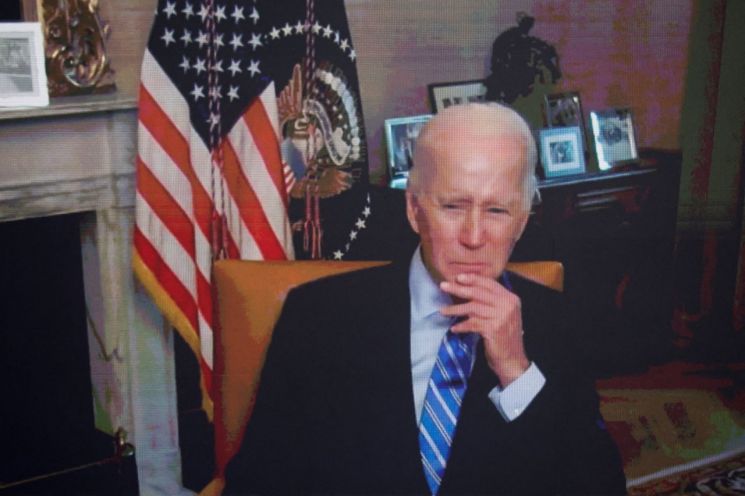
According to the industry on the 28th, the preliminary working-level meeting, the first meeting of Chip4, was held via video conference. The meeting was attended by directors or senior officials from the four member countries: the U.S., Korea, Japan, and Taiwan. The U.S. aims to use Chip4 to foster workforce development, research and development (R&D) cooperation, and diversify semiconductor supply chains as a strategy to check China's semiconductor industry. Through this meeting, the four countries will discuss future agendas in broad terms.
The Korean government has not commented on the progress of the meeting or related matters. Currently, considering that China does not recognize Taiwan as a country, the Korean government is making efforts not to provoke China by naming the Chip4 alliance as a 'quadrilateral consultative body' rather than a 'four-country consultative body.'
This is because China is reacting sensitively to the Chip4 alliance. Recently, Xing Haiming (邢海明), the Chinese Ambassador to Korea, visited Yang Hyangja, an independent lawmaker and chairperson of the People Power Party's Semiconductor Special Committee, to inquire about the progress of Chip4 and expressed opposition to Korea's participation. The ambassador did not hide his discomfort with the supply chain construction led by the U.S. It is reported that Ambassador Xing said, "Can't Korea just not join?" and "How about expanding it to Chip5 including China?"
China is a huge market that accounts for half of the global semiconductor demand. In Korea's case, 48% of last year's memory semiconductor exports worth $69 billion were sold to China. Including exports to Hong Kong, the figure reaches 60%. Korea's dependence on the Chinese market for semiconductor production is also 39.5%, which is significantly higher than Japan's 18.3% or the U.S.'s 6.3%.
Moreover, semiconductor production bases are also located in China. Samsung's investment in Chinese semiconductor companies amounts to $46 billion. The Xi'an plant in China produces 42% of Samsung's NAND flash memory. This accounts for 10% of global production. SK Hynix's investment in Chinese factories is $20 billion. The DRAM semiconductors produced at the Wuxi plant in China account for 47% of SK Hynix's total and 15% of global production. SK Hynix also acquired Intel's Dalian plant.
The industry believes that considering the dominant position and technological capabilities of domestic memory semiconductors, the possibility of China taking actual retaliatory measures is very low. However, it is diagnosed that the voices of domestic companies need to be reflected just in case.
Semiconductor companies also plan to pursue practical benefits through cooperation with Chip4 in line with the government's stance. Kyung Kye-hyun, President of Samsung Electronics, recently met with reporters and said regarding Chip4, "There is a need to distinguish what the government and companies should do," adding, "Since more than 40% of the total IT supply and many major customers are in the Chinese market, it is difficult to lose it, so I conveyed concerns that it would be good to work with the U.S. based on understanding China." President Kyung added, "It is natural that the U.S. does various things (such as leading the Chip4 alliance) for its own interests," and "Samsung Electronics also works for our interests, and although there are cases where interests conflict, we need to coordinate well and build a cooperative relationship with the U.S."
© The Asia Business Daily(www.asiae.co.kr). All rights reserved.
![Clutching a Stolen Dior Bag, Saying "I Hate Being Poor but Real"... The Grotesque Con of a "Human Knockoff" [Slate]](https://cwcontent.asiae.co.kr/asiaresize/183/2026021902243444107_1771435474.jpg)















