Conflicting Positions Between Ministry of Justice and National Assembly Over Enforcement of Revised Prosecutors' Office Act and Criminal Procedure Act Limiting Prosecutors' Investigative Authority
Minister of Justice Han Dong-hoon Appears in Court to Argue Petitioner’s Position
[Asia Economy Reporter Choi Seok-jin, Legal Affairs Specialist] Is the prosecutor's 'investigative authority' a constitutional right?
On May 27, the Constitutional Court will hold a public hearing on whether the Democratic Party's passage of the so-called 'Geomsu Wanbak' (complete removal of prosecutorial investigative authority) laws, including the amended Prosecutors' Office Act and Criminal Procedure Act, one day before President Yoon Seok-yeol's inauguration on May 9, infringed upon the prosecutor's investigative authority.
Although the constitutional trial is a dispute over authority between the government (Ministry of Justice) and the National Assembly, the core issue is whether the opposition lawmakers' amendment of the law restricting the prosecutor's investigative authority can be seen as a fundamental infringement on the investigative authority granted to prosecutors by the Constitution or law.
The petitioners (Minister of Justice and six prosecutors) argue that the National Assembly violated the constitutionally granted investigative and prosecutorial authority of prosecutors through an unconstitutional legislative process, and therefore, the National Assembly's amendment of the law as well as the 'Geomsu Wanbak' law itself are invalid.
On the other hand, the respondents (National Assembly) contend that the prosecutor's investigative and prosecutorial authority are not rights granted by the Constitution but merely legal authorities granted by statute, and thus cannot be infringed upon by legislative amendments made by the National Assembly, which holds legislative power. They argue that determining the subject and scope of investigation or prosecution is a typical legislative matter.
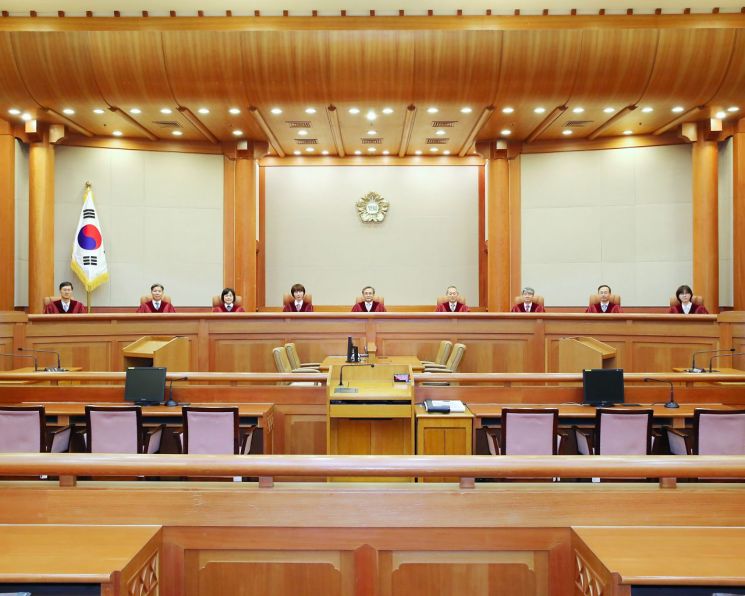
The Constitutional Court will hold a public hearing at 2 p.m. at the Constitutional Court's Grand Bench in Jaedong, Jongno-gu, Seoul, to listen to the opinions of both parties and witnesses in the dispute over authority between the Minister of Justice and the National Assembly.
From the petitioners' side, Minister of Justice Han Dong-hoon will personally explain the purpose of the petition, followed by Professor Lee In-ho of Chung-Ang University Law School providing supplementary explanations as a witness. The respondents have recommended Professor Lee Hwang-hee of Sungkyunkwan University Law School as a witness.
Former Constitutional Court Justice Kang Il-won represents the petitioners, while attorney Noh Hee-beom, a former Supreme Court research judge and Constitutional Court constitutional researcher, represents the respondents.
The key issues in this case are whether the prosecutor's investigative and prosecutorial authority are constitutional rights; whether there were significant procedural defects in the amendment process of the Prosecutors' Office Act and Criminal Procedure Act; whether the passed laws are invalid if the legislative process was illegal; and whether the 'Geomsu Wanbak' laws infringed on the prosecutor's investigative and prosecutorial authority.
The first issue concerns the capacity and standing of the parties in the dispute over authority.
Article 61, Paragraph 2 of the Constitutional Court Act restricts the filing of disputes over authority to cases where a constitutional or legal authority has been infringed or there is a clear risk of infringement.
In the Korean Constitution, the term 'prosecutor' appears only in two places: Article 12, Paragraph 3, which states, "When making an arrest, detention, seizure, or search, a warrant issued by a judge upon the prosecutor's request must be presented," and the postscript of Article 16, which states, "When conducting seizure or search of a residence, a warrant issued by a judge upon the prosecutor's request must be presented." In other words, the Constitution does not explicitly stipulate the prosecutor's investigative or prosecutorial authority.
Therefore, the National Assembly argues that the prosecutor's investigative and prosecutorial authority are not constitutional rights but authorities granted by laws such as the Prosecutors' Office Act and the Criminal Procedure Act. Furthermore, they claim that prosecutors are not constitutional state organs and thus lack the capacity to be parties in disputes over authority.
Conversely, the Ministry of Justice argues that based on the constitutional provisions regarding warrant applications, the prosecutor's investigative and prosecutorial authority are constitutionally recognized rights, and the National Assembly cannot infringe upon their essential parts through legislation. They cite that a warrant is a judge's authorization for compulsory investigative activities.
The second issue concerns procedural defects in the legislative amendment process. The Ministry of Justice claims that the National Assembly violated constitutional principles of majority rule and due process and undermined the multi-party system by: disabling the agenda adjustment committee through Representative Min Hyeong-bae's 'covert party change'; rendering unlimited debate (filibuster) in the plenary session ineffective by splitting the session; and submitting and voting on amendment proposals unrelated to the plenary agenda.
In response, the National Assembly argues that there were no violations of the Constitution or the National Assembly Act during the legislative process, and even if procedural violations occurred, only the internal bodies of the National Assembly whose procedural rights were infringed can raise such issues, not external state organs like prosecutors. They acknowledge that the rights of opposition lawmakers from the People Power Party at the time may have been infringed but assert that this is unrelated to the infringement of the prosecutor's investigative authority.
The third and fourth issues are closely connected. They concern whether the prosecutor's investigative or prosecutorial authority was infringed by the National Assembly's amendments and whether the amended laws are invalid, essentially addressing the constitutionality of the 'Geomsu Wanbak' laws.
The amended Prosecutors' Office Act reduced the crimes for which prosecutors can initiate investigations from six major crimes to two categories: corruption and economic crimes; prohibited prosecutors from prosecuting crimes they initiated investigations on; and introduced a provision requiring the Prosecutor General to report to the National Assembly on investigative departments.
The amended Criminal Procedure Act narrowed the scope of prosecutors' supplementary investigations on cases transferred from the police; introduced a prohibition on separate investigations; and prevented complainants from appealing police decisions not to prosecute.
The Ministry of Justice argues that these amendments infringe upon the essential parts of the prosecutor's investigative and prosecutorial authority. In particular, the provision depriving complainants of the right to appeal police non-prosecution decisions allows the police to make final non-prosecution decisions on complaint cases, violating the Constitution and infringing on the prosecutor's investigative and prosecutorial authority. They also argue that this discriminates between complainants and accusers, violating the principle of equality.
Conversely, the National Assembly contends that procedural defects cannot infringe on the substantive rights of prosecutors such as investigative authority, and that the amendments did not restrict the prosecutor's warrant application rights but rather legitimately exercised legislative authority by reducing and adjusting investigative authority not explicitly stipulated in the Constitution.
In past cases such as the forced passage of the Media Act, the Constitutional Court recognized legislative rights infringements against opposition lawmakers but held that already passed laws were not invalid, considering the principle of separation of powers.
Therefore, even if the Constitutional Court acknowledges clear illegality in the legislative process, it is difficult to predict that it will automatically invalidate the amended laws.
Decisions in disputes over authority require the approval of a majority (five or more) of the justices involved in the final hearing.
Meanwhile, the Constitutional Court is currently reviewing a dispute over authority and injunction application filed earlier by the People Power Party against the Ministry of Justice. The Court views the infringement of the prosecutor's investigative authority as the core issue in this case and has decided to hold a public hearing on the Ministry of Justice's petition, but it is likely that the final rulings on both cases will be announced simultaneously.
© The Asia Business Daily(www.asiae.co.kr). All rights reserved.
![Clutching a Stolen Dior Bag, Saying "I Hate Being Poor but Real"... The Grotesque Con of a "Human Knockoff" [Slate]](https://cwcontent.asiae.co.kr/asiaresize/183/2026021902243444107_1771435474.jpg)
















