Humanity's First Earth Defense Experiment 'DART' Successfully Collides Spacecraft with Asteroid
It Takes Some Time to Confirm Results Like Orbit Change Degree
Heightened Awareness After 2013 Chelyabinsk Asteroid Explosion
Major Powers Respond, South Korea Also Establishes Observation Network
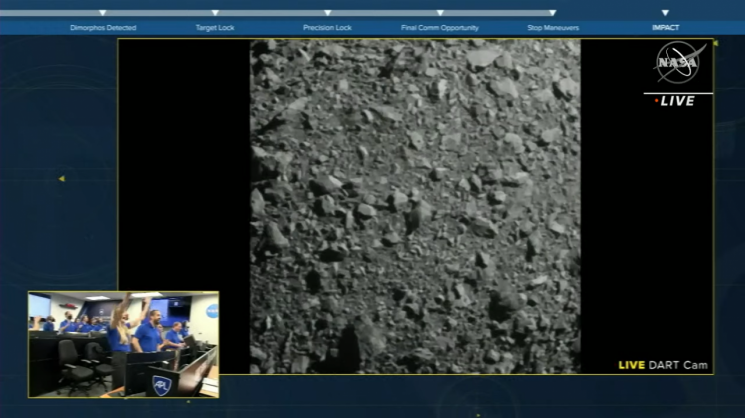
[Asia Economy Reporter Kim Bong-su] The National Aeronautics and Space Administration (NASA) successfully conducted humanity's first asteroid impact mitigation Earth defense experiment on the morning of the 26th (Eastern Time, USA). The Double Asteroid Redirection Test (DART) spacecraft, developed at a cost of approximately 400 billion KRW (330 million USD), was deliberately crashed into an asteroid near Jupiter. The final success, including whether the orbit was altered, will have to wait for observations from the site as well as ground and space telescopes. While one might wonder "why do such a thing," the fear that asteroids could cause human extinction has long been a warning from scientists. In 2013, a 20-meter diameter asteroid suddenly exploded over Chelyabinsk in central Russia, shattering an entire city. More than 1,500 citizens were injured, serving as a wake-up call about the threat of asteroid impacts that humanity had forgotten.
◇Spacecraft Impact Success, On-site Observation Underway
On that day, the DART spacecraft collided at a speed of 6.6 km/s with Dimorphos, the moon of the Didymos asteroid, near Jupiter, approximately 11 million km from Earth. It is expected to take some time to confirm the results of this experiment. Pre- and post-impact on-site observations were conducted by LICIACube, a small satellite developed by the Italian Space Agency that accompanied the DART spacecraft. The LICIACube satellite photographed Dimorphos three minutes after the collision and transmitted the images, which NASA plans to release the following day.
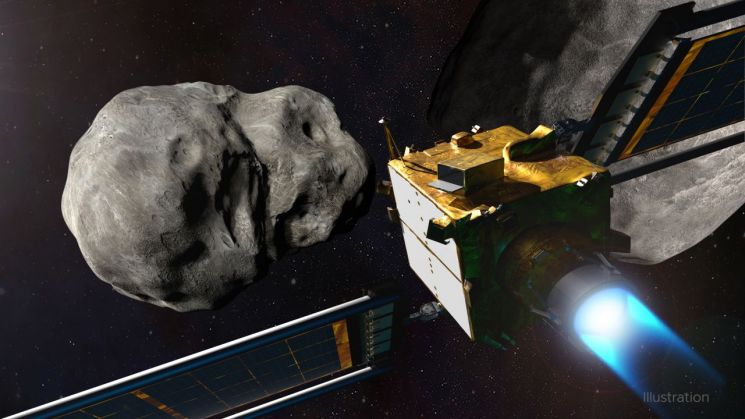
Ground-based astronomical telescopes worldwide, as well as the Hubble and James Webb space telescopes, are also being mobilized. NASA plans to observe whether the speed and trajectory of Dimorphos, orbiting Didymos, have changed to verify the impact results. Scientists predict that the effect of the collision will vary depending on whether Dimorphos is a solid rock or a loose gravel pile, but expect the orbital period to shorten by 10 to 15 minutes, which will ultimately alter the solar orbit time of its parent asteroid Didymos. The final results will be confirmed by the Hera spacecraft, launched by the European Space Agency (ESA) after 2027.
◇Asteroids, Silent Extinction Agents
Mass extinctions, where over 75% of species disappear simultaneously, have occurred five times in Earth's history. Most of these events are analyzed to have been caused by asteroid impacts and the resulting crustal changes, volcanic eruptions, and global warming phenomena due to dust, smoke, and ash. The extinction of dinosaurs about 66 million years ago is believed to have been caused by an asteroid approximately 10 km in diameter colliding with the Yucatan Peninsula in Mexico. Scientists discovered iridium, a major component of extraterrestrial meteorites, in strata worldwide from that period and confirmed a large impact crater in the Yucatan Peninsula.
Small asteroids and comets about 150 meters in diameter are even more dangerous. As in the Chelyabinsk case, current technology makes it difficult to detect them before impact, making them truly "silent killers" that approach suddenly. According to the Korea Astronomy and Space Science Institute, there are about 23,000 near-Earth asteroids, of which about 10% could pose a threat to Earth. Four asteroids, including Apophis and Bennu, occasionally approach Earth, raising potential collision concerns. However, recent NASA observations have confirmed that Apophis's orbit has changed, eliminating the possibility of collision within the next 100 years. Bennu is expected to pass between Earth and the Moon in 2135 and will make its closest approach to Earth in 2181.
 (Photo by National Geographic Channel)
◇Major Powers’ ‘Earth Defense’ Responses
The United States began seriously planning "Earth defense" after the Chelyabinsk asteroid explosion. At one point, it planned an experiment to capture an asteroid and enter the atmosphere, but due to cost and technical limitations, it shifted to the DART project. The U.S. plans to launch a space telescope specializing in observing near-Earth asteroids after 2026 to establish an early warning system. It is also considering impact experiments on Bennu. Other space powers such as China and Russia are also taking action. China announced plans in April this year during the National Space Day event to conduct asteroid impact experiments and establish an early warning system between 2025 and 2026. Russia revealed plans in 2016 to launch intercontinental ballistic missiles (ICBMs). South Korea has been operating its own astronomical telescope network called the "Optical Wide-field Patrol Network for Space Objects (OWL-Net)" since 2015 to observe asteroids and space debris. The Air Force has also been operating a space object monitoring system since early this year.
There are concerns about the "weaponization of asteroids." In fact, shortly after the DART spacecraft launch last November, the U.S. defense science journal The Debrief published an article quoting experts saying, "It is the most powerful and catastrophic weapon and theoretically possible. However, the technology still has a long way to go."
© The Asia Business Daily(www.asiae.co.kr). All rights reserved.
![Clutching a Stolen Dior Bag, Saying "I Hate Being Poor but Real"... The Grotesque Con of a "Human Knockoff" [Slate]](https://cwcontent.asiae.co.kr/asiaresize/183/2026021902243444107_1771435474.jpg)

















