Hanwha Focuses on Light Aircraft Carrier Construction Project through Acquisition of Daewoo Shipbuilding & Marine Engineering
Synergy Expected by Utilizing Subsidiary Hanwha Systems' Combat Systems
Some Doubt Competitive Landscape Due to Separate Contracting Format
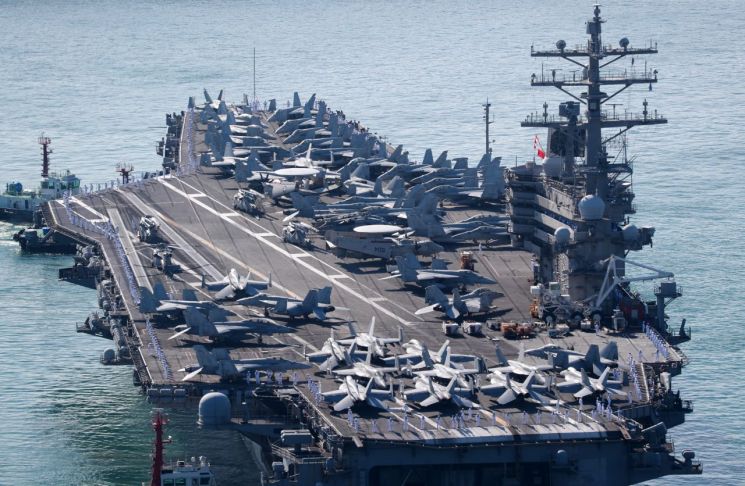
[Asia Economy Yang Nak-gyu, Military Specialist Reporter] Hanwha Group has risen as the "Lockheed Martin of Korea" by acquiring Daewoo Shipbuilding & Marine Engineering (DSME). With this acquisition, Hanwha plans to transform into a "comprehensive land, sea, and air defense company." In particular, it is expected to make a decisive move in next-generation shipbuilding projects such as aircraft carriers, together with Hanwha’s defense affiliates.
According to the defense budget included in the 2023 budget proposal submitted to the National Assembly earlier this month, no budget has been allocated for the light aircraft carrier project. This has raised concerns about the potential collapse of the aircraft carrier project. However, there is also an interpretation that the project’s flame has not been completely extinguished. Recently, Kim Seung-gyeom, Chairman of the Joint Chiefs of Staff, appeared before the National Assembly’s Defense Committee and responded affirmatively when asked whether the domestic development plan for carrier-based aircraft for the light aircraft carrier project was considering the KF-21.
If the light aircraft carrier project proceeds, the leading candidate is Daewoo Shipbuilding & Marine Engineering. Starting with the construction of the KSS-I class submarines in the late 1980s, DSME participated in the KSS-II and KSS-III projects. Based on over 30 years of unparalleled expertise in building special-purpose vessels, DSME has a track record of constructing more than 50 combat ships, including one 10,000-ton destroyer. DSME has also partnered with the Italian state-owned shipyard Fincantieri for aircraft carrier construction. Fincantieri has experience building the U.S. next-generation frigates and two Italian light aircraft carriers.
Accordingly, Hanwha Group, which decided to acquire DSME, is expected to actively pursue orders for the light aircraft carrier construction project. The capabilities of its affiliates are supportive. Hanwha Systems has developed combat systems for over 80 naval vessels, including warships and submarines. Leveraging cutting-edge multifunction radar technology, it is currently developing the combat system and Integrated Mast (I-MAST?a new concept weapon system that enhances a ship’s stealth capabilities) for the Korean Destroyer Experimental (KDDX). Recently, it also submitted a proposal to participate in the research and development project for the ‘Shipborne Electronic Warfare Equipment-II.’
A Hanwha Group official said, “Based on vertical integration of ship weapon systems, it is possible to shorten shipbuilding schedules as well as reduce costs,” adding, “By applying maritime unmanned system technology, we can secure capabilities to develop autonomous navigation-capable civilian merchant ships.”
Competitors have also accelerated their moves. Hyundai Heavy Industries has teamed up with LIG Nex1 to compete against the ‘Daewoo Shipbuilding & Marine Engineering-Hanwha Systems’ alliance. Hyundai Heavy Industries and LIG Nex1 have signed a memorandum of understanding (MOU) for research and development of a Korean-style aircraft carrier. The two companies promised technological cooperation not only for the combat system to be installed on the light aircraft carrier but also for multifunction radar (MFR) and control radar. These technologies are considered core to enhancing the operational capabilities of aircraft carriers.
Within the industry, there are also criticisms that even if Hanwha acquires DSME, the nature of the defense sector means that projects are carried out through separate contracts, which may limit synergy effects. Since weapon system procurement projects are contracted separately by sector, competition is inevitable. Even if DSME wins the light aircraft carrier project, combat systems and radars will be separately contracted, making it difficult for Hanwha Group to monopolize the project.
The Korean-style light aircraft carrier, a long-cherished project of the Navy since the 1990s, is estimated to cost about 2.03 trillion won for construction and about 100 billion won annually for operation. If the light aircraft carrier project proceeds, it is expected to go through 2 to 3 years of basic design, 5 to 7 years of detailed design and construction phases, and then be delivered to the Navy.
© The Asia Business Daily(www.asiae.co.kr). All rights reserved.
![Clutching a Stolen Dior Bag, Saying "I Hate Being Poor but Real"... The Grotesque Con of a "Human Knockoff" [Slate]](https://cwcontent.asiae.co.kr/asiaresize/183/2026021902243444107_1771435474.jpg)















