The Second Mass-Produced Distributed Power High-Speed Train Following 'KTX-Eum' Emerges
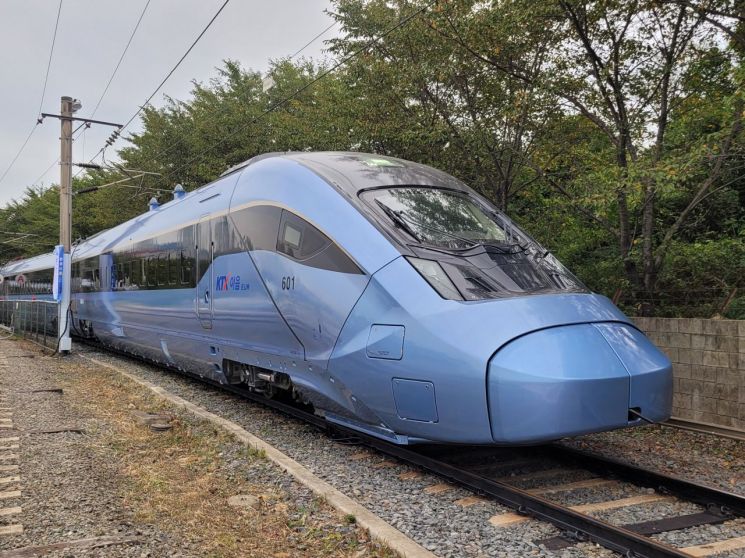
[Asia Economy Reporter Park Sun-mi] The production of the country's first 320km/h distributed power high-speed train has been completed.
Hyundai Rotem announced on the 27th that it held a 'EMU-320 Distributed Power High-Speed Train Delivery Ceremony' at its Changwon factory and delivered the EMU-320 high-speed train. The event was attended by Park Wan-su, Governor of Gyeongsangnam-do, Kim Young-sun, member of the People Power Party, Koo Ja-cheon, Chairman of the Changwon Chamber of Commerce and Industry, Kim Min-tae, Director of Railway Operations at the Ministry of Land, Infrastructure and Transport, as well as Hyundai Rotem President Lee Yong-bae and representatives of local partner companies.
The delivered EMU-320 high-speed train will undergo mainline test runs and then be supplied to Korea Railroad Corporation (KORAIL), after which it will operate alongside KTX-I, KTX-Sancheon, and others on existing high-speed rail lines such as the Gyeongbu High-Speed Line and Honam High-Speed Line.
The EMU-320 high-speed train is a distributed power high-speed train, the same type as the currently operating 'KTX-Eum'. The 'KTX-Eum' is a 260km/h class distributed power high-speed train, with 114 cars currently in commercial operation since January last year on lines including the Jungang Line, Gangneung Line, Yeongdong Line, and Jungbu Naeryuk Line.
A distributed power high-speed train is a type where the driving power is distributed across all cars, unlike the concentrated power type which has power units only on the front and rear power cars. This distributed power system offers superior acceleration and deceleration performance. KTX-I, KTX-Sancheon, and SRT are examples of concentrated power high-speed trains.
In particular, distributed power high-speed trains are efficient for Korea's railway environment, which features many curves and short distances between stations. Unlike concentrated power trains, they do not require separate power cars, resulting in better passenger transport capacity. Globally, distributed power high-speed trains are increasingly preferred due to their operational efficiency. Domestically, existing concentrated power high-speed trains are expected to be gradually replaced by the distributed power EMU-320 high-speed trains.
Hyundai Rotem plans to successfully complete the scheduled mainline test runs after today's delivery and actively respond to customer satisfaction (CS) and various technical supports after delivery to ensure the successful commercial operation of the EMU-320 high-speed train. Additionally, following the initial set delivered today, the second set is scheduled for delivery in November.
A Hyundai Rotem official said, “The EMU-320 high-speed train, developed with domestic technology following the KTX-Eum, is expected to serve as a foundation for further growth of the domestic railway industry. We will do our best to ensure that the EMU-320 high-speed train, which will be the fastest commercial high-speed train in the country, operates stably.”
© The Asia Business Daily(www.asiae.co.kr). All rights reserved.
![Clutching a Stolen Dior Bag, Saying "I Hate Being Poor but Real"... The Grotesque Con of a "Human Knockoff" [Slate]](https://cwcontent.asiae.co.kr/asiaresize/183/2026021902243444107_1771435474.jpg)















