National Assembly Science and ICT Committee Members Park Wan-joo and Kim Young-joo
to Hold Legislative Policy Forum on the 26th
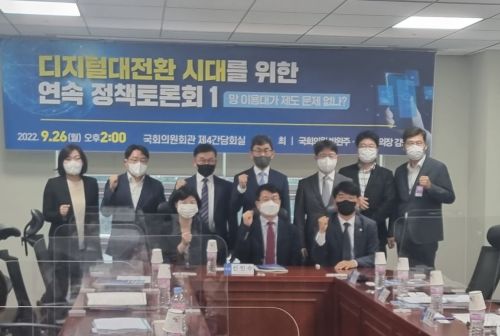 On the afternoon of the 26th, Park Wan-joo, a member of the Democratic Party belonging to the National Assembly Science, Technology, Information, Broadcasting and Communications Committee, and Kim Young-joo, the Deputy Speaker of the National Assembly, held a continuous policy forum titled "Is There Any Problem with the Network Usage Fee System?" at the National Assembly for the era of digital transformation.
[Asia Economy Reporter Cha Min-young] As Google leads a 'petition against' using its blog and social networking services (SNS) to block legislative discussions on the 'Network Usage Fee Act (Amendment to the Telecommunications Business Act),' a policy forum related to the legislation was held at the National Assembly.
On the afternoon of the 26th, Park Wan-joo, a member of the National Assembly's Science, Technology, Information and Broadcasting and Communications Committee from the Democratic Party of Korea, and Kim Young-joo, the Deputy Speaker of the National Assembly, hosted the "Continuous Policy Forum for the Digital Transformation Era: Is There a Problem with the Network Usage Fee System?" at the National Assembly. This was the first discussion session following the public hearing held at the full committee meeting on the 20th.
The event was chaired by Professor Shin Min-soo of Hanyang University, with presentations by Cho Dae-geun, a senior advisor at the law firm Kwangjang, and Professor Choi Kyung-jin of Gachon University. Government officials, including Kim Jun-mo, Director of the Telecommunications Competition Policy Division at the Ministry of Science and ICT, and Choi Sun-kyung, Director of the User General Division at the Korea Communications Commission, also participated as panelists. Yang Jung-sook, a former member of the Science, Technology, Information and Broadcasting and Communications Committee who co-proposed related legislation, also attended.
Park Wan-joo, who hosted the event, pointed out, "Network usage fee disputes are likely to expand not only between Internet Service Providers (ISPs) and Content Providers (CPs) but also into various fields where ICT and technology are applied. To prepare for this, terminology must be clarified first, and the scope of application must be clearly defined."
Cho Dae-geun, senior advisor at the law firm Kwangjang, who gave a presentation, analyzed, "For CPs to deliver content to users, they must use the network in some way and pay fees. While mutual settlement-free arrangements may occur depending on negotiations between users, network usage is essentially paid, and institutional discussions are underway to address unfair issues caused by the negotiation power gap between telecom companies and CPs."
Cho identified the core of the dispute as CPs refusing to share costs or passing on costs beyond acceptable levels. With the growth of OTT services, the asymmetry in traffic exchange ratios has become widespread, increasing the scale of costs. Disputes inevitably arise when costs exceed the level ISPs can tolerate.
Professor Choi Kyung-jin of Gachon University opened by saying, "There is a perspective questioning why the government intervenes in what is a civil matter regarding network usage fees, but civil law applies to individual-to-individual issues, not to companies. As network usage is expected to increase in the future, it is meaningful to first discuss the roles and responsibilities of those involved with the network."
Professor Choi discussed various legal issues, explaining that there are complex aspects such as the gratuitous nature of network usage, the relationship definition between ISPs and CPs, the legal nature of network usage fees, criteria for calculating fees, payment methods, whether it violates Free Trade Agreements (FTAs), and the desirable regulatory framework for network usage fees.
He emphasized, "Since the two companies have a merchant relationship, there is a legal relationship, and regarding whether network usage fees violate FTAs, it can be said they do not. CPs should strive to reduce traffic burdens, and ISPs should work to improve network quality." He also added that regulation should be ex-post rather than preemptive obligations.
An Jeong-sang, senior expert of the Democratic Party of Korea, also rebutted claims that the passage of the law to prevent free-riding on networks could burden domestic CPs when expanding overseas, stating, "The facts are incorrect." He explained, "For domestic CPs to expand overseas, they must either provide their platform locally or use overseas platforms, so they already bear costs in some form, making internet free-riding impossible."
The government plans to observe the legislative discussions in the National Assembly and align its steps accordingly. Kim Jun-mo, Director of the Telecommunications Competition Policy Division at the Ministry of Science and ICT, stated, "Network usage fees currently involve various issues and opinions among stakeholders. Rather than viewing it narrowly as a dispute between specific operators, it is necessary to seek solutions from the perspective of coexistence within the network ecosystem."
Choi Sun-kyung, Director of the User General Division at the Korea Communications Commission, also said, "I agree that investment and internet network stability must be guaranteed for the sustainable development of the internet ecosystem. Including clauses prohibiting unfair acts as ex-post regulations in contracts and combining them with preemptive regulations such as surveys will enable efficient law enforcement."
© The Asia Business Daily(www.asiae.co.kr). All rights reserved.
![Clutching a Stolen Dior Bag, Saying "I Hate Being Poor but Real"... The Grotesque Con of a "Human Knockoff" [Slate]](https://cwcontent.asiae.co.kr/asiaresize/183/2026021902243444107_1771435474.jpg)















