46.3% Cite 'Rapid Price Increases' as Reason for Reduced Spending... Expected Consumer Recovery in 'Next Year'>
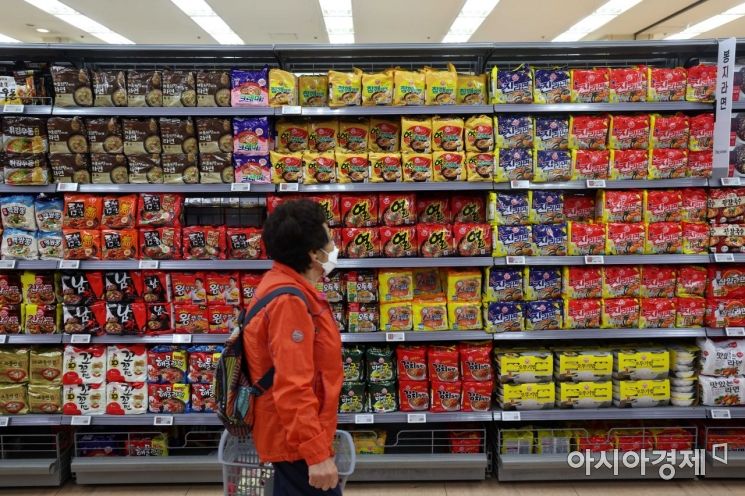
[Asia Economy Reporter Han Yeju] Due to the ongoing high inflation and increased debt repayment burdens caused by interest rate hikes, there is a growing concern that the private consumption growth trend, which had continued since the COVID-19 pandemic, may come to a halt. If the recent slowdown in private consumption, which has been driving our economic growth, materializes, it is expected that this year's growth rate will inevitably be impacted.
The Federation of Korean Industries (FKI) commissioned a survey through the public opinion research firm Mono Research on the 27th, targeting approximately 1,000 citizens nationwide aged 18 and older, to investigate the 'Second Half of 2022 National Consumption Expenditure Plans.' The results showed that 59.7% of respondents plan to reduce their consumption expenditure in the second half of the year compared to the first half. Additionally, respondents on average forecast a 3.6% decrease in consumption expenditure in the second half compared to the first half of the year.
Looking at the data by income quintile, it was found that lower-income groups plan to reduce spending more significantly. For the lowest 20% income group (1st quintile), consumption expenditure in the second half is expected to decrease by an average of 7.9% compared to the first half, whereas the highest 20% income group (5th quintile) plans to maintain spending at nearly the same level as the first half (0.01%). The FKI explained that lower-income groups are more affected by the recent economic downturn and rising prices, which proportionally reduces their consumption capacity.
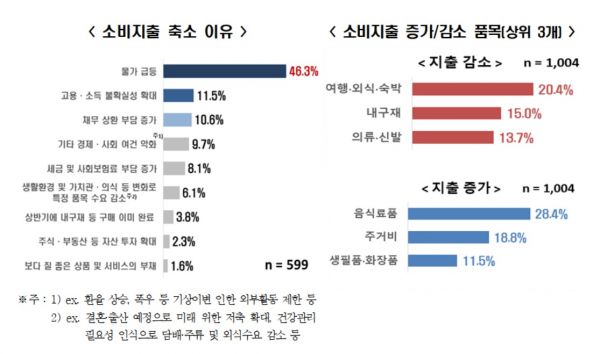
The main reasons for reducing consumption expenditure in the second half were ▲rapid price increases (46.3%), followed by ▲increased employment and income uncertainty (11.5%), and ▲increased debt repayment burdens (10.6%). By category, spending is expected to decrease mainly on ▲face-to-face services such as travel, dining out, and accommodation (20.4%), as well as on ▲durable goods (15.0%) and ▲semi-durable goods like clothing and footwear (13.7%).
Meanwhile, spending on non-durable goods such as ▲food products (28.4%), ▲housing costs (rent, utilities such as electricity and gas) (18.8%), and ▲daily necessities and cosmetics (11.5%) is expected to increase compared to the first half. An FKI official analyzed, "Although prices for food and daily necessities have surged recently, these are essential consumer goods, making it difficult to reduce consumption volume, which likely explains the increase in expected spending for the second half."
Citizens identified the following risk factors that could affect consumption activities in the second half of this year: ▲continued inflation (51.0%), ▲interest rate hikes (28.6%), and ▲contraction of asset markets such as stocks (9.6%). The FKI expressed concern that sustained inflation is reducing real purchasing power, interest rate hikes are increasing debt repayment burdens, and the contraction of asset markets is expanding future income uncertainty, all of which are significantly constraining consumers' spending capacity. In fact, more than half of respondents (53.1%) reported insufficient capacity to carry out their planned consumption for the second half, with 15.1% stating that their capacity is 'very insufficient.'
When asked about the expected timing for consumption to become active again, only 4.1% responded that it would be in the second half of this year, while about half (46.8%) said consumption would revive next year. The shares of those responding 'after 2024' and 'no foreseeable time' were 25.2% and 20.4%, respectively. The FKI interpreted this as consumers postponing their consumption to next year or later due to ongoing uncertainties such as high inflation, high interest rates, and high exchange rates.
For policy tasks aimed at stabilizing livelihoods and improving the consumption environment, citizens cited ▲price stabilization (48.2%), ▲moderation of the pace of interest rate hikes (17.9%), and ▲stabilization of agricultural and fishery product supply (11.9%).
Choo Kwang-ho, head of the FKI Economic Headquarters, said, "While income uncertainty is increasing due to recession concerns, prices of daily necessities such as food continue to soar and loan interest is rising, forcing citizens to tighten their belts. We must focus on stabilizing prices by enhancing the economy’s supply capacity through revitalizing corporate activity and support household liquidity through proactive tax and financial measures."
© The Asia Business Daily(www.asiae.co.kr). All rights reserved.
![Clutching a Stolen Dior Bag, Saying "I Hate Being Poor but Real"... The Grotesque Con of a "Human Knockoff" [Slate]](https://cwcontent.asiae.co.kr/asiaresize/183/2026021902243444107_1771435474.jpg)
















