KOSPI Ends Down Over 3%, KOSDAQ Falls Over 5%
Exchange Rate Fear Pressure Amid Strong Dollar Boost from Europe
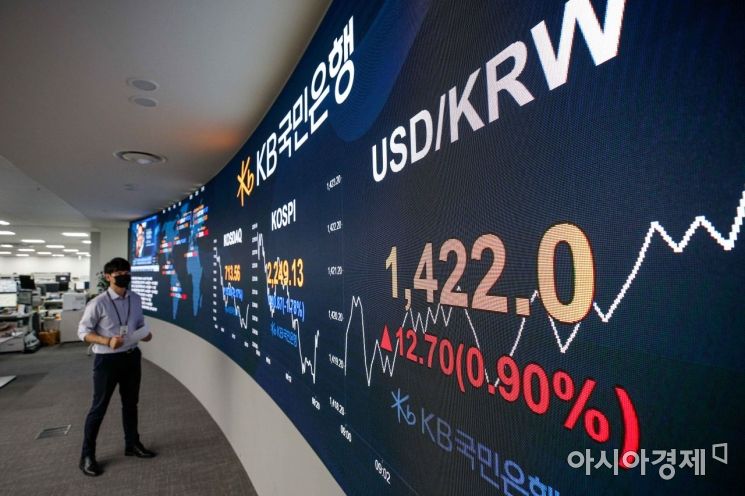 On the 26th, when the won-dollar exchange rate surpassed 1,420 won for the first time in about 13 years and 6 months, dealers were working in the dealing room of KB Kookmin Bank in Yeouido, Seoul. On that day, the KOSPI index opened at 2,260.80, down 29.20 points (1.28%) from the previous trading day, continuing its downward trend. Photo by Jinhyung Kang aymsdream@
[Asia Economy Reporter Hwang Junho] On the 26th, the stock market saw the KOSPI plunge by over 3%. The KOSDAQ dropped by as much as 5%. Although there was no particular reason pressuring the market, fears about the dollar strength triggered by Europe grew stronger than ever, and as investor sentiment weakened, the market fell sharply.
On that day, the KOSPI closed at 2,220.94, down 3.07%. While institutions started net buying from the morning to support the index, individuals and foreigners sold off stocks. Individuals continuously offloaded shares throughout the day, recording net sales worth 245.7 billion KRW.
However, foreigners began net buying in the afternoon as bargain hunting emerged due to the expanding KOSPI decline. But as the market close approached, they switched back to net selling. The net sales by foreigners on that day amounted to 3.6 billion KRW.
This was the third time the KOSPI experienced a decline of over 3%. On January 27, right after the Federal Open Market Committee (FOMC) confirmed tightening intentions, the KOSPI fell 3.50%, and on June 13, the day after the release of the US May Consumer Price Index (CPI) that shocked the market with inflation, it dropped 3.52%.
Kim Daejun, a researcher at Korea Investment & Securities, said, "Even though there were no changes in key indicators that the market focuses on, such as the FOMC and US inflation, the expanded decline has greatly increased fears about the downside. The most unsettling thing is that the trigger leading the market decline is ambiguous, and if it is the dollar strength, it is currently difficult to gauge where its ceiling might be."
KOSPI Drops Over 3%... Only 34 Stocks Rise
Among all KOSPI stocks, only 34 showed gains. Among them, STX was the only stock to hit the upper limit. STX closed at 3,935 KRW, up 29.87% (905 KRW) from the previous trading day, following news that its subsidiary, PK Valve & Engineering, developed the first liquefied hydrogen valve in Korea.
Top market capitalization stocks all recorded declines. Samsung Electronics, the unchanging market leader, fell 1.10% to 53,900 KRW. SK Hynix also closed down 1.20% at 82,500 KRW.
Among the top market cap stocks, those related to secondary batteries experienced significant drops. Representative stocks include LG Energy Solution (-3.04%), Samsung SDI (-2.13%), and LG Chem (-5.46%). Hyundai Motor and Kia also fell 4.20% and 3.61%, respectively.
Han Jaehyuk, a researcher at Hana Securities, stated, "Out of 2,423 listed stocks in the domestic market, 2,324 (95.91%) declined." However, he analyzed, "Nickel-related stocks showed strength following reports that the government's nickel reserves significantly decreased."
On that day, the USD/KRW exchange rate rose 1.56% to 1,431.30 KRW compared to the previous close.
KOSDAQ Drops Over 5%
The KOSDAQ experienced an even larger decline. It fell below the 600-point mark for the first time since June 2020. Foreigners and institutions engaged in net buying worth 122.9 billion KRW and 83.9 billion KRW, respectively, but individuals net sold 190.4 billion KRW, causing the index to take a steep downward path.
Only 65 stocks among all KOSDAQ stocks rose. Top market cap stocks also plummeted. Ecopro BM dropped 8.70%, and L&F fell 8.15%. HLB and Ecopro recorded declines in the 5% range, while JYP ENT. and Celltrion Pharm fell in the 4% range.
Han Jiyoung, a researcher at Kiwoom Securities, said, "Compared to the January and June crashes when the market fell more than 10% in a month, this might be a tougher period in some ways." She added, "Nevertheless, at this point, rather than 'reacting' to violent price movements, it is judged that a strategy of 'responding' according to each one's price change scenario is more necessary."
Seo Sangyoung, a researcher at Mirae Asset Securities, stated, "The weakness today is presumed to be due to the dollar strength caused by the additional sharp drop of the British pound, which pushed the USD/KRW exchange rate above 1,430, expanding the won's depreciation."
He continued, "Attention should be paid to changes in the dollar and bond markets following remarks by Federal Reserve Bank presidents on this day," and added, "Among other economic indicators, the Chicago Fed National Activity Index is also worth noting. Last month it recorded 0.27, supporting a robust US economy, but whether this figure contracts or not could either stimulate or ease recession concerns."
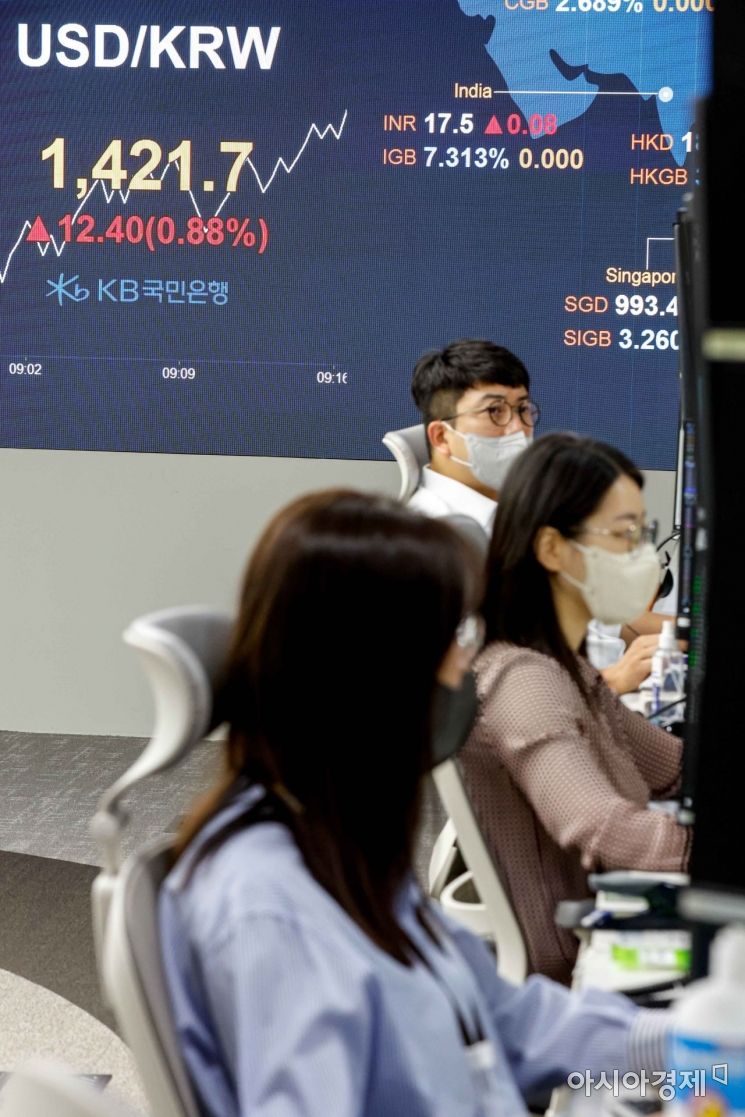 On the 26th, when the won-dollar exchange rate surpassed 1,420 won for the first time in about 13 years and 6 months, dealers were working in the dealing room of KB Kookmin Bank in Yeouido, Seoul. On that day, the KOSPI index opened at 2,260.80, down 29.20 points (1.28%) from the previous trading day, continuing its downward trend. Photo by Jinhyung Kang aymsdream@
© The Asia Business Daily(www.asiae.co.kr). All rights reserved.
![Clutching a Stolen Dior Bag, Saying "I Hate Being Poor but Real"... The Grotesque Con of a "Human Knockoff" [Slate]](https://cwcontent.asiae.co.kr/asiaresize/183/2026021902243444107_1771435474.jpg)
















