Ministry of the Interior and Safety Holds '2022 Local Finance Strategy Meeting'... Targets Local Debt Ratio at 8% and Integrated Fiscal Balance Ratio at 2%
Ministry Emphasizes Urgent Need to Ensure Local Finance Sustainability Amid Low Birthrate and Aging Population
Active Support for Local Governments to Strategically Utilize Idle and Underused Assets to Diversify Revenue
Efforts to Strengthen Local Tax Revenue Base by Reviewing Local Tax Reduction Cases
[Asia Economy Reporter Lim Cheol-young] The government has set targets to reduce the local government debt-to-budget ratio to 8% and the integrated fiscal balance ratio to 2% by 2026, and will significantly expand local government grant tax incentives by more than 20% over five years for local governments that streamline expenditures. Additionally, it will actively support local governments in strategically utilizing idle and underutilized assets to diversify income, and improve the debt ratio of local public enterprises from 33.8% last year to 30% by 2026.
On the 26th, the Ministry of the Interior and Safety (MOIS) held the '2022 Local Finance Strategy Meeting' with local governments nationwide to discuss the new government's direction for local finance management. The Local Finance Strategy Meeting is a forum to share major local finance issues among the central government, local governments, and private experts, and to seek development strategies.
This year's Local Finance Strategy Meeting was attended by over 100 participants, including the 17 metropolitan local governments, Vice Chairman Yoo Jeong-bok of the Korea Association of City and Provincial Governors (Mayor of Incheon Metropolitan City), Lee Man-hee, the secretary of the National Assembly's Public Administration and Security Committee, the Association of Mayors, County Governors, and District Heads, professors, researchers, and officials from central government ministries.
At the meeting, MOIS declared the vision of the new government's local finance management as "Robust Local Finance, Thriving Regional Economy Together," presenting the keywords "Establishing a sound local finance management stance" and "Regional economic recovery and livelihood stabilization," and announced five major strategies and twelve detailed tasks.
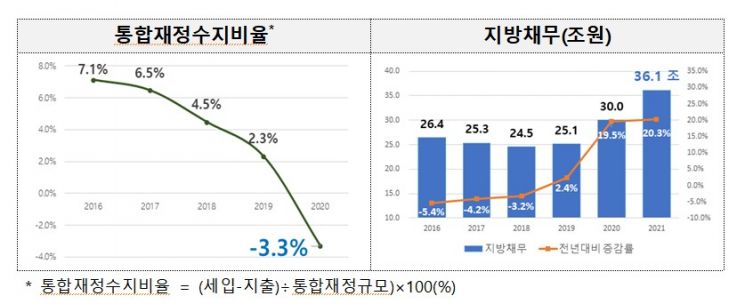
First, MOIS diagnosed that securing the sustainability of local finance in line with national finance is urgent amid uncertain revenue conditions and continuously increasing social welfare demand due to low birth rates and aging population. In 2016, the integrated fiscal balance, calculated by subtracting local government expenditures from revenues, recorded a surplus of 12.5 trillion KRW with an integrated fiscal balance ratio of 7.1%. However, in 2020, the integrated fiscal balance showed a deficit of 9.1 trillion KRW, causing the ratio to sharply drop to -3.3%. Local government debt increased from 26.4 trillion KRW in 2016 to 36.1 trillion KRW in 2021, rising by 9.7 trillion KRW, nearly 40% over five years.
In response, MOIS and local governments discussed a plan to continuously manage and improve the debt-to-budget ratio to 8% and the integrated fiscal balance ratio to 2% by 2026 under a sound fiscal stance. Local governments agreed to strategically manage finances by boldly reorganizing unnecessary budgets, special accounts, and funds, and reinvesting the saved resources into strengthening social safety nets and regional economic recovery.
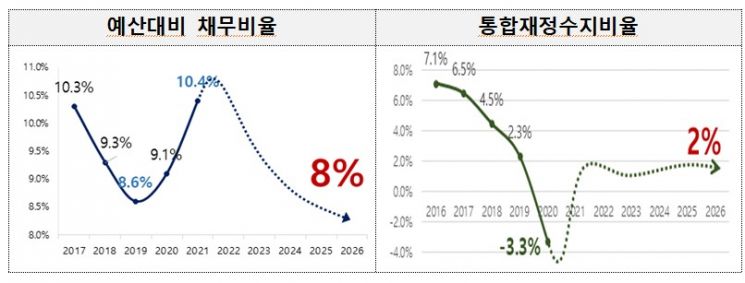
MOIS will also significantly increase grant tax incentives by about 200 billion KRW over five years for local governments that improve expenditure efficiency. Additionally, it will strengthen the evaluation of fiscal soundness during investment reviews for large-scale projects and consider measures to transparently disclose various information related to local finance management to residents. The evaluation weight on local government expenditure soundness will be expanded, and the designation criteria for fiscal caution and crisis local governments will be strengthened, improving the local finance crisis management system.
Furthermore, MOIS plans to improve local tax revenue forecasting to secure predictability of revenues and expenditures and enhance delinquent tax collection efficiency. It will also revise habitual local tax exemption cases to strengthen the local tax revenue base. The government plans to enact the Special Act on Restrictions of Shared Property Privileges to systematically manage shared property privileges and actively support local governments in strategically utilizing idle and underutilized assets to diversify income.
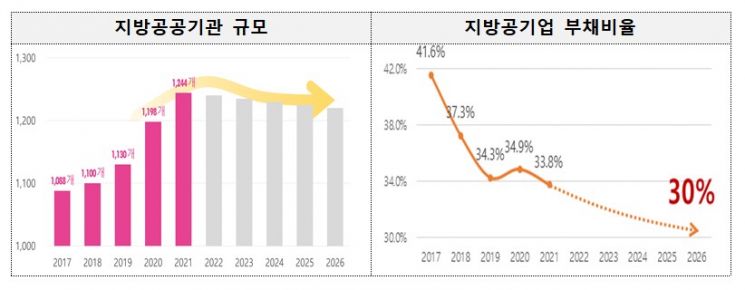
Local public institutions will also be innovated. MOIS will strengthen feasibility reviews and consultations to prevent unnecessary establishment of local public institutions, provide guidelines for consolidation of similar or overlapping institutions, and promote outsourcing or transfer of private competitive businesses (such as golf driving ranges and hotels) to the private sector to improve efficiency and productivity of local public institutions. Moreover, through focused debt management for institutions with debts exceeding 100 billion KRW or debt ratios over 200%, MOIS aims to continuously improve the debt ratio of local public enterprises from 33.8% in 2021 to 30% by 2026.
Support for Regional Economy and Livelihood Stabilization... Introduction of Next-Generation Fiscal System
MOIS plans to use the resources secured through sound fiscal management to intensively support vulnerable social groups by expanding local tax exemptions for all social welfare facilities, and to stabilize livelihoods by supporting small business owners and farmers and fishermen. The scale of 100% exemptions for acquisition tax, property tax, local resource facility tax, registration license tax, and resident tax will be expanded from the current 3,000 locations (29.2 billion KRW) to about 11,000 locations (64.5 billion KRW). Additionally, to support corporate relocation to local areas and foster small and venture businesses, MOIS will improve grant tax distribution criteria and extend local tax exemptions.
In particular, to enhance the self-sustainability of depopulated areas, MOIS plans to improve grant tax distribution criteria to encourage infrastructure improvements such as healthcare and transportation and induce population growth. It will also consider drastically shortening feasibility study and periodic review periods to about half of the current duration to ensure timely investment projects.
Moreover, the next-generation local finance and revenue information system will be sequentially launched from next year, integrating and linking decentralized fiscal and revenue data managed by each local government into a unified system for systematic management. With the establishment of the next-generation local tax revenue information system, from 2024, Seoul's ETAX and the 16 metropolitan and provincial WETAX systems will be integrated, enabling unified local tax inquiry and payment with a single membership registration. Payment methods will diversify with mobile easy payment and virtual accounts, and AI-based consultation assistants will provide taxpayer-tailored services, enhancing taxpayer convenience.
Meanwhile, at the meeting, Kim Jong-han, Vice Mayor of Daegu Metropolitan City, and Shin Dong-heon, Vice Mayor of Cheonan City, Chungnam Province, each presented their fiscal innovation directions and shared them with other local governments. Daegu Metropolitan City announced a fiscal innovation plan for drastic debt reduction by extensively reorganizing its own funds and special accounts, selling idle and unused shared properties, and conducting strong expenditure restructuring on populist, habitual spending and underperforming projects.
Cheonan City, Chungnam Province, shared its fiscal management direction to achieve sustainable growth by restructuring expenditures through reducing current expenses and strengthening the sunset system for local subsidies, using saved resources primarily for local debt repayment, while maintaining strategic investments in support for vulnerable groups and the low-income economy sector.
In the subsequent discussion session, chaired by Professor Yoo Tae-hyun of Namseoul University’s Department of Taxation, Jo Ki-hyun, President of the Local Finance Association, presented on "Local Finance Issues and Development Tasks Focusing on Sound Finance and Budget Efficiency."
Minister Lee Sang-min stated, "It is now time for local governments to go beyond habitual spending, innovate finances, and focus on building ‘Robust Local Finance, Thriving Regional Economy Together’ through mid- to long-term investments for the future." He added, "With this Local Finance Strategy Meeting as an opportunity, the government will continuously work with local governments over the next five years to provide high-quality services to local residents and achieve sound local autonomy for future generations through strategic local finance management."
© The Asia Business Daily(www.asiae.co.kr). All rights reserved.
![Clutching a Stolen Dior Bag, Saying "I Hate Being Poor but Real"... The Grotesque Con of a "Human Knockoff" [Slate]](https://cwcontent.asiae.co.kr/asiaresize/183/2026021902243444107_1771435474.jpg)

















