"Real-time Monitoring of Health and Emotional States"... Privacy Invasion and Stress Risks Raised in the Name of Public Safety
Effectiveness of Accident Prevention Also Debated
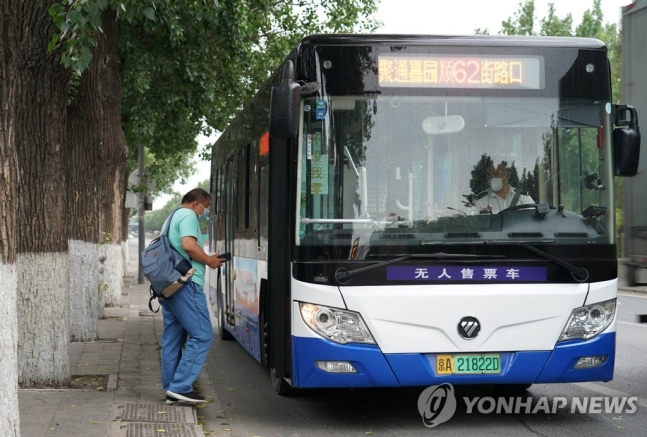 Beijing, China, has decided to equip long-distance bus drivers with "electronic bracelets" that can monitor their health and emotional state. Photo by Yonhap News
[Asia Economy Reporter Kim Juri] Beijing, China, is facing controversy for deciding to equip long-distance bus drivers with "electronic bracelets" that can monitor their health and emotional states for public safety reasons.
On the 26th, the Hong Kong South China Morning Post (SCMP), citing the Beijing Daily, reported that the state-owned Beijing Public Transport distributed 1,800 electronic wristbands to long-distance route drivers using highways and other roads on the 21st.
These wristbands are said to measure vital signs such as the drivers' respiration, body temperature, heart rate, blood oxygen saturation, blood pressure, and sleep, as well as monitor emotional states like anxiety in real time.
This measure was implemented following a fatal accident on the 18th in Guizhou, where 27 residents being transported to a COVID-19 quarantine facility died in a bus collision.
At the time, a bus carrying 47 people fell off the road, resulting in 27 deaths and 20 injuries, causing nationwide outrage in China.
However, some have raised concerns about the wristbands regarding personal information infringement, stress induction, and doubts about their effectiveness in preventing accidents.
Beijing lawyer Wang Chongwei expressed to SCMP, "We need to consider whether it is necessary to collect so much personal information from bus drivers," adding, "It is questionable whether timely intervention is possible if abnormalities are detected in real time."
Professor Calvin Ho from the University of Hong Kong also questioned the accuracy of the information measured by the wristbands. He pointed out, "We need to consider how reliable the emotional and health data measured by the wristbands are," and warned, "Inaccurate information could cause undue suffering and discrimination."
In China, where reportedly over 500 million surveillance cameras are installed nationwide, controversies over personal information infringement due to government surveillance activities are frequent.
In July, residents under home quarantine for COVID-19 in a residential complex in Beijing, who had visited other regions and returned, were instructed to wear electronic bracelets capable of measuring body temperature.
However, when a resident refused to wear the device due to privacy concerns and posted about the unfairness on Chinese social media platform Weibo, public outrage ensued, leading to the withdrawal of the directive.
© The Asia Business Daily(www.asiae.co.kr). All rights reserved.
![Clutching a Stolen Dior Bag, Saying "I Hate Being Poor but Real"... The Grotesque Con of a "Human Knockoff" [Slate]](https://cwcontent.asiae.co.kr/asiaresize/183/2026021902243444107_1771435474.jpg)















