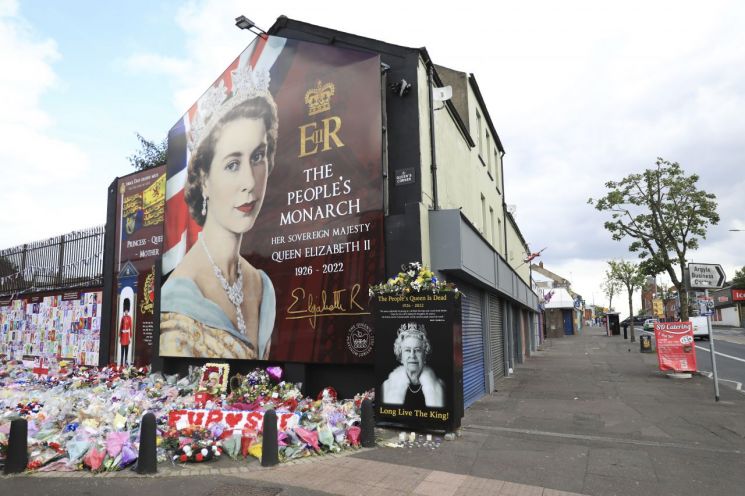
 On the 19th (local time), bouquets commemorating Queen Elizabeth II of the United Kingdom were placed on Shankill Street in Belfast, the capital of Northern Ireland.
 Photo by AP Yonhap News
[Asia Economy Reporter Park Byung-hee] In Northern Ireland, the term 'Troubles' refers to the violent conflict between the pro-British faction (Protestants) and the pro-Irish faction (Catholics) that lasted for about 30 years from the late 1960s until the Good Friday Agreement (Belfast Agreement) was signed in 1998, resulting in over 3,500 deaths. Northern Ireland is a region separated from the Catholic country of Ireland in 1921, primarily centered around pro-British Protestants.
Recently, it has been confirmed that for the first time in 101 years since its founding, the number of Catholics in Northern Ireland has surpassed that of Protestants, which is expected to strengthen movements toward unification with Ireland. Following the death of Queen Elizabeth II on the 8th, it is anticipated that countries within the British Commonwealth will actively attempt to leave the Commonwealth, increasing the likelihood of Northern Ireland also withdrawing from the union.
Major foreign media outlets reported on the 22nd, citing the Northern Ireland Statistics and Research Agency, that in the population census conducted for the first time in 10 years, the proportion of Catholics exceeded that of Protestants for the first time.
In this survey, 45.7% identified themselves as Catholics, while 43.5% identified as Protestants. In the 2011 survey, Protestants accounted for 48.4%, ahead of Catholics at 45%. At the founding of Northern Ireland in 1921, two-thirds were Protestants. Over a long period, the number of Catholics has gradually increased.
In the general election last May, the nationalist Sinn F?in party, which seeks the reunification of Ireland, became the largest party in the assembly for the first time, confirming that the number of Catholics has increased, bringing Northern Ireland closer to Ireland. Sinn F?in aims to hold a referendum on reunification with Ireland within 10 years and intends to advance this timeline as much as possible. Sinn F?in means 'Ourselves' in Irish.
John Finucane, a Sinn F?in member of parliament, issued a statement claiming, "The census results clearly show that an irreversible historic change is taking place."
On the other hand, the Democratic Unionist Party (DUP), which has been the ruling party for the past 20 years, criticized, "Claiming that the change in religious proportions means a referendum on reunification is imminent is a simplistic analysis." The DUP, which advocates unionism, had consistently won elections since the 2003 general election but lost the position of the largest party to Sinn F?in in the May general election.
Political commentator Sarah Cryton wrote on her Twitter regarding the census results, "Northern Ireland has been gradually changing over a long period since its founding in 1921," adding, "The census results do not necessarily mean that Ireland is heading toward unification, but they are significant for the British Commonwealth."
Of course, not all Catholics are nationalists who desire unification with Ireland, nor are all Protestants unionists.
People in Northern Ireland tend to identify themselves more as British rather than Irish.
In this survey, 43% identified themselves as British, higher than the 33% who identified as Irish. Compared to 10 years ago, this gap has narrowed; 10 years ago, the figures were 48% and 28%, respectively. The proportion identifying as Northern Irish also slightly increased in this survey.
According to the Good Friday Agreement, people in Northern Ireland can choose to identify as British, Irish, or both, and currently, the proportion holding British passports is higher. Although the number of Irish passport holders has surged by 63% compared to the 2011 survey, the overall holding rate remains about one-third.
Liam Kennedy, a history professor at Queen's University Belfast, told the BBC, "Unionists will be uncomfortable with the long-term trend of increasing Catholic proportions." However, Professor Kennedy noted, "Making this a constitutional priority is another matter," and pointed out, "It is clear that Irish republicans have not gained meaningful support from Protestants."
The 2016 Brexit referendum is analyzed as having increased Northern Irish resentment toward Britain. Although the Brexit vote concluded with leaving the EU, Northern Ireland, along with Scotland, supported remaining in the EU. The remain vote was 55.8%, higher than the leave vote at 44.2%. As a result, the Brexit vote became an opportunity for Northern Ireland to move closer to Ireland, an EU member state.
During Brexit negotiations with the EU, the UK signed the Northern Ireland Protocol, which keeps Northern Ireland in the EU single market. However, the new Prime Minister Liz Truss, while serving as Foreign Secretary in May, prepared legislation to nullify the Northern Ireland Protocol, causing friction with the EU.
© The Asia Business Daily(www.asiae.co.kr). All rights reserved.
![Clutching a Stolen Dior Bag, Saying "I Hate Being Poor but Real"... The Grotesque Con of a "Human Knockoff" [Slate]](https://cwcontent.asiae.co.kr/asiaresize/183/2026021902243444107_1771435474.jpg)















