Sudden Drop in Korea Electric Power University Early Admission Competition Rate... Halved in the Past Year
Established as a Moon Administration National Task... KEPCO Funds Operating Expenses
Controversies Over Hasty Opening Continue... Also Hit by 'Comprehensive Real Estate Tax Bomb'
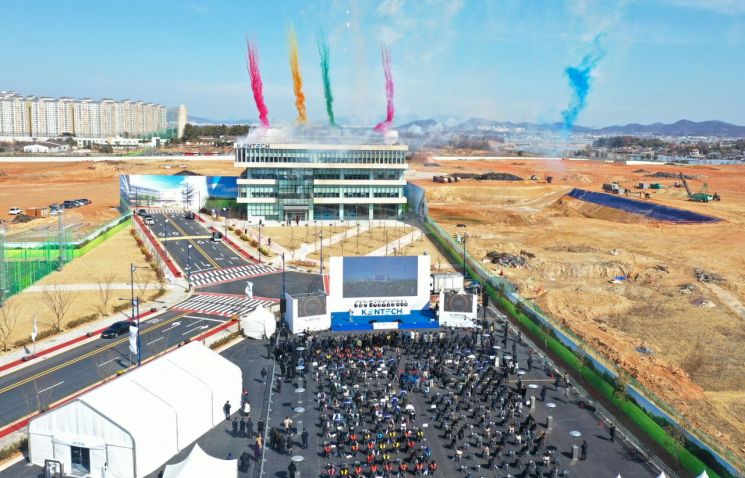 Fireworks Exploding at Korea University of Energy and Technology
(Naju=Yonhap News) Reporter Jo Namsu = On the morning of March 2nd, fireworks exploded at the entrance ceremony and vision proclamation ceremony held at Korea University of Energy and Technology in Naju, Jeollanam-do. Korea University of Energy and Technology, which welcomed its first freshmen on this day, is the world's first energy-specialized research and startup-focused university, operated as a small elite university with 400 undergraduates (100 per grade) and 600 graduate students. [Joint Coverage] 2022.3.2
iso64@yna.co.kr
(End)
<Copyright(c) Yonhap News Agency, Unauthorized reproduction and redistribution prohibited>
[Asia Economy Sejong=Reporter Lee Jun-hyung] The admission competition rate for Korea Energy Engineering University (KEEU), established as a national project under the Moon Jae-in administration, has reportedly halved over the past year. Analysts attribute this to intensified student avoidance amid controversies surrounding KEEU, including its hasty opening and the heavy comprehensive real estate tax burden. Critics also point out that this is a "foreseen disaster" caused by the previous government's reckless push to establish KEEU.
According to related ministries on the 24th, the recently closed 2023 early admission competition rate for KEEU was recorded at 12.63 to 1. The early admission quota for KEEU is 90 students, with about 1,100 applicants. When KEEU first recruited freshmen last year, the early admission competition rate was 24.1 to 1. In just one year, the competition rate has shrunk by more than half.
KEEU is a university established with funding from Korea Electric Power Corporation (KEPCO) as a national project under the Moon Jae-in administration. When it recruited its first freshmen last year ahead of its March opening this year, over 2,000 students applied for the 90 early admission spots, marking a successful launch. This was thanks to exceptional benefits such as full tuition exemption for all students and free dormitory accommodation. KEEU's ambitious plan to become a top 10 university in the energy sector by 2050 also raised students' expectations.
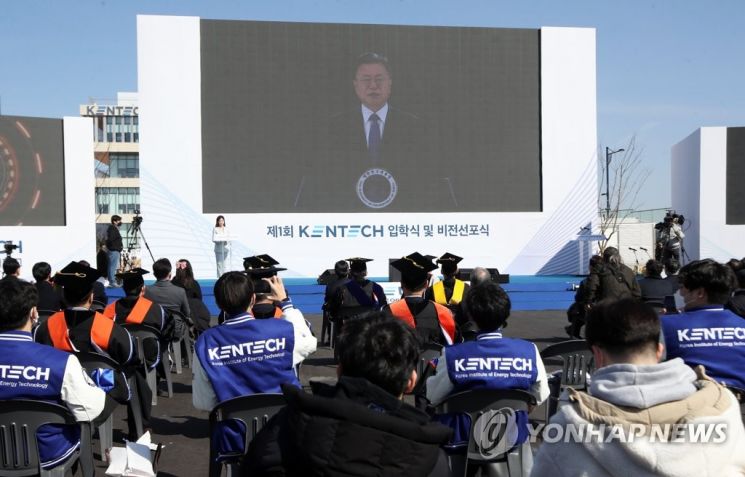 (Naju=Yonhap News) Reporter Jo Namsu = On the morning of March 2nd, at the entrance ceremony and vision proclamation held at Korea Energy Engineering University in Naju, Jeollanam-do, President Moon Jae-in delivered a greeting via video. Korea Energy Engineering University, which welcomed its first freshmen that day, is the world's first energy-specialized research and startup-focused university, operated as a small elite university with 400 undergraduates (100 per grade) and 600 graduate students. 2022.3.2
iso64@yna.co.kr
Opened One Year After Special Act Passed
However, KEEU was embroiled in controversy over its "hasty opening." The school opened with only one four-story building on a 400,000㎡ site, equivalent to 48 soccer fields. Until the official dormitory is completed in 2025, KEEU students must stay in a temporarily remodeled golf hotel. The university library, temporarily set up in the only completed four-story building, is only 226㎡ (about 68 pyeong). Additionally, a photo of fireworks going off right after the opening ceremony with only one building in the middle of a construction site drew public attention.
Critics argued that the Moon Jae-in administration pushed for the opening recklessly to boost national project achievements ahead of the presidential election. Previously, the Democratic Party of Korea secured 180 seats in the 2020 general election and forcibly passed the "Korea Energy Engineering University Special Act (KEEU Special Act)" in March the following year. KEEU opened just one year after the special act was passed, contrasting with the usual six or more years required to establish a university.
In the rush to open, the government also faced a "comprehensive real estate tax bomb." Most of KEEU's 400,000㎡ campus land was subject to comprehensive real estate tax last year, resulting in a 10 billion KRW tax bill. Although school land is exempt from this tax under current law, most of the site was classified as "real estate under construction" due to ongoing construction, making it taxable. Consequently, KEEU spent over 10% of its total budget (92 billion KRW) on this tax last year.
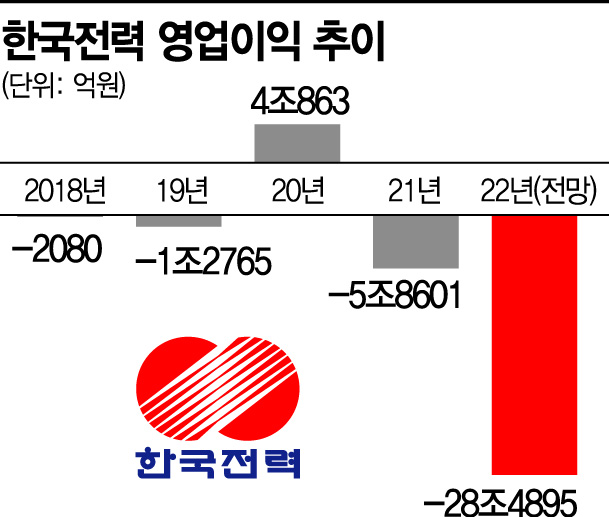
KEPCO Bears Deficit Burden for Establishment and Operation Costs
Another issue is the ballooning deficit of KEPCO, which finances KEEU's establishment and operation costs. KEPCO has been operating under a "negative margin" structure, selling electricity at a loss, and posted a deficit of 14.3033 trillion KRW in the first half of this year alone. Some forecasts suggest KEPCO could incur a deficit exceeding 35 trillion KRW this year.
In this situation, KEPCO's annual contribution to KEEU amounts to hundreds of billions of KRW. The amount KEPCO must contribute to KEEU next year is approximately 132 billion KRW. If the scope is expanded to include power generation subsidiaries and other power group companies, the contribution amount increases further. KEPCO expects to invest a total of 1.6112 trillion KRW in KEEU's establishment and operation costs by 2031.
There is also a widespread view that the halving of the admission competition rate over the past year was a "foreseen result." Since KEEU was promoted as a "brand project" of the Moon Jae-in administration, it is vulnerable to external influences whenever the government changes. If school policies change with each administration, it cannot be an attractive option for students. In fact, KEEU did not establish nuclear-related departments at its founding in line with the Moon administration's "nuclear phase-out" policy. However, after the inauguration of the Yoon Seok-youl administration, plans to establish a nuclear fission major in the nuclear power field were confirmed.
Even figures who led the nuclear phase-out policy have taken a reserved stance on KEEU. Former Korea Hydro & Nuclear Power CEO Jeong Jae-hoon is a representative example. Recently, through social media, Jeong expressed regret, stating, "(KEEU) could have had other alternatives." Jeong is currently on trial over allegations of involvement in the economic manipulation of the Wolseong Unit 1 nuclear reactor case.
© The Asia Business Daily(www.asiae.co.kr). All rights reserved.
![Clutching a Stolen Dior Bag, Saying "I Hate Being Poor but Real"... The Grotesque Con of a "Human Knockoff" [Slate]](https://cwcontent.asiae.co.kr/asiaresize/183/2026021902243444107_1771435474.jpg)

















